

You are here
The super powers of the plant microbiota

In June 2025, you were awarded the CNRS Silver Medal for your contribution to the discovery and study of the plant microbiota, which plays a key role in plants. Just what is it exactly?
Philippe Vandenkoornhuyse1: The plant microbiota is a component of plants whose very existence was long unsuspected. It is analogous to another element that is more frequently mentioned in the media, because of its importance for our health: the intestinal microbiota (or gut flora), a collection of bacteria and other microorganisms that live naturally in our intestine, and whose imbalance is associated with several diseases, such as obesity, allergies, autistic disorders, and so on.
In concrete terms, the plant microbiota is made up of a fairly diverse range of microorganisms specific to plants, including bacteria, fungi, protists, and viruses. These are found in all vegetation types and mainly originate in the soil. Some are recruited by the roots from the rhizosphere, the region of the soil close to the roots. Among these, some are then transferred to the aerial parts of the plant, namely the stems, leaves, and flowers. Another fraction comes from the female parent, which directly transmits part of its microbiota to its descendants, via its seeds or else by clonal reproduction (cuttings, shoots, tubers, etc.). As a result, the composition of the microbiota is complex. Moreover, it varies according to the species of plant and the characteristics of the environment (soil type, climate, etc.).



In what way is this microbiota important for plants?
P. V.: Rather like the intestinal microbiota in animals, it is involved in several major functions. Firstly, it is crucial for plant nutrition. The microbiota and its host plant take part in mutually beneficial interactions: the plant provides the microbiota with carbohydrates (sugars) produced via the biochemical process of photosynthesis, while the microorganisms enable the plant to take up various nutrients from its environment more efficiently.
For example, starting out from the roots, mycorrhizal fungi produce a network of filaments in the soil, the hyphae, which are able to take up water, nutrients, and minerals, and bring them back to the plant. Certain bacteria associated with the roots fix atmospheric nitrogen, thereby boosting plant growth.
The microbiota also contributes to the health of plants: certain microorganisms protect them from pathogenic microbes, either by occupying the root habitat, which prevents the pathogens from settling there (through a process of competition), or by stimulating the plant's defence mechanisms.
Finally, the root microbiota is also involved in the resistance of plants to various kinds of environmental stress, such as hydric stress (i.e. a lack of water), via a number of complex molecular mechanisms.
You contributed to the discovery of this microbiota, didn't you?
P. V.: That's right. I have been interested in the interactions between plants and microorganisms ever since my doctoral thesis, which focused on the genetic diversity of mycorrhizal fungi. In 2002, while on a postdoctoral fellowship in England, I published a pioneering paper that showed the existence of a complex microbiota associated with plants2.


In this work, my colleagues and I investigated fungal diversity in the roots of tall oatgrass (Arrhenatherum elatius3). When we analysed the DNA extracted from the roots, we identified some fifty different fungi living in them, only seven of which were similar to others already known. This diversity was totally unexpected.
However, it was not until 2012 that research on the plant microbiota really took off, with the publication of two studies4, one German and the other American, which described the microbiota of the ideal model plant in plant biology, Arabidopsis thaliana5.
The CNRS Silver Medal also recognises your contribution to the concept of the holobiont, another important notion in biology. What does this term refer to?
P. V.: It defines a new level of biological organisation. In this concept, the individual is not just the host, seen as an autonomous entity, but rather the whole it forms with the microbiota it harbours6. In an article dating from 20157, we were the first to examine the validity of the holobiont concept.
Then, in 2023, we demonstrated experimentally that this notion is not just a simple intellectual construct but corresponds to a biological reality8. The evidence we presented is that even in a grafted specimen, consisting of roots from one plant and an aerial part from another, the composition of the microbiota is not random. On the contrary, it very strongly resembles that of the plant from which the root system originates. This is the hallmark of a very high degree of co-evolution between the host and its microbiota.
The concept of the holobiont represents a major paradigm shift. Why?
P. V.: Because it suggests that it is wrong to treat plants as autonomous entities! Plants cannot be isolated from their microbiota, and vice versa, as their individual traits and functions are mutually enhanced by their interactions. For example, the uptake of nutrients and water by the plant alone is boosted by some of the microorganisms that make up the microbiota, which in turn benefits from the plant.


Viewing the plant and its microbiota as a single entity, as advocated by the holobiont concept, is essential to improving our understanding of plant biology. This notion should also help to optimise agricultural crop production. However, the importance of this shift in perception has not yet been fully appreciated in this sector, which continues to take little notice of the plant microbiota and its functions.
Talking of which, some of your research shows that conventional agriculture is harmful to the plant microbiota.
P. V.: Indeed. Since 2020, together with colleagues from a number of Chinese organisations, including Nanjing Agricultural University, Lanzhou University of Technology and the Chinese Academy of Sciences, we have started to assess the impact of agriculture on the plant microbiota. An important analysis that compiled data from 150 studies identified a sharp decline in microorganism diversity in agricultural soils worldwide9.
This alteration is worrying as it directly affects the composition of the microbiota of crop plants by limiting the number of strains of microorganism they can recruit. All this could make plants more vulnerable to environmental change, since there is a serious risk that some stress-reducing microorganisms will disappear.
What are these changes linked to?
P. V.: To a number of conventional agricultural methods. For instance, the use of chemical rather than organic fertilisers reduces the amount of decomposable carbon in the soil, on which many soil microorganisms depend for nutrition. This leads to strong selection pressures, and, therefore, to the risk of domination by microorganisms that are not beneficial to the plant, to the detriment of useful ones10.
Another example: the fungicides used to control plant pathogens also cause collateral damage to beneficial fungi. All these practices lead to lower-quality microbiotas that are less able to help plants grow and remain healthy. A change of direction is therefore urgently needed.
How can the diversity of the plant microbiota be restored in agricultural soils?
P. V.: We have identified three possible approaches. One is to co-cultivate wild ‘helper’ plants, such as Veronica, which have not lost their ability to interact with beneficial microorganisms. As a result, they could transfer or exchange some of the beneficial organisms in their microbiota with crop plants, thanks to proximity effects (e.g., via root-to-root contact).
Another approach aims to transform varietal selection, which would no longer focus solely on crop plants, but also on the microbiota as an important factor in this selection. To select the most successful holobionts, one idea would be to place plants in conditions where they are totally dependent on microorganisms for their growth, such as in soil lacking nutrients or water. This would make these plants very successful at interacting with beneficial microorganisms.

What about the third approach?
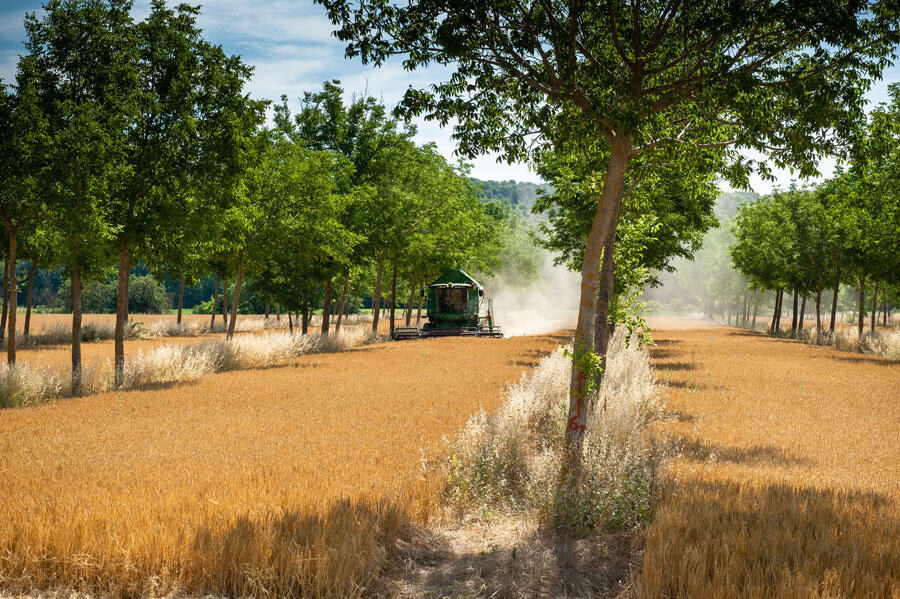
P. V.: It simply consists in changing farming practices in order to take better account of the plant microbiota. We could, for example, increase the diversity of plants in fields. That way, they would not have the same needs at the same time and, as a result, would be less dependent on fertilisers.
Taking into consideration the plant microbiota, forged by hundreds of millions of years of co-evolution with plants, is key to improving current farming practices and moving towards sustainable and effective crop production. Admittedly, implementing a ‘holobiont agriculture’ is a huge challenge. But, in my view, this transition will be crucial for the agriculture of the future.
See also
A universal law may govern all living beings (opinion)
- 1. Ecologist, professor at Université de Rennes and researcher at the ECOBIO ecosystems, biodiversity and evolution laboratory (CNRS / Université de Rennes).
- 2. Philippe Vandenkoornhuyse et al., Science, 15 March 2002: https://doi.org/10.1126/science.295.5562.2051
- 3. Also called “false oatgrass”.
- 4. Respectively Davide Bulgarelli et al., Nature, 2 August 2012: "Revealing structure and assembly cues for Arabidopsis root-inhabiting bacterial microbiota"; and Derek S Lundberg et al. Nature, August 2, 2012: “Defining the core Arabidopsis thaliana root microbiome”.
- 5. Thale cress.
- 6. The term “holobiont” comes from the Greek “holos” (all) and “bios” (life).
- 7. Philippe Vandenkoornhuyse et al., New Phytologist, June 2015: https://doi.org/10.1111/nph.13312
- 8. Marine Biget et al., iScience, 17 February 2023: https://doi.org/10.1016/j.isci.2023.106031
- 9. Qicheng Xu et al., mSystems, 14 July 2020: https://doi.org/10.1128/msystems.00337-20
- 10. Qicheng Xu et al., PNAS, 16 April 2024: https://doi.org/10.1073/pnas.2318160121
Explore more







Author
A freelance science journalist for ten years, Kheira Bettayeb specializes in the fields of medicine, biology, neuroscience, zoology, astronomy, physics and technology. She writes primarily for prominent national (France) magazines.