
You are here
Giants with feet of clay

Millions of years ago, with the colossal dinosaurs long since gone, our planet saw the emergence of a number of exceptionally gigantic animals. During the Oligocene epoch (34 to 23 million years ago (Mya)), Asia was home to Paraceratherium, a hornless rhinoceros five metres high at the shoulder and nine metres long, weighing 17 tonnes (t) and looking like a cross between an elephant and an okapi. Two million years ago, during the Pleistocene, a cousin of the orangutans weighing nearly 400 kg, Gigantopithecus blacki, roamed the tropical forests of China, while nearer the present day, (from 400,000 to 8,000 years ago), Megatherium americanum, a six-metre-long ground sloth weighing four tonnes, lumbered around the savannas of South America.
These little-known behemoths bear witness to an era, the Cenozoic (the one we are currently living in, 65 Mya to the present), which saw the emergence of giant mammals after millions of years spent in the shadow of the dinosaurs.


The reign of these huge animals reached its peak between the Eocene and Miocene (56 to 20 Mya), says Pierre-Olivier Antoine, a palaeontologist at the Institute of Evolutionary Science of Montpellier1. "Shortly after the crisis that led to the extinction of the dinosaurs, the ecological niches they had occupied were rapidly taken over by the survivors." This set off an evolutionary “arms race” between prey and predators. To protect themselves from the latter, the first tended to grow larger, which in turn resulted in a corresponding increase in the size of their predators, and so on.
Lush vegetation
However, feeding such large animals requires abundant resources, which grow especially well in hot climates. These environmental conditions were precisely those that prevailed during much of the Cenozoic era.
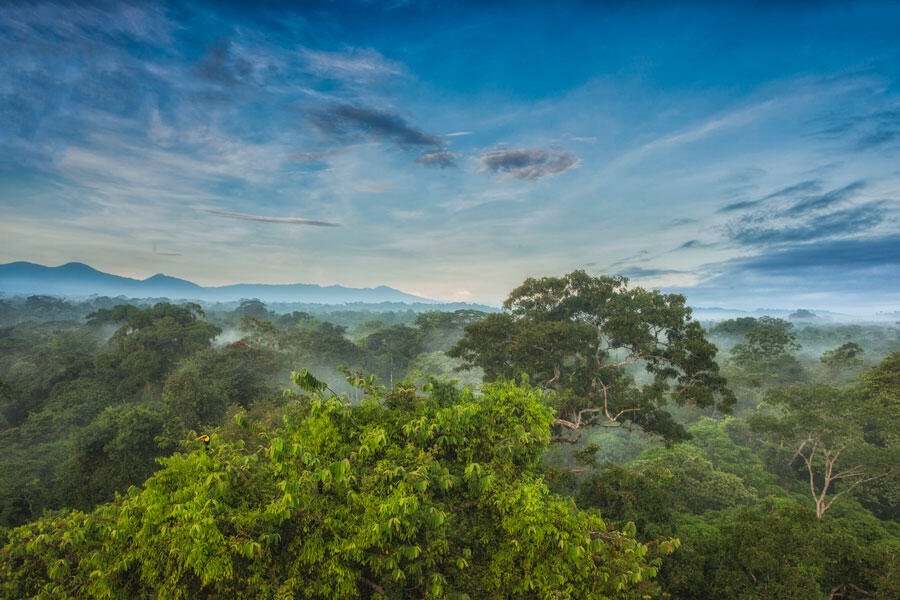
During what is known as the Palaeocene-Eocene Thermal Maximum, 56 million years ago, the Earth's average surface temperature was 8 °C higher than today. In addition, latitude-related thermal gradients were less pronounced. As a result, there was a continuity of ecosystems between the tropical forests at the equator and the temperate forests at the poles – where there was no permanent ice at the time. The land was covered with lush vegetation from pole to pole, which meant that "ecosystems had no difficulty in supporting large numbers of herbivores and providing them with an abundance of food", Antoine explains. This was especially true during the Oligocene, when tropical forests gave way to open savannas, which were ideal for large herbivores.

Being able to move masses exceeding a tonne also requires morphological adaptations, which are the focus of research by Alexandra Houssaye, a CNRS research professor at the MECADEV adaptive mechanisms and evolution laboratory2. With her team, she studied graviportality, or "the sum of adaptations that enable organisms to support and move a massive body weight", comparing in particular rhinoceroses and hippopotami to elephants and four-legged dinosaurs.
Inclined bones for galloping
Despite their weight, hippos and rhinos are still able to gallop. To avoid injuries caused by contact between the ground and their feet, their bones have evolved accordingly. "Rather than being aligned, those in the limbs are still inclined relative to one another, so that their legs are bent, enabling them to run. They are necessarily stocky animals, with large joints that can withstand the associated loads."
At the same time, their internal structure is strengthened by the thickening of the compact tissue and extension of the bone trabeculae in the areas usually occupied by bone marrow, which boosts mass and, therefore, bone strength. This combination of flexibility and sturdiness is not found in elephants and sauropod dinosaurs, which are considerably more massive. By losing the ability to gallop, these species were able to become bigger by developing columnar bones, which do not bend. This arrangement greatly reduces the stress exerted on each one. "In excess of five to six tonnes, the optimal adaptation is to switch to columnar bones," Houssaye concludes.



Such gravity-related issues do not apply in water, where heavy masses can move around easily, as is demonstrated by the huge sizes observed in cetaceans as soon as they returned to the sea some fifty million years ago. One of them, Perucetus colossus (39-37 Mya), which weighed at least 80 t, is thought to have been one of the heaviest animals ever to have lived on Earth.
Beyond mammals
However, gigantism is not confined to dinosaurs and mammals alone. Antoine rails against what he describes as “mammalocentrism”: "In the Cenozoic era, the very great diversity of mammals has masked that of other vertebrates. Since non-avian dinosaurs had disappeared, it wasn't thought that their relatives would follow in their footsteps."
And yet this is true of Titanoboa, the largest snake that has ever lived, with a length of 15 m (the size of a bus), as well as the giant bird Gastornis, standing 2 m tall, both of which roamed the Palaeocene forests nearly 60 million years ago. However, all these animals were vertebrates. Were there no giant invertebrates?


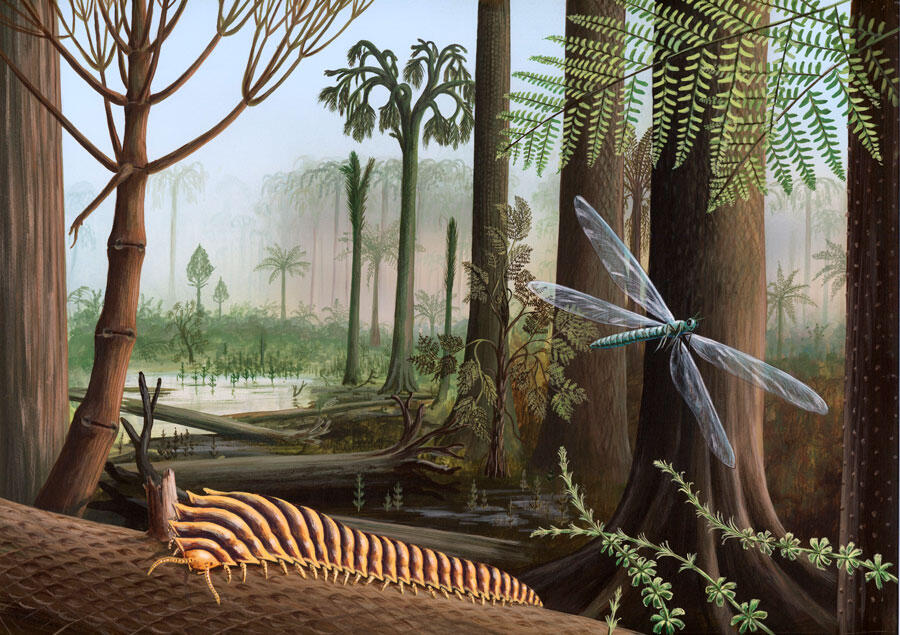
There were. Between 350 and 250 Mya, giant insects and arthropods ruled the forests of the Carboniferous and Permian periods. These animals, including the carnivorous dragonfly Meganeura (with a wingspan of up to 70 cm) and other herbivorous insects, such as some members of the order Palaeodictyoptera (35 cm wingspan), have been studied by the researcher André Nel, who works at the ISYEB institute of systematics, evolution, and biodiversity3. He talks about the conditions that led to invertebrate gigantism in the Palaeozoic (540-255 Mya), the era that preceded that of the dinosaurs (the Mesozoic, 225-65 Mya).
Evolutionary arms race between prey and predators
Just like mammals 200 million years later, insects were able to benefit from an unoccupied ecological niche. They were the only animals that could fly. As is often the case, there ensued an evolutionary arms race between prey and predators, causing them both to become ever bigger. In addition, these winged insects could take advantage of the denser air (more than 2 bars, twice today's atmospheric pressure) that prevailed between the end of the Carboniferous period and the middle of the Permian. As Nel explains, "large flying organisms such as Meganeura are able to sustain flight better when the air is denser".
Similarly, the tropical forests of the Carboniferous were far richer in oxygen, which accounted for 35% of the Earth's atmosphere, as compared to 20% today. Arthropods were able to make the most of this, because, as their tracheal respiratory system carried oxygen directly to the centre of the body, the more O2 there was in the air, the larger they could grow. This led to the emergence of a two-metre-long myriapod, Arthropleura, at the end of the Carboniferous.

All these species declined due to changing environmental conditions as well as to competition from new groups, including small gliding reptiles in the Middle Permian, pterosaurs during the Triassic, and finally birds in the Jurassic. Although large dragonflies lasted right into the Cretaceous, "these animals decreased in size with each successive group", Nel points out, until they finally became extinct, along with the non-avian dinosaurs.
Unitary architecture vs serial repetition
However, the prize for gigantism in the living world undoubtedly goes to plants. A 130-metre-high fossil plant holds the record for the largest living organism ever observed on land, while some marine algae can reach lengths of several hundreds of metres. Even today, eucalyptuses and sequoias regularly reach heights of around a hundred metres. This is due to the specific architecture of plants.
Tristan Charles-Dominique, a botanist at the Botany and Modelling of Plant Architecture and Vegetation laboratory (AMAP)4, distinguishes animals, "which have a unitary architecture", from plants, "which grow by serial repetition". In other words, as long as they have the necessary resources, plants continue to grow, usually by competing with one another for light. At a certain height they eventually reach a limit when the stem pressure reaches -2 megapascals. At this level, the pressure is too negative for the tissues to develop any further, and as a result, growth ceases.
In addition, very few trees grow more than 30 or 40 metres above the surrounding vegetation. According to Charles-Dominique, this is because "growing taller than its neighbours in order to get more light exposes a tree to desiccation, frost and wind".
On the other hand, plants encounter few obstacles to horizontal growth. Some rattan palm stems, in the form of lianas, can reach 200 m in length, while another rooted liana can grow up to 2 km long.
Being big comes at a cost
When plants grow through clonal reproduction – in other words, by replication of the same individual –, their size far exceeds that of giant animals. In Utah (USA), one tree, a clonal quaking aspen (Populus tremuloides), breaks all records. With an estimated age of 16,000-80,000 years, it has 47,000 stems (seemingly individual trees that are in fact connected by a common root system), covering 43 hectares and weighing some 6,000 tonnes. The tree-cum-forest, which was named Pando (from the Latin for I spread – Ed’s note), is still growing. "And there is nothing to suggest it has any intention of stopping,” the botanist says in jest.


Despite their differences, giant animals and plants are affected by the same problem, which Houssaye sums up in a single sentence: "Being big comes at a cost. There must therefore be an evolutionary advantage to size." Given all the biomechanical, energy and environmental constraints, giant species adopt a strategy that is unique in the living world: they take a longer time to grow, reproduce late, and have fewer offspring.
This strategy can be observed in animals weighing 45 kg or more. This threshold, although somewhat arbitrary, nonetheless distinguishes smaller species – with shorter lifespans, large progeny, and less parental investment – from what are known as megafauna.
Giants that fear change
In plants, although the threshold is not as clear, similar reasoning applies. " For a plant to become very large, it must continue to explore its surroundings for as long as possible," Charles-Dominique explains. "Remaining large therefore means staying young and not reproducing over a long period of time, which is not optimal in disturbed environments. As a result, gigantism only thrives in places where competition for light is so intense that plants sacrifice all other functions to it." In other words, their size masks their weakness.
"Giant species turn out to be highly successful in stable conditions, but not very resilient when it comes to environmental crises and fluctuations, of which they are the first victims," Antoine says. The palaeontologist points to the fact that the world’s last remaining giants (trees in savannas and rainforests, and mammals in Africa and Asia) are located in tropical regions, far removed from the disturbances caused by the warming of the planet, which began 20,000 years ago, following the Last Glacial Maximum. And yet, these regions are now at the forefront of current global warming.
What future do they face under these new environmental conditions? Looking at the life and death of the colossal organisms of the past can only fuel our admiration for today’s giants with feet of clay. ♦
To find out more:
How aquatic plants changed the face of the Earth
How Jurassic Park changed the image of dinosaurs
Explore more