
You are here
Chilling out in the cold

In response to cold weather, even before we seek shelter or put on warmer clothes, our body’s very first response is shivering: rapid involuntary contractions of certain muscles under the skin. This phenomenon produces heat, rather like a small engine revving up.
“Muscle contraction generates a lot of heat,” notes Felix Viana, a researcher at the IN institute for neurosciences in Alicante (Spain). “That’s why we quiver when we feel cold.”
Voluntary physical activity also plays a key role. Using our muscles increases energy expenditure and produces heat. “At night, we move much less than in the daytime,” says Guy Lenaers, a CNRS research professor at MitoVasc1 in Angers (western France), “so we need to cover up more to stay warm.”



Cold first detected under the skin
Mobilising the muscles is very effective in the short term, but does not suffice to maintain body temperature for long periods of time. To endure prolonged exposure, the body has to deploy other strategies at the cellular level.
The organism first perceives cold under the skin, where sensory nerve cells called “thermoreceptors” detect temperature variations via ion channels (which function like gates, opening or closing depending on the temperature). Among these, the TRPM8 channel plays a major role.
“TRPM8 activates the sensory neurons that transmit information to the brain,” explains Guillaume Sandoz, a CNRS research professor at the iBV institute of biology in Nice (southeastern France). This message reaches the brain, where its integration activates several structures: the hypothalamus, thalamus, cortex and amygdala. They make it possible to be aware of the cold and mount an appropriate response.
“The brain then initiates a behavioural response (putting on a jacket, gloves, etc.),” Viana adds, “but also involuntary automatic reactions like shivering, vasoconstriction (contraction of blood vessels – Ed’s note) or the activation of thermogenesis.”


Vital organs take priority
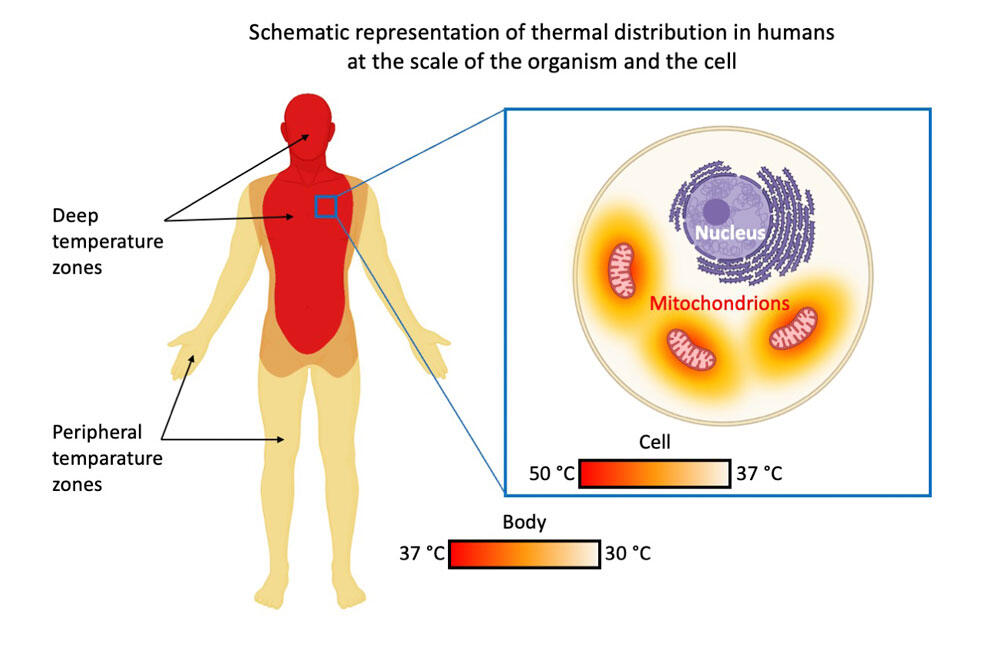
In addition to quivering, the body’s other automatic protection mechanism is vascular: the peripheral blood vessels contract. “When the body starts to cool down, the blood circulation concentrates on vital organs such as the brain, heart and lungs,” Lenaers says.
Extremities like the hands and feet are much more exposed and less well insulated. These are the parts that get cold the fastest. The constriction of the vessels that usually irrigate them reduces the amount of blood that can reach them, preventing it from cooling down and then carrying the cold to the vital organs. However, one of the side effects of this “cold blocking” protective mechanism is the risk of numbness and frostbite in the extremities – which is why it is so important to protect them in extreme cold.
Inside the cells, thermogenesis
The primary cold response mechanism, however, takes place within the cells. It is provided by the mitochondria, organelles2 often described as the cells’ “power plants” because they produce ATP, the molecule that supplies the energy needed for cellular functions. But they also generate heat via a process called “thermogenesis”, which, in reaction to the cold, increases to compensate for the drop in temperature.
To maintain thermogenesis, the body needs a higher calorie intake, especially in the form of lipids, which have a greater energy density than carbohydrates or proteins. This explains why we tend to crave fatty foods in winter.

When the cold hurts
For some people, the sensation of being cold can be especially severe or even painful. Called cold hypersensitivity, this condition is common among chemotherapy patients. Their treatments can damage the sensory nerves, especially in the extremities. Moderate exposure to cold becomes enough to trigger intense discomfort.
To understand this mechanism better, researchers have reproduced it in animal models by modifying the ion channels involved in cold detection. The goal is twofold: to identify the exact nature of the dysfunction and, ultimately, to develop new treatments that will relieve the patients’ suffering. According to Viana, “In a pathological situation, understanding what’s not working properly allows us to better understand how the system functions in its normal state.”
Life in constant cold
In some parts of the world, cold is not an occasional inconvenience, but a permanent environment. Over time, populations like the Inuit have developed adaptations to these extreme conditions. As Lenaers reports, “One hypothesis is based on the selection of genetic variations in which slight DNA mutations direct the metabolism towards thermogenesis rather than ATP production.”


These biological adaptations are accompanied by dietary adjustments. The Inuit eat a lot of fish with a high fat content. This calorie-rich diet enables the mitochondria to produce the heat needed to maintain body temperature.
The shiver reflex is thus only the first in a whole cascade of behavioural and physiological responses taking place at every scale, from the entire organism down to the cell. This nearly imperceptible but vital biological process allows the body to keep its natural balance in the cold of winter.
For further reading
Muting tinnitus
Iron and cancer, a balancing act
The truth behind the placebo effect
Explore more