
You are here
Sleeping in cold blood
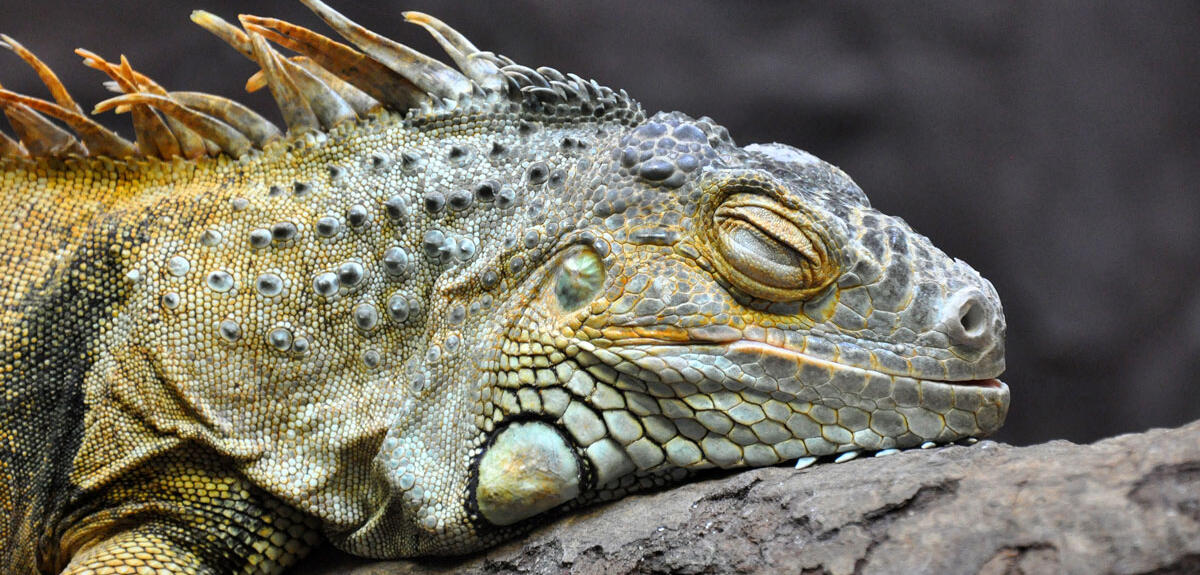
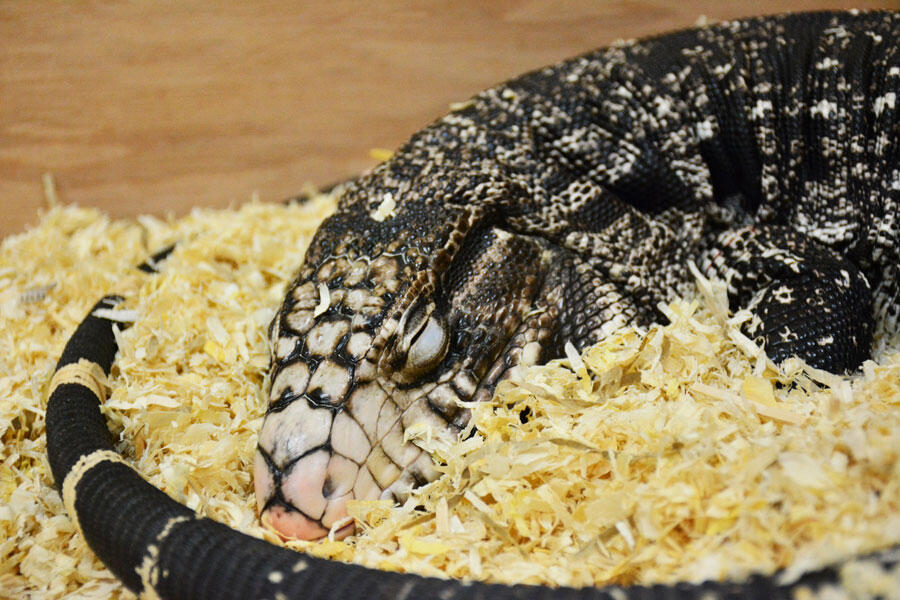
Reptiles sleep slowly. More precisely, during their sleep, numerous physiological parameters jointly undergo variations based on an infraslow rhythm.
To understand how the researcher Paul-Antoine Libourel and his team reached that conclusion, let’s start with what is already familiar. While sleeping, humans alternate between two phases: paradoxical sleep and slow-wave sleep. The former is characterised by the appearance of slow waves on the electroencephalogram, while the latter is named for its combination of total muscle atonia, rapid eye movement, and brain activity similar to waking. All of us go through multiple cycles of 60-120 minutes, during which these two phases follow each other.
Homeothermy and paradoxical sleep
Humans are not the only ones to experience two stages of sleep, as they share this distinction with all land mammals and birds. “The other similarity between these living beings is they are homeotherms – they maintain their body at a constant temperature,” points out Anthony Herrel, a biologist at the French National Museum of Natural History, and co-author of the study1.
“Are these two components random or correlated?” asks Paul-Antoine Libourel, a researcher at the Lyon Neuroscience Research Centre (CRNL), and later at the CEFE centre for functional and evolutionary ecology2 in Montpellier (southern France). This led him to study the sleep of reptiles, which are ectotherms, meaning that their body temperature varies with that of the surrounding environment.



Sleeping reptiles
The researcher took an interest in the sleep of chameleons, geckos, and other scaly critters on land. This was much easier said than done, for how to determine whether a lizard warming itself in the sun – motionless on a rock – is sleeping or lying in ambush?
What is more, the brains of reptiles are organised differently to those of mammals, for the reptilian cortex has three layers, and that of mammals six. “We can assume that a different anatomical structure leads to different functioning, which makes comparison difficult,” explains Libourel.
Multimodal recordings
With his colleagues at the Lyon Institute of Nanotechnology (INL)3, he developed a wireless miniaturised device that can sense and record physiological, brain, and behavioural changes in reptiles, birds, and mammals. The device enabled multimodal monitoring of variations in brain, heart, respiratory, muscular, and ocular activity throughout all cycles of sleep.
“We also used functional ultrasound imaging, a technique that can detect very subtle changes in blood volume.” Ten species of vertebrates were studied during their rest, including geckos, bearded dragons, chameleons, pigeons, rats, and…humans.

Slowness at all times
The team revealed the existence of a very slow (or “infraslow”) physiological oscillation, which appears to synchronise brain activity, heart activity, breathing, and eye movements. This infraslow rhythm – which lasts approximately 100 seconds – was observed in all sleeping reptiles. Among other vertebrates, a slow rhythm (actually a little slower, down to 50 seconds) appears during slow-wave sleep, but not during paradoxical sleep.
The fact that these slow rhythms are shared by species that diverged 300 million years ago suggests that it is probably a fundamental physiological mechanism. “This infraslow rhythm could be the physiological manifestation of the functioning of a pump of sorts, which cleans the brain during sleep.”
Clearing neuronal waste
The maintenance of the brain is provided by circulating cerebrospinal fluid, samples of which are taken during lumbar punctures. Brain tissue is steeped in it, and it clears the metabolic waste of neurons towards the peripheral lymphatic system.


The infraslow rhythm orchestrates variations in blood volume, which allow cerebrospinal fluid to enter and exit. To understand this phenomenon better, Libourel is now focusing on elephant seals, whose sleep can vary greatly depending on whether they are at sea or on land…
See also
How light governs sleep
The mysteries of the brain (special report in French)
- 1. A. Bergel, et al., “Sleep-dependent infraslow rhythms are evolutionarily conserved across reptiles and mammals,” Nature Neurosciences, 2025: https://doi.org/10.1038/s41593-025-02159-y
- 2. CNRS / EPHE-PSL / IRD / Université de Montpellier.
- 3. CNRS / CPE Lyon / Centrale Lyon / INSA Lyon / Université Claude Bernard Lyon 1.
Explore more