

You are here
Ticks under watch

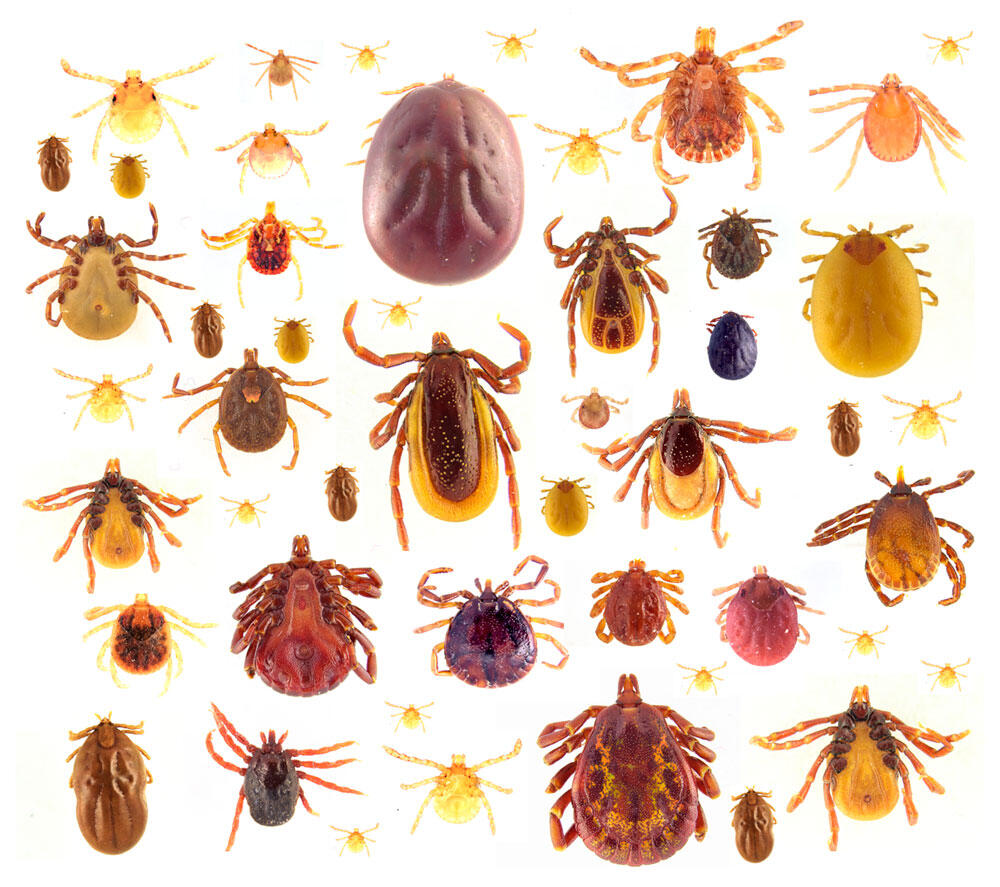
Ticks are Acari that feed off the blood of humans and animals, both wild and domesticated. They bite one person in 20 each year in France, and approximately 50,000 people are subsequently infected by the bacterium that causes Lyme disease.
The most vulnerable individuals are children who play in natural spaces and parks, as well as those aged over 50 who work in their gardens or go for walks. Indeed, ticks – contrary to common preconceptions – are not only present in woodland! They live in gardens (one in four bites) and enter homes via rodents or dogs.
The developmental cycle of ticks is known. The mite lays its eggs in a natural environment. The egg becomes a larva which then waits, fixed to a blade of grass. As soon as an animal such as a rodent or bird comes close, the larva attaches itself to them. It feeds off their blood, falls off, and turns into a nymph. After a first metamorphosis, the arachnid waits until a new host to attach itself to is within reach. It then takes a second meal of blood, which enables it to become an adult. When full of blood, it can multiply its volume 40-fold!



Joint and neurological disorders
The bite is painless, because tick saliva contains analgesics. However, when feeding off the blood of living beings, the tick can transmit viruses and bacteria, even when it is a nymph measuring around 1 mm in diameter and thus difficult to detect.
In the great majority of cases, no pathogen is transmitted. A study by INRAE of 2000 ticks that bite humans (the CiTIQUE programme1) showed that 27.7% of them carried a potentially pathogenic agent. Nevertheless, it is not because a tick is a carrier that it transmits the disease to its host. The actual risk of being contaminated after a bite remains very low, at between 1% and 4%, although this figure varies, depending on the region and the environment. In all cases, vigilance is necessary and each tick should be removed from the skin as quickly as possible.
Lyme disease becomes apparent six months later
The principal illness caused by ticks in humans is Lyme disease, which induces joint and neurological disorders. Its precise name is Lyme borreliosis, from the name of the causal bacterium, Borrelia burgdorferi. “When the tick transmits the Borrelia burgdorferi bacterium, a ring of inflammation develops around the bite site,” explains the immunologist Hugues Gascan, CNRS research professor in Angers (western France) and a specialist in Lyme disease.
If the skin becomes red, a visit to the doctor is necessary so that an antibiotic can be prescribed. In principle, any risk is thus avoided. However, the situation is sometimes more complicated...
“This classic form of the illness affects around 90% of individuals, but there is another scenario," Gascan warns. “It is possible to contract Lyme disease without knowing! Even if the tick has left no mark on the skin, the condition can declare itself more than six months later.” Antibiotic therapy, prescribed too late, cannot always eliminate it.
Fatigue and “brain fog”
Medics have long been suspicious about this chronic form of the disease, and wrongly diagnosed psychosomatic problems in patients presenting with difficult-to-treat joint or neurological disorders for several years. Only in 2025 was this pathology finally described as Post-Treatment Lyme Disease Syndrome (PTLDS), or “Chronic Lyme” by the French health authority (HAS).
“This form is defined in particular by a memory of being bitten, joint pain, fatigue that hampers social interactions and ‘brain fog’, or in other words, concentration and memory disorders,” summarises Gascan.


Reaching a diagnosis, a difficult process
Although the disease has now been identified, diagnosis remains difficult. Tests are available, based on the detection of antibodies, but they are not 100% reliable. They may produce negative findings at the start of the infection, or be hard to interpret in late-onset forms. No test can determine with certainty whether the bacterium is present in the body.
Current research by Sébastien Bontemps-Gallo, a bacteriologist at the CIIL infection and immunity centre2 in Lille (northern France), could help to establish a reliable diagnosis. His work focuses on ticks from the Ixodes ricinus species3, responsible for most bites. “We still do not know which biomarkers are specific to strains of Borrelia burgdorferi, which causes Lyme disease in Europe,” he explains. “We are trying to determine them by studying the infectious process, or in other words how the bacterium circulates from a tick to a human.”
A highly-adaptable bacterium
Bontemps-Gallo has understood the incredible ability of Borrelia burgdorferi to survive, live and proliferate in organisms quite unlike itself. Mites and mammals are very different beings. The former live at ambient temperature, while the latter maintain a body temperature at 37°C. Nevertheless, the bacterium passes from one to the other and colonises them both. How does it do it?
“The tick can wait a very long time between two blood meals,” the scientist details. “The Borrelia burgdorferi bacterium survives in the tick’s intestine. As soon as blood arrives, it migrates towards the mite’s salivary glands so that it can be transmitted to the bitten animal, which it then colonises.”
The adaptability of the bacterium is linked to the expression of its genes. “In the laboratory, we are deleting one gene in the bacterium and replacing this (mutant) bacterium in the tick. We are trying to see whether it resists the immune defences of the tick, and then if it colonises it.”

Undercover agent
The second asset of Borrelia burgdorferi is its camouflage. Our immune system may struggle to recognise it in the long term. When a gene is expressed, this is reflected by proteins. Those at the bacterial surface, which form its “molecular coat”, are the first to be detected by the immune system.
“Borrelia burgdorferi manages to escape the host’s immune defences because it is covered in numerous different surface proteins,” Bontemps-Gallo adds. By “changing its coat”, Borrelia complicates the action of antibodies.
Designing tests and vaccines
Understanding what happens at this scale is important to design tests capable of detecting the bacterium, and also to develop vaccines. One of the surface proteins of Borrelia burgdorferi, called OspA, is currently the target of inoculation strategies.
Several actors are progressing in their research on a vaccine against Lyme disease. One is the French company Valneva, which is working in partnership with Pfizer. At Institut Pasteur, the scientist Valérie Choumet has also obtained promising results using a candidate.
So is there hope that a treatment for Lyme borreliosis will eventually be available? For the past eight years, Gascan, a member of the scientific committee of the French federation for tick-borne diseases (FFMVT), has been conducting research that could lead to a medication. “In order to find out whether the bacterium can remain at low levels in the body, several years after a tick bite, we have sought to identify biological markers for the disease in patients suffering from chronic Lyme,” he explains.
Stimulating the immune response
The immunologist is focusing on the functioning of white blood cells in the immune system. In chronically infected patients, he has seen that some white blood cells – monocytes – are deceived by the Borrelia burgdorferi bacterium. As soon as they detect it, they secrete hormones, or cytokines. The role of these molecules (about 200 of which are known) is to stimulate the immune response to help with recovery. However, some of them play the opposite role and inhibit this response in order to prevent a surge phenomenon.
The problem is that in cases of chronic Lyme, patients produce an abundance of some of these antagonistic molecules which neutralise the immune response and thus hinder recovery. “We are looking for a drug that could neutralise this counter-productive effect, so that the immune response will once again be able to function to its full capacity.”
A drug candidate
Gascan is conducting this research on a drug candidate with his colleague Sylvie Chevalier, senior lecturer and hospital practitioner at Angers University Hospital (CHU d’Angers) and Dr Raouf Ghozzi, of Lannemezan Hospital (southwestern France), a renowned specialist in complex types of Lyme disease.
Initial tests are under way in mice, in collaboration with Monica E. Embers, Professor of Microbiology and Immunology at Tulane University (New Orleans, USA), and international expert in the field. The idea is to use a new biodrug that is able to remove the inhibition of the immune response in association with antibiotics, so as to eliminate the probable presence of residual bacteria in the case of chronic Lyme. The technology transfer company Ouest Valorisation is in charge of finding applications for this project in North West France.


80,000 frozen ticks
Without waiting for the test, vaccine, and treatment, it is essential to monitor the development of different tick species, and of the numerous viruses and bacteria they carry. From the Nancy region (northeastern France), the INRAE microbiologist Pascale Frey-Klett has been coordinating the national CiTIQUE programme since 2016.
This participative research project is a success. Since 2017, more than 115,000 reports of tick bites have been collected via an app, a website or a form, by both citizens and professionals4. Around 80,000 ticks have been shipped from sites throughout France to the four freezers in the INRAE laboratory.
Prevention and training
“Understanding the geographical distribution of ticks, as well as their content in pathogenic agents, is important to helping physicians interpret certain symptoms,” explains Frey-Klett. This programme is aimed at training the general public and professionals, especially in forestry, to prevent tick-borne diseases throughout France. And those who so wish can even share the life of the scientists for two days on site, handling pipettes and learning to identify, under the microscope, different tick species.
Around forty of these are present in France, including Ixodes ricinus, which transmits Borrelia burgdorferi. So far, the CiTIQUE programme has only found seven species that bite humans, the others feeding off animals.
Hyalomma marginatum, also known as the bont-legged tick, is now attracting the attention of the INRAE scientists. “This species has bitten humans in France,” explains Jonas Durand, tick specialist and INRAE research engineer in Champenoux (North East France). “Present in southeastern France for a few years now, it is a vector for Crimean-Congo haemorrhagic fever virus, which is potentially fatal in humans.”


This virus was identified in 2023 in ticks on a cattle farm in the French Pyrenees. To better detect this striped-legged tick, Durand is collaborating with Cirad scientists in Montpellier (southern France). At the AnimalS health Territories Risks Ecosystems (ASTRE) joint research unit, the HolisTique and Arche projects5 are targeting this invasive mite. “Last year, out of the 800 specimens we analysed from the south of France, 5% were Hyalomma marginatum,” reveals the specialist.
Like other species, it is spreading northwards. Global warming is shuffling the cards of tick distribution, and those of emerging diseases.
See also
When the immune system goes haywire
Slaves to parasites
- 1. https://www.citique.fr (in French)
- 2. CNRS / INSERM / CHU de Lille / Institut Pasteur de Lille / Université de Lille.
- 3. Commonly known as the “sheep tick”.
- 4. https://www.citique.fr/signaler-une-piqure/(in French)
- 5. https://umr-astre.cirad.fr/en/news/2025/publication-first-detection-of-a...
Explore more


