

You are here
The magic of sound and light physics
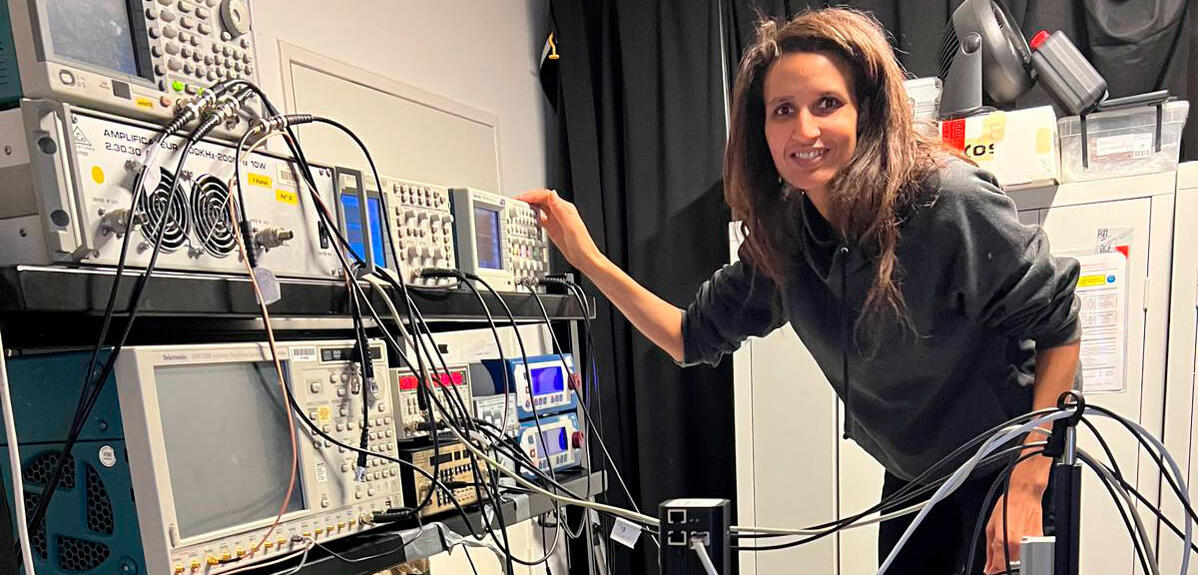
“I like learning and exploring areas that I am not familiar with,” says Maïmouna Bocoum, a researcher at the Langevin Institute1. A graduate of France’s ENSTA high school of advanced technologies, she describes her initial background as “fairly theoretical”, hence her decision to complete an experimental thesis: “The combination of the two was in keeping with my idea of a fairly good physicist!” Something she has clearly become, to say the least, for this specialist in acousto-optics just received the Irène Joliot-Curie “Young Female Scientist” award for her contributions to biomedical imaging.
Initially trained in optics, in 2016 Bocoum defended her PhD thesis on generating attosecond laser pulses, with the added bonus of the world’s shortest high-cadence near-infrared pulse at 3.4 femtoseconds, which corresponds to light compression of nearly a single optical cycle (a full oscillation of a light wave, in other words the transition of light through all of its phases).
Mastering multiple fields
Once she completed her thesis, her need for renewal, coupled with a desire to shift towards applications, prompted her to change direction. “At a seminar where doctoral students were presenting their subjects, I was struck by the possibilities of acousto-optics.” Thanks to postdoctoral funding, she joined the Langevin Institute, where she trained in acoustic imaging. “When you master multiple fields, you can transfer concepts from one to the other, which often paves the way for innovation.”
Recruited by the CNRS in 2018, she worked to develop methods that combine optics and acoustics in order to detect small objects located deep inside tissue, typically tumours.
“Light is limited by diffusion, unlike ultrasound, which spreads ballistically (in a straight line without deviation – Ed’s note), but is only sensitive to interfaces. The trick is to make the matter vibrate with ultrasound, which modulates the phase of a light wave travelling through it, from which it is possible to reconstruct an optical image that presents the resolution and penetration of ultrasound waves.”
Exploring every facet of a technique
Yet to move from the principle – known for decades – to potential applications, Bocoum had to tackle every facet of a technique whose chief difficulty resides in its weak signal.


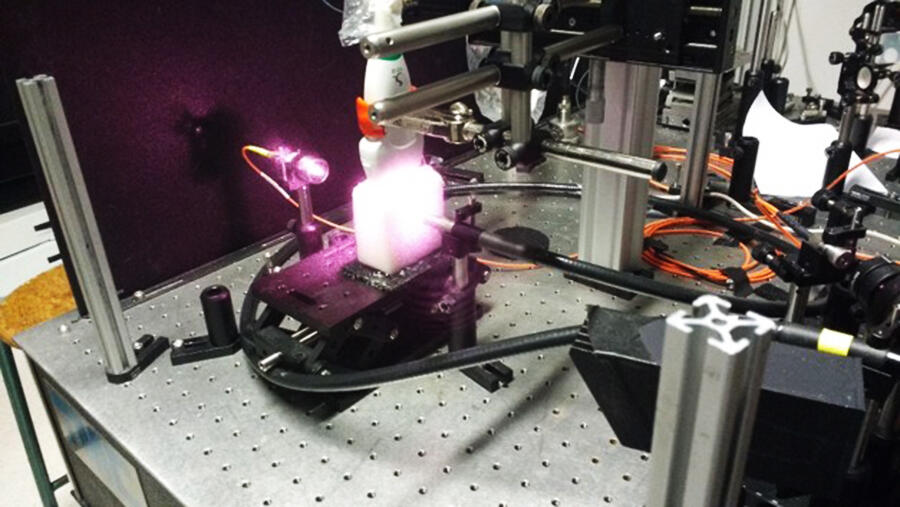
Detection proceeds via digital holography, an affordable interferometric technique2. A new tissue sonication method (exposing tissue to ultrasound) requires a comprehensive reworking of imaging patterns. More powerful laser sources, some of which are based on fibre technologies, are also being developed, along with algorithms based on graphics processing units (GPU) for image processing virtually in real time.
Towards an alternative to biopsies
“We still have multiple bottlenecks to overcome, but a pre-prototype has been operating in the laboratory since 2024,” enthuses Bocoum, who is awaiting the response to a request for prematuration funding to initiate technology transfer, with sights notably set on detecting nascent breast tumors as an alternative to biopsies.
The scientist has not yet decided which technology to use, for between 2023 and 2024, she completed a stay in Copenhagen (Denmark) to familiarise herself with the manipulation of quantum sources with unmatched stability. This resulted in a publication on their use in detecting gravitational waves, published last year in the journal Nature3, while awaiting their possible integration within her acousto-optic devices. “I would also like to train in biology to get a better grasp of what the needs are.”
Overcoming self-censorship
When her award is mentioned, the insatiable physicist nevertheless speaks of the self-censorship – often unconscious – that female scientists can come up against. “The distinction gives me confidence, including the confidence to – who knows? – one day apply for a prize open to both genders, which I would never have considered before.”
To combat gender stereotypes, Bocoum believes in transmission, to which end she serves on the jury for the French Physics Olympiad, and willingly accepts invitations to present her work to young students.
The specialist reveals that she was inspired by the figure of Anne L’Huillier, winner of the 2023 Nobel Prize in Physics, who was the thesis supervisor of her supervisor: “I had seen her at a conference where she spoke of her career as a woman, and how she coped with motherhood. It left a deep mark on me.” And it encouraged her to have no limits when exploring the physical universe.
Further reading
When glass and light make sparks
- 1. CNRS / ESPCI-Paris PSL.
- 2. Interferometry is a measurement process that uses the phenomenon of wave interference (generally light, radio, or acoustic waves).
- 3. V. Novikov, et al. “Hybrid quantum network for sensing in the acoustic frequency range,” Nature, 2025: https://dx.doi.org/10.1038/s41586-025-09224-3
Explore more





Author
Born in 1974, Mathieu Grousson is a scientific journalist based in France. He graduated the journalism school ESJ Lille and holds a PhD in physics.