
You are here
Avatar vs science

Pandora. From the very first images of Avatar, the viewer is struck by the beauty of this imaginary world. The creatures move and act in a natural way, the landscapes seem to be alive, and every interaction between species is convincing. This impression of realism is not solely due to the imagination of the director, James Cameron: it is the result of a subtle mix between artistic intuition and biological knowledge. Behind the enchantment lies a question: how can the imagination, guided by science, create a believable fictional world, while at the same time encouraging us to rediscover life on Earth?
Eywa, or the poetry of a living network
The central force of Pandora, the deity Eywa embodies a global consciousness interconnecting all life forms through the moon’s flora. It’s a spectacular idea, but also partly inspired by concepts actually used by scientists. On our own planet, mycorrhizal fungi live in symbiosis with plant roots, delivering nutrients from the soil in exchange for carbon.



At times the Pandoran “plant network” resembles the “Internet of Plants”1, a hypothesis proposed by certain Anglo-Saxon scientists, according to whom plants communicate through mycorrhizal fungi. As Pierre-Marc Delaux2, a biologist at the ISYEB3, explains, “There is no solid proof at this time to substantiate this highly romanticised vision.” However, this poetic imagery illustrates a key point: in science, ideas can emerge in the imagination before being verified.
One thing is certain: even though the “Internet of Plants” remains speculative, plants do in fact communicate with one another. Some release molecules into the soil to impede the growth of their neighbours (allelopathy)4, while others emit chemical signals5 to warn their neighbours of an attack by herbivorous fauna. Eywa is thus not an exact mirror of nature, but a powerful reminder that the plant world is active, reactive and complex, far removed from the notion of a simple green décor.
Creating plausible creatures
The animals of Pandora were not invented haphazardly. Their conception is based on a creative discipline: speculative evolution. Artists and scientists use this approach to envision plausible life forms within the limits of physical and biological possibility.
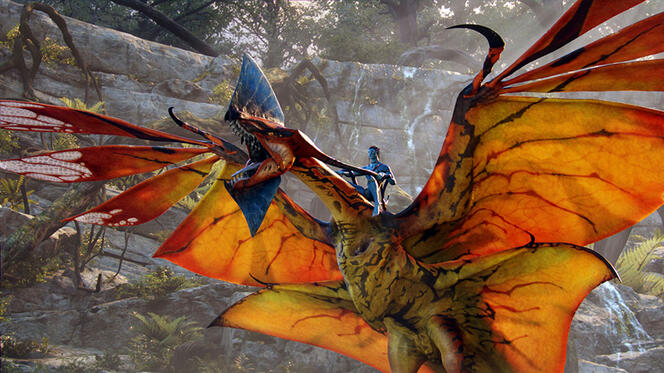
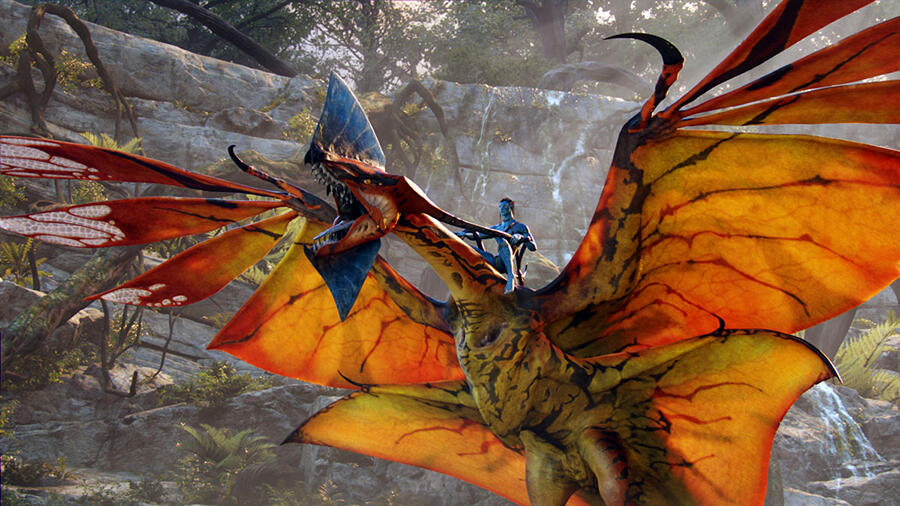
According to the paleoartist Marc Boulay, who frequently collaborates with scientists and whose work has been widely published in the press, speculative art “develops an approach based on the observation of actual life forms to formulate reasonable biological hypotheses in keeping with evolutionary likelihood”.
The idea is not to dream without limits, but to wonder what kind of animals could appear if certain conditions were to change (lower gravity, a different atmosphere, denser ecosystems etc.). As Guillaume Lecointre6, a systematist who works with Boulay, points out, “Evolution does not offer infinite options: some things are possible and others never will be.”
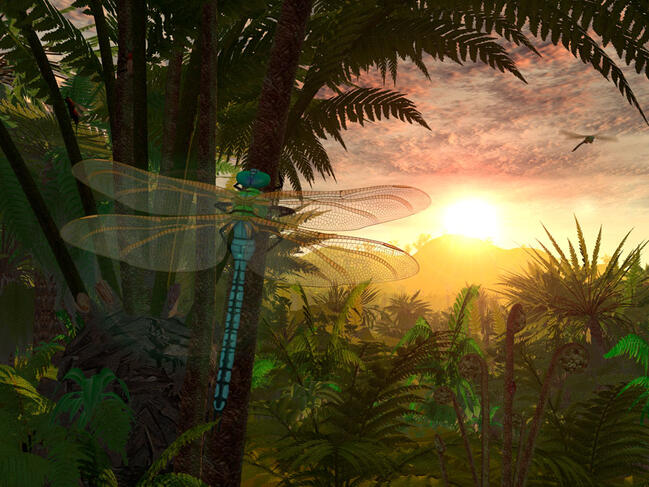
Virginie Courtier-Orgogozo7, a biologist at the Paris-based Jacques Monod Institute, cites the example of the dragonflies with 70 cm wingspans that populated the forests of the Carboniferous Period 350 to 300 million years ago, when the oxygen level was nearly 30%, compared with 21% now: “What seems incredible today is in fact a past reality, and speculative evolution explores these plausible zones of the imagination.”

However, Pandora does not align with all the principles of biology. Most of its fauna have six limbs, whereas the Na’vi, the humanoid species that inhabits Pandora, have only four. On Earth, most vertebrate animals (including humans) have four limbs, because they all descend from a common tetrapod that emerged about 360 million years ago. Such a discrepancy suggests that the Na’vi, as tetrapods, and the other hexapodal Pandoran species do not share the same evolutionary ancestor. For a biologist, this inconsistency is difficult to explain.
Fifty shades of skin
Lecointre points out another important detail: the deep blue hue of the Na’vis’ skin. “On Earth, this colour usually results from optical effects,” the ecologist explains. “Producing a pigment that reflects the colour blue requires a great deal of energy. A species pigmented entirely in blue would therefore be very costly to maintain biologically.”
Conversely, in the latest episode of Avatar, the Ash People have grey skin, ideal for camouflaging in their rocky environment and as a protection against heat and dust. The influence of the volcanic surroundings goes beyond skin colour. Unlike the forest and sea clans, the Ash People are portrayed in the storyline as being fiercer and more impulsive – a trait that contrasts sharply with scientific reality. A CNRS study in Indonesia has determined that populations living in high-risk volcanic zones tend to become more careful and cautious over the generations8. A phenomenon that Courtier-Orgogozo sums up as follows: “An unstable environment can have as much influence on behaviour as physiology.”


Imagination as a scientific tool
Far from being mutually exclusive, science and creativity are closely linked. According to Lecointre, “Biologists use the imagination as a genuine working tool.” He mentions the example of Proavis, a fictional animal envisioned in the early 20th century as a means of understanding the origin of flight in birds. Scientists drew images of it based on two possible scenarios: either a small reptile jumping from tree to tree whose scales elongated into primal feathers, or a terrestrial animal running after its prey and gradually developing the ability to glide through the air.
These representations were not mere fantasies, but rather prototypes for reflection. Today we know that feathers developed before flight, originally to conserve heat or to attract a mate. The example of Proavis illustrates how the imagination can guide scientific investigation, even when the definitive answer comes from another source. “Scientists had visualised this ‘missing link’ as a conjecture, long before palaeontology provided solid answers,” Lecointre notes.
The appeal of Avatar has never been the depiction of a scientifically perfect world. As Courtier-Orgogozo observes, “What’s so enchanting is the way the film triggers our curiosity about the mechanisms of life.” With the release of Avatar: Fire and Ash, the third instalment in the franchise, this journey to Pandora promises to remind audiences that the line between science and fiction is permeable: the imagination can inspire, guide, and stimulate scientific rigour. As scientists themselves admit: the most fertile ideas are often born in dreams.
For viewing
Avatar: Fire and Ash, directed by James Cameron.
For further reading
• Avatar. Exploration scientifique et culturelle de Pandora (“Avatar. A scientific and culturaleExploration of Pandora”), editorial directors Jean-Sébastien Steyer and Roland Lehoucq, pub. Le Bélial, October 2025, 288 pages, €19.90 (in French).
• Comment habiter notre planète – Une lecture d’Avatar, by Perig Pitrou, pub. Puf, November 2025, 192 pages, €19 (in French).
- 1. “Positive citation bias and overinterpreted results lead to misinformation on common mycorrhizal networks in forests”, Karst et al., Nat Ecol Evol 7, 501–511 (2023): https://doi.org/10.1038/s41559-023-01986-1
- 2. CNRS research professor at the LRSV plant science research laboratory (CNRS / Toulouse INP / EPE Université de Toulouse).
- 3. ISYEB systematics, evolution and biodiversity institute (CNRS / EPHE-PSL / MNHN / Sorbonne Université).
- 4. “Plant neighbor detection and allelochemical response are driven by root-secreted signaling chemicals”, C.H. Kong et al., Nature Communications 9, 3867 (2018): https://doi.org/10.1038/s41467-018-06429-1
- 5. “Rapid Changes in Tree Leaf Chemistry Induced by Damage: Evidence for Communication Between Plants”, I.T. Baldwin, J. C. Schultz, Science 221, 277-279 (1983): https://www.science.org/doi/10.1126/science.221.4607.277
- 6. Academic at the National Museum of Natural History, under the auspices of the ISYEB.
- 7. CNRS research professor, Institut Jacques Monod (CNRS / Université Paris Cité).
- 8. “Evidence of genotypic adaptation to the exposure to volcanic risk at the dopamine receptor DRD4 locus”, C. Faurie, C. Mettling, M. Ali Bchir et al., Sci Rep. 6, 37745 (2016): https://doi.org/10.1038/srep37745 – Erratum in: Sci Rep. 2017 Mar 09; 7:43978: https://doi.org/10.1038/srep43978
Explore more