
You are here
The secret of sand patches

They have long gone unnoticed on beaches and in deserts, overshadowed by their cousins, sand dunes. These small sand deposits are much less impressive in size – a few meters long and wide, and only a few centimetres tall. They can be found between dunes, in the middle of gravel beds, or on beaches when the sand is wet. They have much to tell us about how the wind forms sand structures.
Their origin remained a mystery until an international team of researchers including CNRS physicists recently solved the enigma. They used precise field measurements to develop a model that can, for the first time, reproduce the formation of these structures1. Their results have been published in the scientific journal PNAS2.
Patches: between dunes and wrinkles
Dunes, wrinkles, and other objects created by the interaction of sand and wind are of great interest to physicists specialising in granular environments, who can use these natural structures to study complex collective behaviour. In the space of twenty years, the experimental observations and measurements of researchers have forged a strong theory to explain the formation of dunes. Another model also helps explain the birth of wrinkles.
Yet these newcomers – sand patches, also known as “mini sand dunes” – have blown down previous beliefs and prompted physicists to reconsider. “According to the traditional theory of dune formation, no sand structure less than 10 meters long can emerge from a flat sand bed. This is the fundamental size of a dune, and such patches should therefore not exist,” explains Philippe Claudin at the PMMH physics and mechanics of heterogeneous environments laboratory3, who co-authored the study.

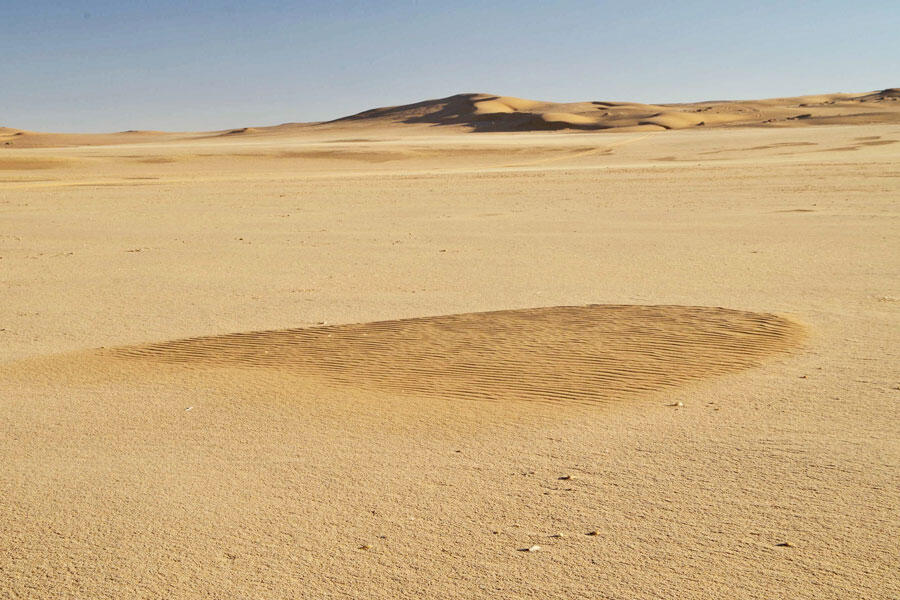
So how to explain the origin of these patches? To answer the question, several members of the team went out into the field, in the Namib Desert (Namibia) and Great Sand Dunes National Park (Colorado, United States).
Their initial observations revealed that the sand deposits do not appear just anywhere, but in specific locations where the ground is hard: on the gravel beds present in interdune areas in the Namib Desert, and on sand wet from the presence of a river, as at Great Sand Dunes. The difference between a soft, erodible surface (a bed of dry sand), and a harder consolidated one must therefore play a key role.
Hopping grains of sand
This was confirmed by measurements (wind speed, sand flow) taken on site, which precisely quantified the process. “They show that for a given wind speed, sand transport capacity (the quantity of sand transported by wind) is much higher on consolidated surfaces than on erodible ones,” points out the primary author of the research, Camille Rambert, who is completing her thesis at the PMMH and the IPGP institute of planetary physics in Paris.
Why is this the case? Because when they are carried by the wind, grains of sand move by making short hopping motions, known as “saltation”. However, on gravel beds and wet sand, these hops are much more effective – much higher and longer – than on a layer of dry sand, where the rebounds are cushioned. More sand is moved as a result.


When all these elements are put together, the mechanisms behind patch formation clearly emerge. “Imagine a large amount of sand transported by the wind on a solid surface. Suddenly, this sand comes across an area where there is already some of it. The transport capacity begins to drop, and the wind can no longer move as much sand. Some of it is deposited there as a result, and the phenomenon continues until a clearly visible patch appears,” Rambert adds.
Transport capacity and formation speed
These are the key features of the pattern, but in reality things are a bit more complicated. “What we discovered is that the transition from a high transport capacity to a smaller one does not happen instantly when shifting from one surface to another. The change occurs after a certain distance, on the order of one metre. Hence this new parameter, transition length, which we introduced in our model,” explains Claudin.
When these two elements are combined – transport capacity change and transition length between these two regimes – digital simulations from the model accurately reproduce the observations. Not only are topographical profiles for sand deposits the same as those measured on the ground4 (5 meters in length, crest height of 5 centimetres for the structures observed in the Namib), but there is no difference either in the dynamic of these patches, which take approximately an hour and a half to form, and move 2 meters in the direction of the wind during that same period of time.
When patches become dunes
Thanks to their model, the researchers were even able to conduct forecasts on what would happen to these sand deposits. The simulations highlighted a remarkable fact, namely that these objects could represent the precursors of future dunes.
“In certain conditions, if the wind blows constantly in the same direction, and provides enough sand, then the patches could get bigger and create a dune in the space of a few days,” Rambert points out. “These conditions nevertheless seem to come together rarely in the desert. Most of the time, since wind changes direction, or nearby sand sources are not big enough, the patches end up disappearing.”
Such events, that some already suspected before this research, are rare but possible, as demonstrated by an observation conducted by the Great Sand Dunes team. Two readings performed two hours apart showed the growth of a sand deposit continued until it stretched over ten meters, the minimal length needed for a pile of sand to change into a dune. With these patches, the researchers put their finger on an alternative way of creating dunes!
They intend to confirm this hypothesis with new monitoring campaigns on beaches, where measurements are lacking. With a sustained wind often blowing in the same direction (from the sea towards the land), and the permanent presence of sand dried by the wind, beaches are a more favourable environment than deserts for witnessing the birth of a dune from a sand deposit. These surveys will also be the occasion for physicists to refine their model by precisely determining what factors influence transition length (wind speed? size of sand grains?), whose physical origin remains poorly understood.
All the way to Mars!
With this new model, patches have emerged from the shadows, and have required physicists to change their view on the dynamics of sand transport. These objects have indeed revealed that the movement of sand grains from one location to another is much more complex than previously thought.
Sand is not simply transported by the wind from one dune to another in linear fashion, its movements are more elaborate: sand deposits are born here and there between dunes, move before disappearing, provide sand for these same dunes, and in some cases contribute to the formation of new ones.



Better still, this discovery will make it be possible to estimate the movement of sand, which is little known in interdune areas, without having to use elaborate measurement instruments. “Given the characteristics of patches (size, speed of progression, etc.), our model could trace back to the sand flow that created them,” Claudin suggests. “With simple photos taken at regular time intervals, we could estimate the quantity of sand transported, doing so on much shorter time scales than for dunes, as patches appear and move much more quickly.”
This idea could even be used on Mars! In the images taken on the Red Planet by NASA’s robot Perseverance, the researcher thinks he has spotted, amid a field of rocks, the presence of structures strongly resembling patches on Earth. Regular monitoring of these sand deposits would help determine the movement of sand, and thereby some of the characteristics of the wind and atmosphere on Mars. Piles of sand will continue to be a physicist’s castle for a long time to come. ♦
Further reading
Saudi Arabia, the desert recovers its memory (in French)
When the Mediterranean was empty
Breaking the ice (slideshow)
- 1. The team includes French, British, and American researchers. The French scientists developed a model based on observations conducted by their UK and US colleagues.
- 2. Vol. 122, e2426143122 : doi.org/10.1073/pnas.2426143122.
- 3. CNRS / ESPCI Paris-PSL / Sorbonne Université / Université Paris Cité.
- 4. Measurements conducted by tripod-mounted laser scanners that capture the surrounding relief with a precision of a few millimetres.
Explore more