
You are here
Sharks fall prey to "Jaws"

As an ichthyologist specialising in sharks, what do you think of Jaws?
Eric Clua1: I have had a very personal relationship with the movie since I was a child. I was eleven years old when it came out, and in the schoolyard I was the only one who hadn’t seen it, because my father wouldn’t allow me to go. Today I can appreciate the soundness of his decision. He took me diving in the Mediterranean starting when I was four, at first freediving and later scuba diving, which helped spark my budding passion for the sea. Quite rightly, he thought that if I saw Jaws it could have given me such a fear of sharks – what’s called ‘galeophobia’ – that I would never practice again. Since then, I’ve still never seen the whole film! But enough to analyse it…
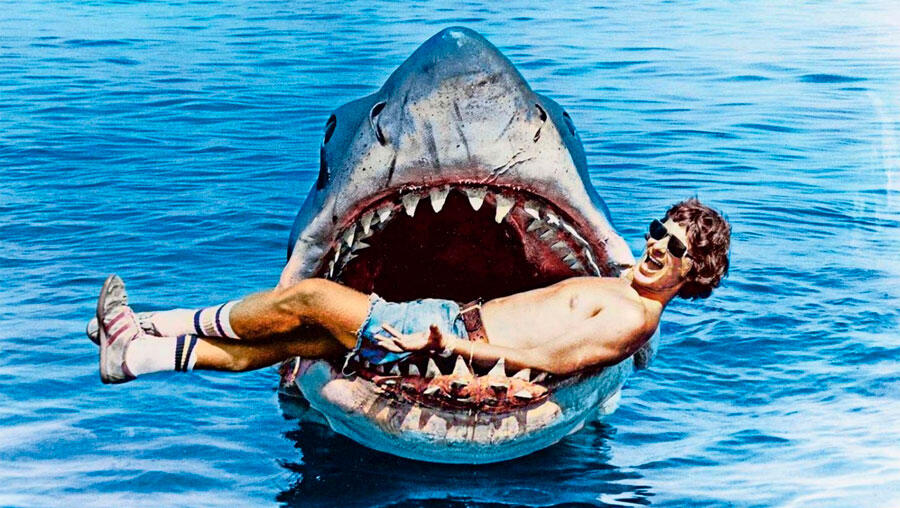
In fact, what makes Jaws so compelling is that we hardly ever see the shark. For the adaptation of Peter Benchley’s novel, Spielberg had initially commissioned a mechanical model. But it turned out to be so fake-looking and hard to control that he revised the whole script to keep its appearances on screen to a minimum.



Everything is done to suggest its presence in incredibly effective ways, through the framing as well as the music, to arouse that fear of the unknown that we can feel at sea – and to revive the vilifying image of the bloodthirsty shark that attacks humans. A vein that would later be mined in spinoffs of Jaws, now grouped under the term ‘sharksploitation’.
Are sharks really the bloodthirsty, merciless monsters depicted in this movie subgenre?
E. C.: I’d like to remind everyone of a few figures, because the shark is far from being the most dangerous predator for humans. Compared to dogs, ‘man’s best friend’ is responsible for 4 to 5 million attacks causing more than 20,000 deaths annually, while there are at most 100 to 200 shark attacks and a dozen fatalities each year. Even cows kill more people (22 per year) than sharks! Not to even mention bees and hornets (400 deaths per year), snakes (100,000) and mosquitoes (750,000)…
The time has come for us to completely change the way we understand the individual motivations of the sharks that cause the attacks, which will result in better prevention. As an ethologist with veterinary training, I make an effort to get inside the predator’s head, rejecting the image of the shark as a killing machine driven by instinct. In reality, there are very marked personality differences among sharks, even within the same species. Only very few specimens venture to cross the interspecific barrier and consider humans as prey.
In a recent paper, my colleagues and I even proved that some of the bites come from repeat offenders, scientifically qualified as ‘problem sharks’. There are in fact ‘atypical’ individuals in the shark population – just like in the human population, for that matter – but 99.99% of all sharks are and will always be harmless to humans.
So managing the actual risks associated with sharks would be more analogous to a crime thriller than to Jaws?
E. C.: That’s right. Imagine we dealt with the risk of murder by a serial killer in Paris in the same way as we do with sharks. There’d be police snipers at the top of the Eiffel Tower in charge of shooting all the Homo sapiens down below… You must admit that this isn’t the most effective way to track down a murderer!
This type of risk management, known as ‘culling’, based on the volume and density of the population in a given region, simply demonises all the sharks to appease a frightened population. And the effects are tragic for local shoals. Between 2013 and 2020, at the height of the shark crisis in Réunion, more than 800 specimens were killed without really solving the problem: there were six fatal attacks during the culling operations, compared with five before then.
For my part, I have revisited and updated the controversial theory from the 1950s proposed by the Australian surgeon Victor Coppleson, who referred to the animals responsible for attacks on humans as ‘rogue sharks’. I will explain my theory of the ‘atypical shark’ in more detail in a book to be published by CNRS Éditions early next year. Paradoxically, the best example comes from Jaws: the shark is depicted as a serial man-eater thirsty for human blood, a marginal figure among the local shark population.

I think of myself as the first 'shark profiler'. Like a police investigator, I look for physical evidence to identify the animal that caused the attacks and surgically eliminate it to prevent any recurrence.
My approach was largely dismissed in the early 2010s, for lack of a viable technical solution, but it has gained considerable momentum in the past four or five years thanks to recent technological progress in genetics. DNA samples can now be extracted from the wounds inflicted on humans, to determine not only the species responsible for the bite but also the individual genetic profile of the offending shark, just like fingerprints at a crime scene.
What does your atypical shark theory change in terms of risk management?
E. C.: It reverses the logic: instead of reducing the density of sharks – based on the misconception that the risk is directly correlated with their number – attacks can be prevented by individually identifying the animals in a given area, so that in the event of an attack the offending individual(s) can be found. The first step is to organise non-lethal fishing expeditions, in which a piece of skin is taken from each shark to get a DNA sample. At the same time, the sharks are marked with subcutaneous chips, permanent numbered tags or notches on the fins, so that they can be identified more easily.
This form of risk management turns out to be more effective than the mass slaughter of a shark population. The more exhaustive the database, the more efficient the identification of the sharks responsible for the attacks. It also reassures the public without labelling all sharks as potential killers.

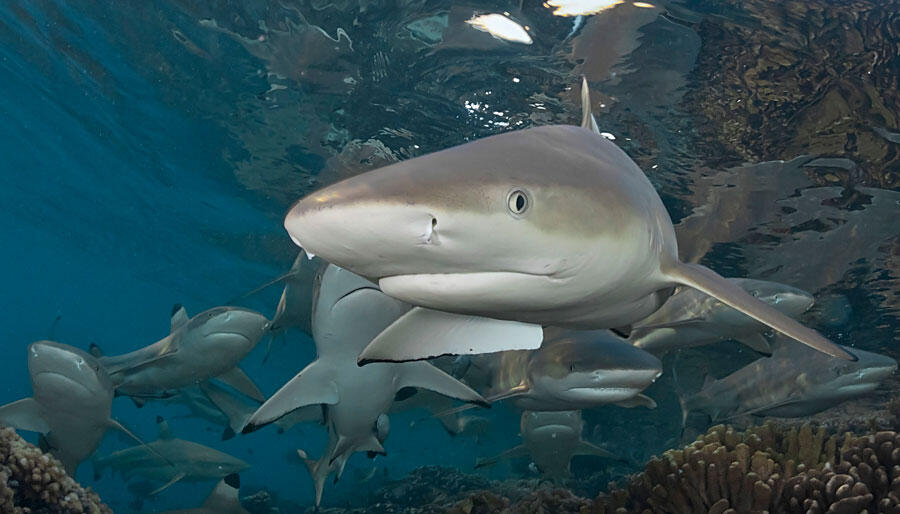
A trial programme is currently underway on the French island of Saint Martin, in the West Indies. Launched in 2021, the ‘One Shark’ project2 is mobilising all of civil society (from fishermen to surfers and environmental protection groups) to find a female tiger shark called Torvi, responsible for two predation attacks on swimmers – one fatal, in Saint Martin in December 2020, and the other resulting in a leg amputation, 85 kilometres away in Saint Kitts in January 2021. This Caribbean experiment, the only one of its kind in the world, has already drawn the attention of the Egyptian government, which recently hired me as a consultant after two successive tiger shark attacks.
The shark is the monster in Jaws, but outside the movie theatre, wouldn’t it be the humans?
E. C.: Absolutely. Sharks kill about ten humans each year, but humans kill more than 100 million sharks annually, nearly 15,000 per hour… This is mainly the result of direct fishing for sharks, but also includes accidental capture by industrial trawlers, or, for larger species like whale sharks, collisions with ships.
These deaths are all the more detrimental to the shark population because their reproductive strategy, based on internal fertilisation, is not very effective. Whereas a blue shark, the most prolific of all shark species, can give birth to 100 to 120 pups per litter, any bony fish lays a million eggs. In short, these animals can no longer compensate for the losses, which explains why 70% of them have disappeared from the planet in the past 30 years.
The harmful effects on marine ecosystems of the decimation of these predators can already be felt. In South Africa, the disappearance of the white shark has triggered a cascade effect, with the proliferation of smaller predators that used to be prey for the big shark, including sea lions, seals and other sharks, to the detriment of local fish species, which now suffer from overpredation.


Instead of Jaws, what kind of representations of sharks would you like to see in movies?
E. C.: I would very much like to raise awareness about sharks among the younger generations, but the most recent animated films on the subject have been particularly frustrating. In Finding Nemo (2003), a shark loses its carnivorous instinct and becomes a vegetarian, until a drop of blood sends it into a frenzy. The same goes for Shark Tale (2004), in which the shark protagonist also wants to be a vegetarian and becomes a target of ridicule from his carnivorous father. I find both films utterly silly: the only way of depicting a friendly shark is for it to go vegan!
The problem with representing sharks arises from our difficulty in accepting them as they are: carnivores radically different from primates like us. We can identify with a dolphin but not with a shark, yet we must accept their otherness.
For viewing
Jaws, by Steven Spielberg, back in theatres in the US and beyond from 29 August, 2025.
For further reading
Le Requin Singulier, by Eric Clua, to be released in January 2026 (CNRS Éditions – in French).
See also
In the Middle of a Shark Feeding Frenzy
How Jurassic Park changed the image of dinosaurs
Sylvie Rétaux, the all-terrain biologist
- 1. Professor at the EPHE, part of the CRIOBE (CNRS / EPHE-PSL / Université de Perpignan-Via Domitia). https://ericclua.com)
- 2. https://one-shark.fr/fr/projet-one-shark
Explore more