

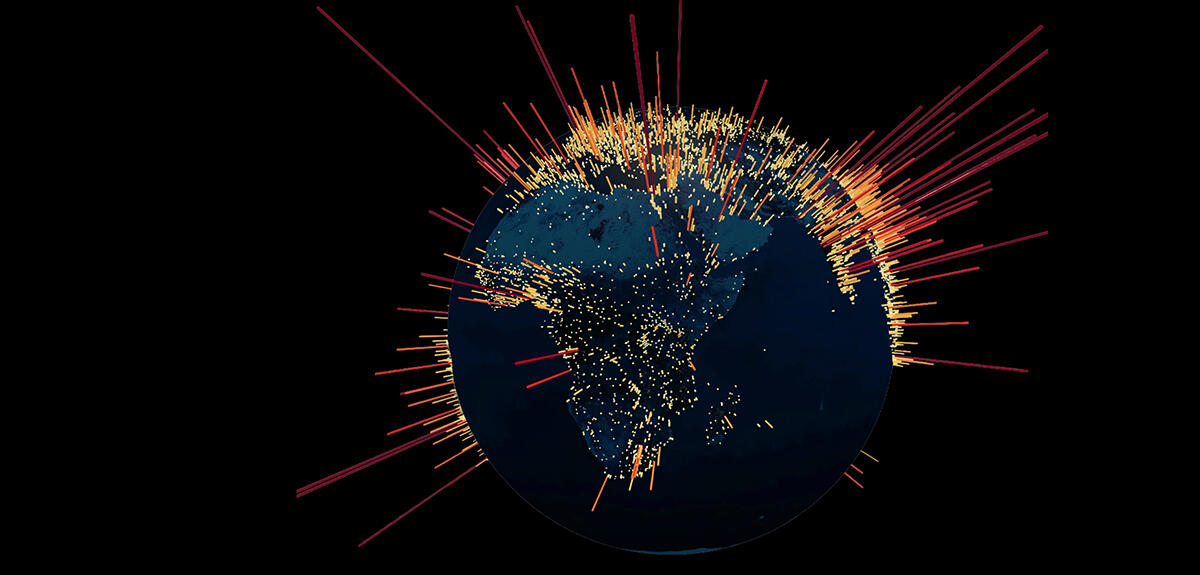
Virtual globes, 2D or 3D representations of the world produced from digital data, can fool us into thinking that we now know everything there is to know about the Earth. But a deluge of data is no guarantee of a better picture of “reality”.
Slideshow
09.25.2026

A governing equation in quantum mechanics, the Schrödinger equation is, in practice, impossible to solve exactly. The mathematicians Éric Cancès, Mathieu Lewin, and Julien Toulouse have now proposed a radical reformulation of it, in order to study complex...
Article
09.22.2026

The outstanding physicist Jacqueline Bloch is a specialist in polaritons, microscopic objects halfway between matter and light. She has just been awarded the CNRS Gold Medal, France’s highest scientific distinction. A portrait.
Article
09.17.2026
Our topics
11.15.2024

Astrochemistry, a relatively new field, focuses on exploring chemistry in interstellar spaces to uncover insights about the origins of life on Earth. This discipline has seen significant advancements...
10.16.2024

Interview with the linguist Frédéric Landragin, who recently published a short guide on interstellar communication.
Article
08.30.2024

For nearly ten years, astronomers have been trying to demonstrate the existence of a massive object thought to be orbiting in the outer reaches of the Solar System. Although the hypothesis is widely...
Slideshow
07.12.2024
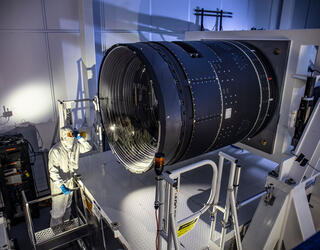
It took hundreds of scientists worldwide, including several CNRS teams, to produce the world’s largest digital camera, the LSST (Legacy Survey of Space and Time), which has finally arrived in Chile....
Article
06.27.2024

On 22 June, a Chinese Long March 2C rocket launched the SVOM satellite, carrying two French-designed instruments, into orbit. The mission's goals are to investigate the mechanism of gamma-ray...
Article
06.20.2024

Alessandro Morbidelli is a specialist in the evolution and formation of planetary systems, and holds the planetary formation Chair at the Collège de France. The astrophysicist looks back on his...
06.14.2024
The “Sanctuary on the Moon” project, launched nearly ten years ago, aims to send a collection of discs containing a vast body of knowledge and material evidence of human civilisation to the Moon.
Article
04.24.2024

The recent discovery of a binary system containing an extremely rare object, the most massive black hole (apart from SgrA*) ever detected in our Galaxy, calls into question the models for the...
Article
03.27.2024
Galactic archaeology uses state-of-the-art telescopes to reconstruct the history of our Milky Way, from the Big Bang to the present day.
03.13.2024
As opposed to black holes, white holes are thought to eject matter and light while never absorbing any. Detecting these as yet hypothetical objects could not only provide evidence of quantum gravity...
Article
02.12.2024
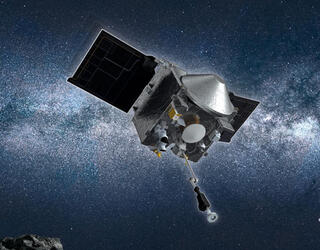
On 24 September, 2023, material collected three years earlier from the surface of asteroid Bennu was successfully returned to Earth by the OSIRIS-REx mission. Some thirty laboratories around the...
10.17.2023
How do planets form? How did life emerge from lifeless matter? Does it exist elsewhere? These are just some of the questions that the multidisciplinary Origins programme will attempt to answer.