
You are here
Jacqueline Bloch, magician of light

She displays a fabulous treasure in the palm of her hand, an ultra-reflective semicircle thin as a razorblade. “This is a typical sample of the microcavities we produce right here at the Centre of Nanosciences and Nanotechnologies (C2N)1!” The local magician is 59-year-old Jacqueline Bloch, with a cheerful air, joyous voice, and constant beaming smile. This miniature laboratory combines light and matter, and serves to probe the quantum world. A Research Professor at the C2N and a member of the French Academy of Science, she has just been awarded the 2026 CNRS Gold Medal.
How does one become a magician of light? “My father, Claude Bloch, was a renowned physicist, and I lost him when I was 4 years old,” she says with a first, emotional smile. “My uncle was also a scientist. So I grew up admiring this brilliant father I had hardly known, and more generally in a kind of aura surrounding physicists, which showed me the way.” The young Jacqueline thus began life with a desire to become a physics researcher.
The revelation of polaritons
After high school and a year of preparatory classes, she chose the Graduate School of Industrial Physics and Chemistry of the City of Paris (ESPCI). “I loved the teaching, especially lab work, when we were free to conduct scientific experiments. It was fascinating! I met two extraordinary professors there: Claude Boccara in optics, and Jacques Lewiner in solid-state physics.”
Inspired by their teaching, she ventured to the crossroads of these two disciplines. After an M. Phil (DEA) in condensed matter physics, Bloch continued with a thesis at the Laboratory of Microstructures and Microelectronics (L2M), on the behaviour of electrons in nanostructures.
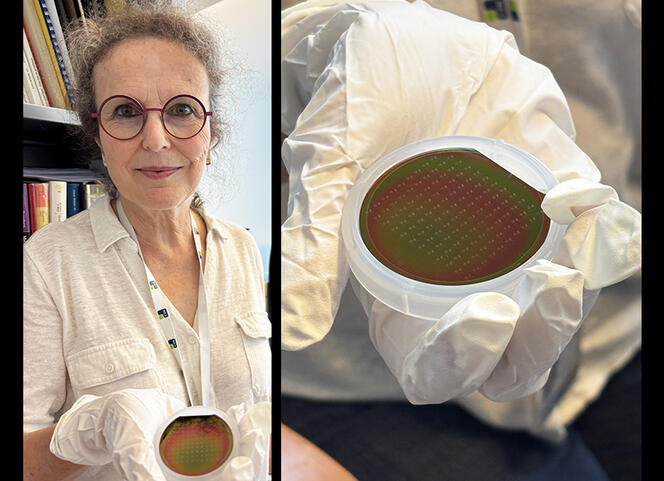

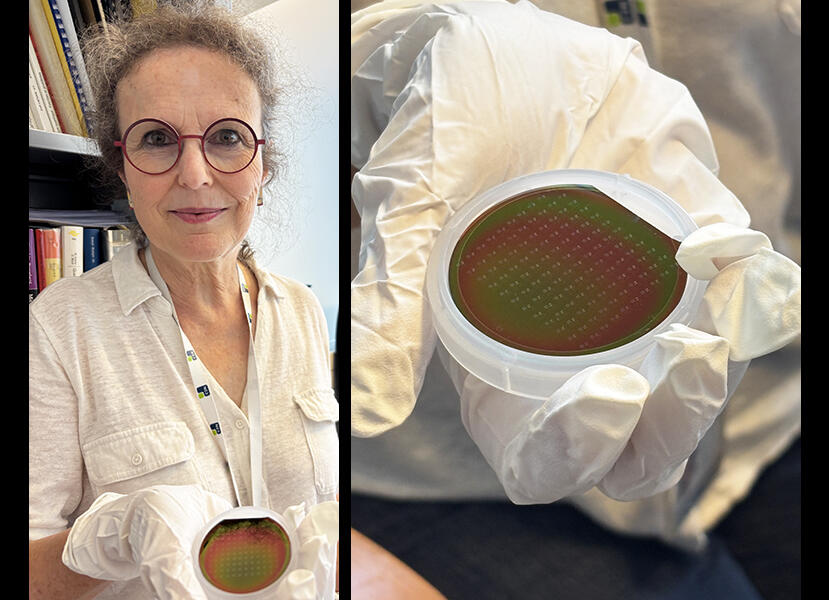
Her true revelation came two years later: polaritons, which notably appear in microcavities similar to those the researcher displayed in her hand. Most often micrometric in size2, these cavities consist of very thin semiconductor layers sandwiched between two facing mirrors. When they are caught in this trap, photons continually bounce between the two mirrors; as they cross through semiconductor layers, they transmit their energy to the electrons present in the semiconductors, catapulting them toward a higher level of energy.
This excitement of matter forms what physicists call an “exciton”, which in turn can render its energy by emitting a photon. In other words, within a microcavity, energy very quickly passes from light to matter and vice versa, such that it is no longer possible to distinguish the photon from the exciton. The duo forms a new quantum object that is half light and half excited matter, a polariton.
“The luminous portion of polaritons enables us to observe them. Since the mirrors are not perfect, some light escapes from the cavity, and it can be measured by our sensors. By studying this light, we can reconstruct the behaviour of polaritons within the system. As for their material portion, it allows them to interact with one another, even though the photons almost never collide. It therefore becomes possible to transform light into a kind of malleable fluid.”
Hybrid entities
Throughout her career, Bloch never stopped playing with these extraordinary hybrid objects, which serve as unique laboratories for observing, reproducing, and manipulating physical phenomena. Just after completing her thesis in 1994, she was recruited by the CNRS as an Associate Research Professor at the L2M.
“I immediately wanted to study the properties of these polaritons in depth. I had no idea where pulling this string would lead me to.” The answer is quite far, and right from the outset. In 1997, she authored multiple publications that generated considerable attention in the community.
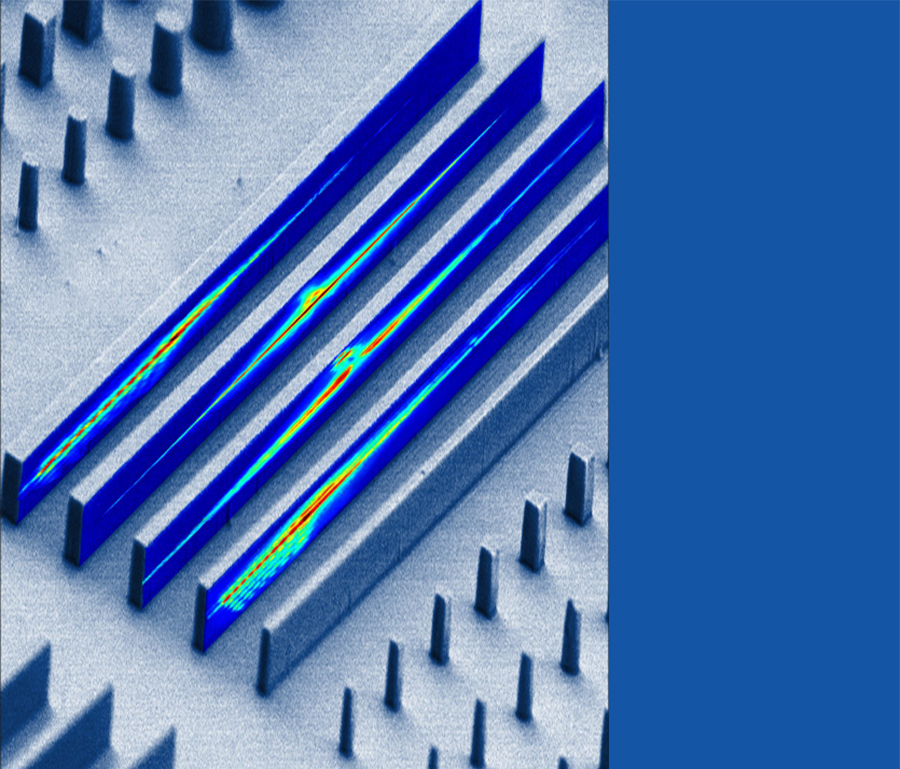
She showed in particular that it was possible to sculpt microcavities into the shape of a pillar. This amounted to adding walls on the sides of the sandwich, and by immobilising photons in a tiny area, allowed for controlling their states.
Playgrounds
In 1998 she joined her partner, a postdoctoral fellow in the United States, and teamed up with the prestigious Bell laboratories as a guest researcher. In that temple of innovation, she trained in ultrafast spectroscopy techniques, which made it possible to follow the evolution of polaritons in real time.

It was also in the US that she gave birth to her first child; her second was born in France three years later. Today aged 24 and 27, both of her sons are budding scientists, one a physicist, the other a chemist. Aside from science, the family shares another passion: mountains. “We still go hiking together in both summer and winter!” she says, with a proud smile.
Upon returning to France in 2000, Bloch rejoined the L2M, where she happily rediscovered her favourite playground – the microcavities from which she brings forth hybrid entities – as well as her colleagues.
“A fantastic collective adventure”
“In advancing my research, I took full advantage of unrivalled ‘in house’ know-how in the production of samples. Especially that of Isabelle Sagnes and Aristide Lemaître, who knew how to fashion high-quality microcavities. Throughout my career, I had the chance to work in a highly stimulating environment, with doctoral students and postdoctoral fellows of multiple nationalities, two young and brilliant research colleagues in Alberto Amo and Sylvain Ravets, and numerous national and international collaborations. I am part of a fantastic collective adventure exploring multiple horizons!”
In the ensuing years she shifted towards nonlinear optics. In a “linear” system, when you double the light, a signal that is twice as intense appears on the sensor, with no change in its nature.
However, by massively injecting light in a highly confined space, Bloch succeeded in considerably increasing the number of polaritons, and hence their interaction. These cavities can also give rise to entirely unprecedented collective behaviour, for light can change into a kind of fluid, flowing and forming whirlpools. As we said earlier, she has the magic touch.
Scientific rigour
With such “nonlinear” systems, Bloch makes hybrid entities dance in perfect synchronisation, until they are one and the same object, which physicists refer to as a “Bose-Einstein condensate3” in connection with polaritons. In 2010 she achieved one of the major coups of her career by using these cavities, sculpted into different forms, to manipulate the movement of polariton condensates.

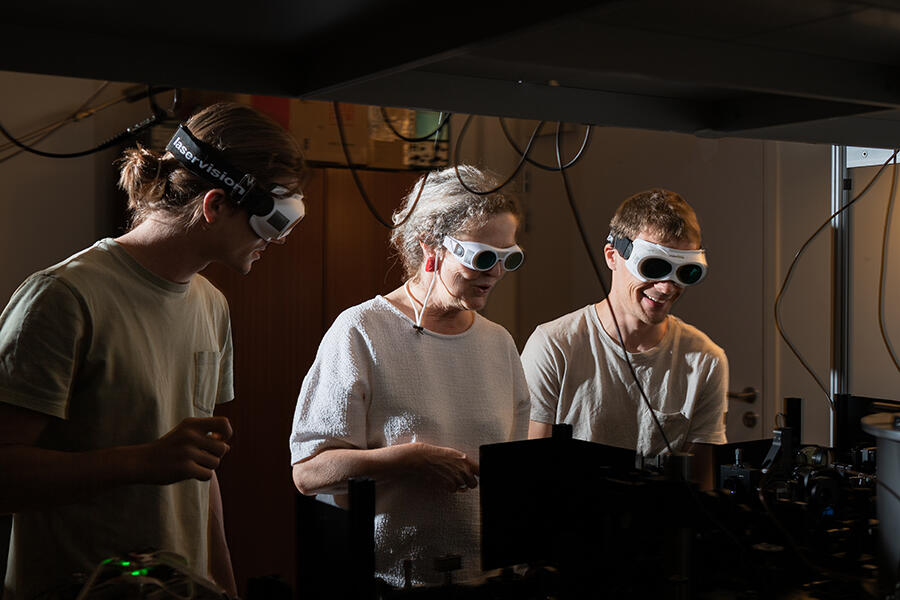
However, interpretations of these experiments were the subject of debate at the time: was it a genuine condensate or a simple laser? It is true that in measurements, the difference in signal is subtle. She set out to clarify the distinction between the two, with her compelling explanations today serving as references.
With a humble smile, she confirms: “I was recognised for my scientific rigour.” And for her breakthroughs, which came one after another.
Simulating the horizon of a black hole
Never short of imagination, Bloch sculpted more and more shapes with her microcavities, in order to impose particular pathways on polaritons and precise rules of movement, thereby refining her exploration of matter. She fashioned pillars that can be assembled like Lego pieces, as well as microcircuits or fractal structures with fascinating mathematical properties. In 2015 she simulated, with her marvellous fluids of light, nothing less than the horizon of a black hole.
“In our experiment, we pour a polariton fluid, and place an obstacle measuring a few micrometres in its path. It’s a bit technical, but essentially this barrier accelerates the overall fluid, while slowing the small density waves that travel within it. As a result, before the obstacle, the fluid advances more slowly than the small waves, and like fish in a river, these can still swim upstream. However, after the obstacle, the fluid is slower: even the waves trying to go backwards are carried along. A boundary thus appears, mathematically similar to the horizon of a black hole, from which nothing can escape, not even light.”
One of the goals of this miniature cosmic monster is to shine a light on Hawking radiation, which was predicted by the physicist Stephen Hawking during the 1970s. “We have not yet been able to capture it, but research is actively continuing, especially at the Kastler Brossel Laboratory (LKB) 4, with which we collaborate.”
In the intimacy of matter
At the same time, Bloch worked on another magic trick, this time with the goal of penetrating the intimacy of matter. How does a material’s architecture dictate the behaviour of its particles, thereby giving it its properties?
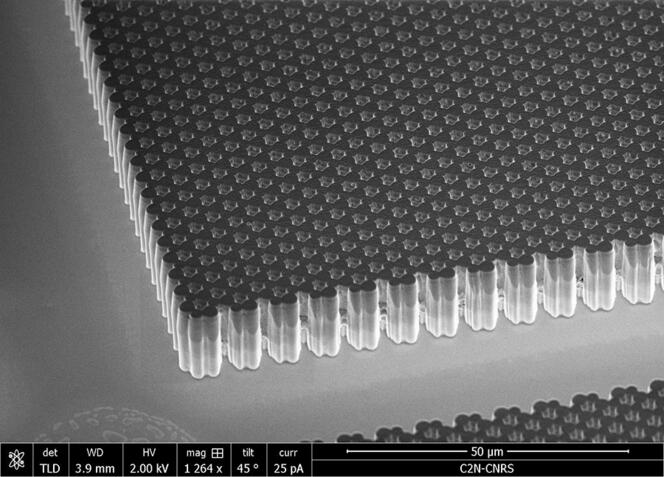
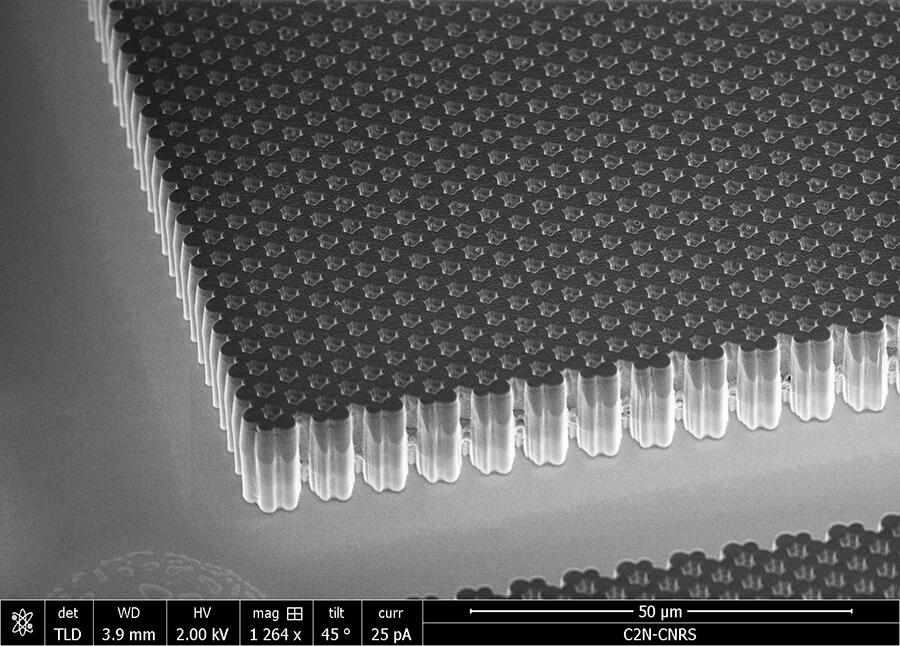
Since what is at play at the scale of atoms is invisible, the physicist built larger-scale models of sorts for these materials, once again thanks to her microcavities sculpted like Lego pieces. In 2014, her team assembled a honeycomb structure in which polaritons reproduce some of the properties of graphene (known for its remarkable properties of conductivity). Another breakthrough.
Thanks to these models, Bloch and her colleagues can change certain parameters at their leisure, in an effort to explore the material’s full potential, or to verify theoretical predictions. They can also modify architectures, thereby exploring materials that do not exist in nature.
“Helping young female talent”
The L2M became C2N in 20165, but Bloch remained Bloch. She racked up prizes and far-reaching publications, shining thanks to her results, enthusiasm, and the clarity with which she presents them in conferences. This talent always drove her to teach: “I greatly enjoy this part of my activity. For example I like conducting discussion sessions in small groups, being close to students.”
So much so that a few years later, she committed to serving in a mentorship programme in partnership with the Femmes & Sciences6 association. “This involves supporting young researchers throughout their PhD, and not just in their research, but on side issues as well, such as organising their work, or managing interactions with their thesis supervisor. At a time when the number of women in science is decreasing each year, let us try to help young female talent that chose the adventure of research!”
Disruptive technologies
A teacher and henceforth a mentor, Bloch never turned away from research, not by a long shot. In 2022, her team showed – once again a major first – that fluctuations in a polariton condensate seem to follow the same universal laws governing the formation of frost on glass, or the spread of fire on a sheet of paper. In 2025, she demonstrated this same phenomenon in experiments, doing so “no longer in one but in two dimensions, which required even more sophisticated analyses”.


The fruitful research of Bloch and her team members could one day lead to disruptive technologies. “It is true that they raise hopes, for instance, of processing and transmitting information simply with light . Our research sometimes precisely leads to proof of concept. But what I like most of all,” she says with one of her bright smiles, “is basic research! There is still so much to discover.” Stay tuned for the next magic trick.
See also
The magic of sound and light physics
Fields day for Hong Wang
Solace of quantum
- 1. CNRS / Université Paris-Saclay.
- 2. 1 micrometre = 1 thousandth of a millimetre.
- 3. A Bose-Einstein condensate is a quantum phenomenon in which a large number of particles act like a single, coherent wave.
- 4. CNRS / Collège de France/ ENS-PSL / Sorbonne Université.
- 5. In the 2000s, L2M first became LPN, located in Marcoussis (near Paris).
- 6. Mentoring programme for doctoral students from the Polytechnic Institute of Paris, in partnership with the Femmes & Sciences association: https://www.femmesetsciences.fr
Explore more