

You are here
Space

In April, the researchers involved in the French-Chinese SVOM space mission presented an update on its initial findings. These provided a number of interesting insights into events that took place in the very earliest days of the Universe. CNRS News takes a...
Article
06.29.2026

The Ramses mission to asteroid Apophis is set to launch in 2028. It forms the cornerstone of a planetary defence programme designed to protect our planet from the risk of collision with near-Earth objects.
Article
04.23.2026

One hundred years after the death of the French astronomer and populariser of science Camille Flammarion, the CNRS physicist Jean-Philippe Uzan follows in the footsteps of his predecessor’s celebrated book Popular Astronomy, providing us with an accessible...
Article
01.16.2026

On 14 September, 2015, the international LIGO/Virgo collaboration detected the very first gravitational wave signal, a tiny distortion of spacetime predicted by Einstein, in this case produced by the merger of two black holes. The CNRS astrophysicist Marie-...
Article
11.03.2025
Article
12.05.2022
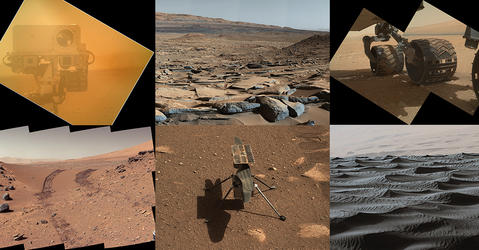
Earth's smaller sister planet, Mars, may have seen the emergence of life in its early history. To be certain, NASA's rovers Curiosity, launched ten years ago, and Perseverance, which landed...
11.24.2022
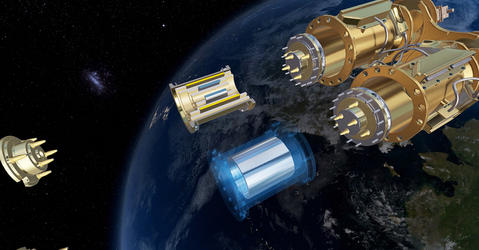
Launched in 2016, the MICROSCOPE satellite has confirmed with unprecedented precision the equivalence principle, which lies at the heart of Einstein's general theory of relativity. Two...
11.21.2022
For the first time, a physical model consistent with observations successfully describes how the tidal force caused by the gravitational pull of the Moon is slowing down the rotation of our planet...