

You are here
The distant past catches up with the Universe

Just one year after starting scientific operations, the French-Chinese SVOM1 mission is already proving a success. "SVOM’s performance has far exceeded our expectations, and has enabled us to make several interesting initial observations," says Susanna Vergani, CNRS research professor and astrophysicist at the Laboratory for the Study of the Universe and Extreme Phenomena (LUX)2, which is involved in this project.
The aim of the mission, which launched in June 2024, is to monitor extreme cosmic events known as gamma-ray bursts, or GRB. It is led by the Chinese (CNSA) and French (CNES) space agencies, with the collaboration, in France, of the French Alternative Energies and Atomic Energy Commission (CEA) and the CNRS.
Colossal energy emissions
Gamma-ray bursts are only visible from space, as they are blocked by the Earth's atmosphere. Such events, which are invisible to the naked eye, consist of fleeting yet colossal energy emissions. In just a few seconds, they release more energy than the Sun during its entire lifetime.
Originating in the depths of the cosmos, they are caused by cataclysmic events. Some, known as short gamma-ray bursts, last less than two seconds. They are emitted during the merger of two neutron stars – objects mainly composed of neutrons (electrically neutral particles found in atomic nuclei) – or of a neutron star with a black hole (an extremely dense object from which not even light can escape).
Other gamma-ray bursts are caused by the collapse of massive stars, with masses up to 250 times that of the Sun. These are called long gamma-ray bursts, since they can last from two seconds to over ten minutes.


A unique way of studying the early Universe
As gamma-ray bursts hardly interact with the interstellar medium, they can travel over very large distances. As a result, they can be observed at the very earliest times. Some bursts occurred when the Universe was less than a billion years old, which is roughly 5-10% of its age today.
They therefore provide "a unique way of finding out what the very first stars and galaxies looked like, along with their environment, and of determining when and how the heavy elements such as oxygen, iron, carbon and gold that make up the world around us, together with our own bodies, etc, first came into existence, and how long this ‘enrichment’ took. This has now become feasible – a point well worth noting – using observational evidence, rather than just theoretical models", Vergani points out. This will hopefully make it possible to accurately determine the sequence of events and the key players in the chemical evolution of our Universe, and thus of our own origins.
Still, the study of gamma-ray bursts has another scientific benefit, Vergani adds, that of "improving our understanding of high-energy physics". Indeed, during these cataclysmic events, matter is ejected at speeds close to that of light. This results in extreme physical conditions that are impossible to replicate on Earth.
SVOM orbits the Earth at an altitude of 625 km. It carries four state-of-the-art instruments that can continuously scan the sky to detect gamma-ray bursts and pinpoint their location. This enables astronomical observatories around the world to rapidly point their telescopes at these flashes of high-energy radiation and study them, despite their short-lived nature.

Some ten CNRS laboratories involved
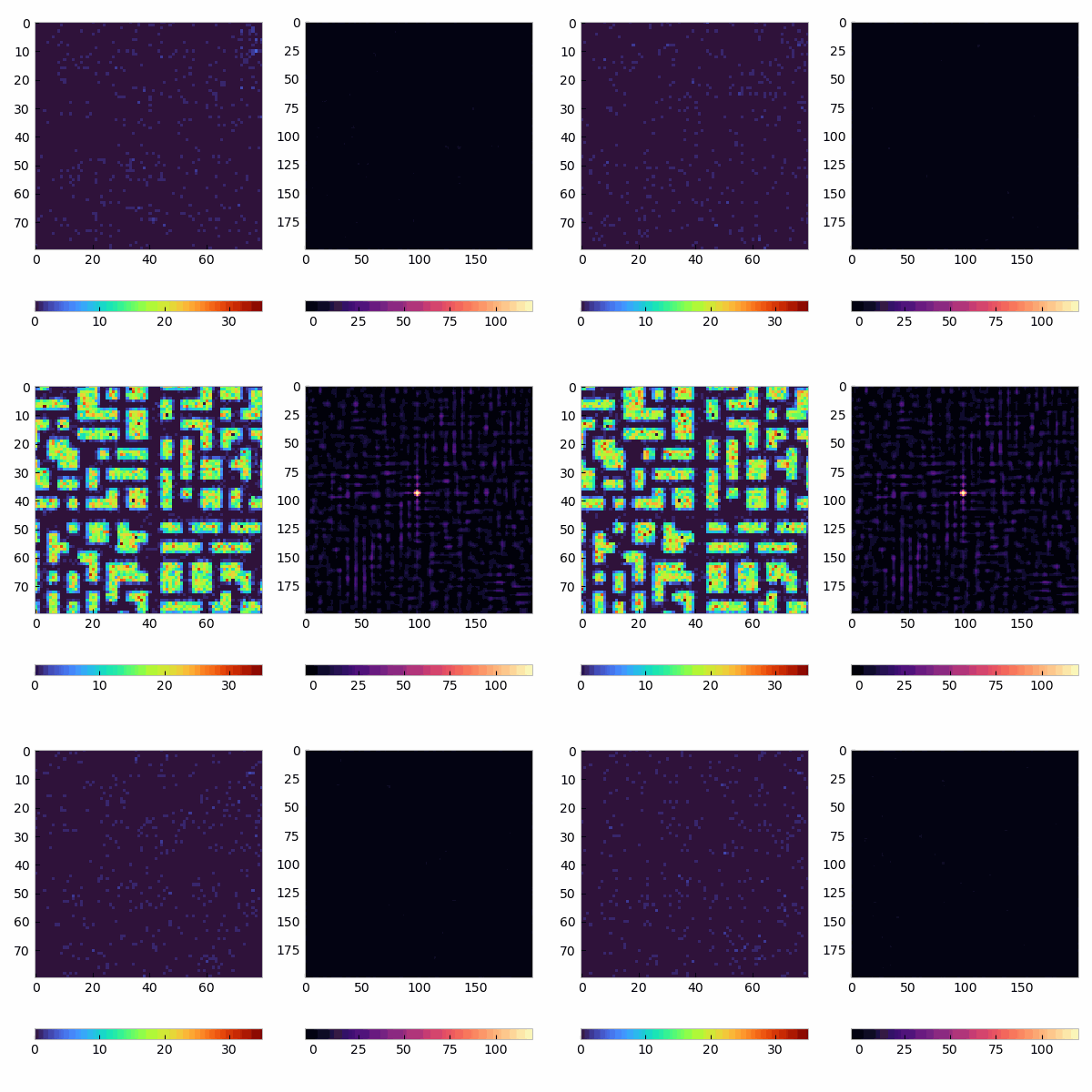
Two of the instruments on board SVOM are French. The ECLAIRs telescope can detect and locate the position of gamma-ray bursts in the X-ray and low-energy gamma-ray bands (from 4 to 150 kiloelectronvolts – keV), while the Microchannel X-ray Telescope (MXT) detects gamma-ray bursts in the soft X-ray range (from 0.2 to 10 keV).
Some ten CNRS laboratories based in five French cities (Paris, Marseille, Toulouse, Montpellier and Strasbourg) were involved in the development of the two instruments. Among them, the APC astroparticle and cosmology laboratory3 in Paris played a key role by developing a crucial component of ECLAIRs, namely the coded mask.
"This unique component, which took twelve years to develop, can detect and locate low-energy sources (down to 4 keV, as compared to 15 keV previously). This makes ECLAIRs the first gamma-ray-telescope able to observe these low energies over a wide field of view," explains Cyril Lachaud, who heads SVOM at the APC. Specifically, "it is a 0.6 mm-thick metal plate made of tantalum, perforated with holes, which absorbs X-rays and gamma rays. When a gamma-ray source illuminates the device, the photons pass only through the openings in the mask and cast a coded shadow onto the detection plane. This shadow is then used to trace the direction of the source."
Other instruments
The other two instruments on SVOM are of Chinese design. These are the Gamma Ray Burst Monitor (GRM), which measures the spectrum of high-energy gamma-ray bursts (from 15 keV to 5000 keV), and the Visible Telescope (VT), which operates in the visible range.
The mission also relies on ground-based instruments designed to supplement observations from space: the Ground Wide Angle Cameras (GWAC) array, and the Ground Follow-up Telescopes (GFT) robotic telescopes, including the French-Mexican GFT Colibrí, which CNRS laboratories contributed to build.


Exceptional performance
In practice, once a gamma-ray burst has been detected and its position pinpointed by the ECLAIRs telescope, an alert causes the SVOM satellite to align itself in the direction of the burst, and triggers follow-up observations by the MXT and VT telescopes as well as by ground-based instruments. The data is then transmitted in real time to the mission control centre, which can then issue an alert to major observatories around the world, such as the VLT in Chile, or the GTC in the Canary Islands. Analysis of the burst can then begin.
So far, "SVOM has performed exceptionally well, at every stage of the observation chain, from its on-board instruments to ground-based telescopes and the coordination of its teams," Vergani points out.
Between April 2025 and the end of April 2026, the mission demonstrated its full potential by detecting more than 280 gamma-ray bursts, 17% of which were short. In addition, it was possible to measure the distance to almost 50% of the bursts spotted by ECLAIRs, as compared to under 30% prior to SVOM. This is a significant result, as "knowing the distance makes it possible to determine the true energy of these events and therefore characterise them more precisely", Vergani explains.


The most distant supernova ever detected
Among the trophies on SVOM's tally, one stands out – the GRB 250314A burst, detected on 14 March, 2025, hence its code name. The James Webb Space Telescope (JWST) showed that it was associated with a supernova, in other words, a cataclysmic stellar explosion marking the end of a star's life, releasing an incredibly powerful flash of light.
This event occurred 13.1 billion years ago, in the very infancy of the Universe, when it was less than 700 million years old. Its light passed through the first galaxies, and travelled across the expanding Universe for billions of years, before eventually reaching ECLAIRs. "This gamma-ray burst enabled us to catch sight of the most distant supernova ever observed," Vergani points out.
But that's not all: SVOM also witnessed a spectacular event, reported in early 20264: a thermonuclear explosion on the surface of a neutron star. On 10 January, 2025, the ECLAIRs instrument spotted a thermonuclear X-ray burst from a source named 4U 0614+091, a binary system formed by a neutron star and a companion star, located around 10,000 light-years from Earth.
Since the two bodies are very close to each other, the neutron star's intense gravitational field causes matter from the companion star to gradually accumulate on the neutron star's surface. When this material becomes hot and dense enough, it ignites, triggering a thermonuclear explosion that can be observed for a few tens of seconds in the form of an intense burst of X-rays. Since then, SVOM has recorded more than 150 other thermonuclear explosions of this type.



Beyond gamma-ray bursts
"These observations demonstrate SVOM's ability to study not only gamma-ray bursts, but also other violent events, especially in our own Galaxy," comments Alexis Coleiro, a researcher at the APC laboratory and head of SVOM's ‘Observatory Science’ programme, which focuses on science unrelated to gamma-ray bursts.
"The high-energy sky is a kind of Christmas tree," Coleiro explains, "with a multitude of constantly flashing energy sources. These can be gamma-ray bursts, but also other phenomena associated with compact objects, such as black holes and neutron stars. And, due to its wide field of view, the ECLAIRs instrument can also see these other sources."
In all, by the end of March 2026, SVOM had already led to the publication of four papers on gamma-ray bursts and another four on observatory science. More than 40 others are due to be released in the coming months, as well as an entire special issue of the scientific journal Research in Astronomy and Astrophysics dedicated to the mission and its initial scientific findings.
SVOM is expected to continue for at least another two years and could be extended for as much as a decade. Its scientific harvest is only just getting under way!
- 1. Stands for "Space-based multi-band astronomical Variable Objects Monitor".
- 2. CNRS / Observatoire de Paris-PSL / Sorbonne Université.
- 3. Laboratoire Astroparticule et Cosmologie (CNRS / Université Paris-Cité).
- 4. S. Le Stum, et al, "Detection of Oscillations in a Type I X-Ray Burst of 4U 0614+091 with SVOM/ECLAIRs", The Astrophysical Journal Letters, 2026: https://doi.org/10.3847/2041-8213/ae3174
Explore more



Author
A freelance science journalist for ten years, Kheira Bettayeb specializes in the fields of medicine, biology, neuroscience, zoology, astronomy, physics and technology. She writes primarily for prominent national (France) magazines.