

You are here
astrophysics
Article
06.29.2026

In April, the researchers involved in the French-Chinese SVOM space mission presented an update on its initial findings. These provided a number of interesting insights into events that took place in...
Article
11.03.2025

On 14 September, 2015, the international LIGO/Virgo collaboration detected the very first gravitational wave signal, a tiny distortion of spacetime predicted by Einstein, in this case produced by the...
Article
10.09.2025

Why is the outermost part of the Sun's atmosphere, the corona, so much hotter than its surface? Ten years after formulating a hypothesis based on a numerical model, CNRS researchers have now...
Article
02.06.2025
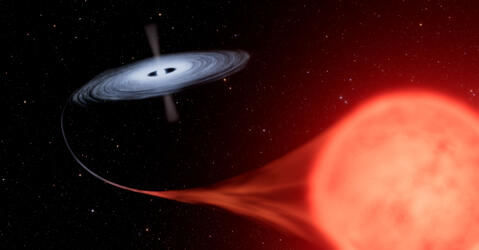
White dwarfs are the extremely dense, compact remnants of stars that have ended their lives, and are at the origin of tremendous explosions known as novae. This phenomenon (not to be confused with...
01.29.2025
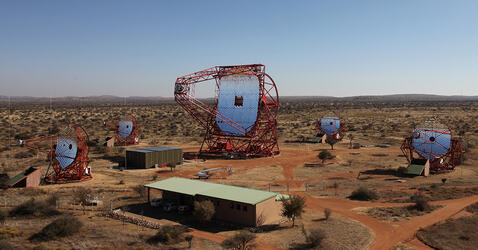
Based in Namibia, the H.E.S.S. telescope array monitors the showers of particles produced when the highest-energy cosmic rays ever observed in the Universe impact the Earth's atmosphere.
Article
12.04.2024
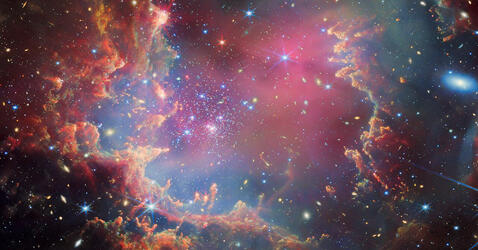
A genuine technological gem, the James Webb Space Telescope has been exploring the smallest nooks of the Universe over the last two years. From the birth of planets and the first galaxies to the...