

You are here
Supernova
Article
06.29.2026

In April, the researchers involved in the French-Chinese SVOM space mission presented an update on its initial findings. These provided a number of interesting insights into events that took place in...
Article
11.03.2025

On 14 September, 2015, the international LIGO/Virgo collaboration detected the very first gravitational wave signal, a tiny distortion of spacetime predicted by Einstein, in this case produced by the...
01.29.2025
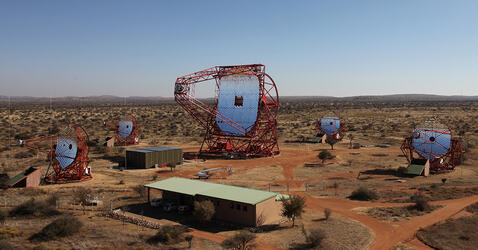
Based in Namibia, the H.E.S.S. telescope array monitors the showers of particles produced when the highest-energy cosmic rays ever observed in the Universe impact the Earth's atmosphere.
03.13.2024
As opposed to black holes, white holes are thought to eject matter and light while never absorbing any. Detecting these as yet hypothetical objects could not only provide evidence of quantum gravity...
Article
10.30.2022
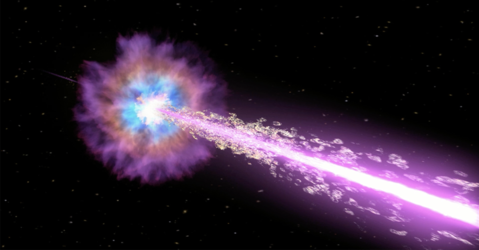
The astrophysicist Jean-Luc Atteia explains why the exceptional gamma-ray burst detected in early October could dramatically change what we know about supernovae and black holes.
Article
05.09.2022
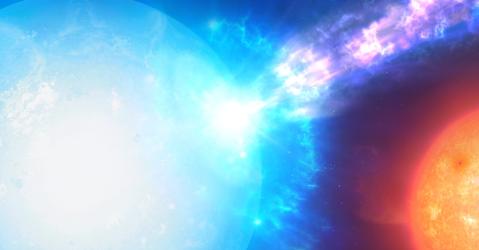
Based on observations by the European Southern Observatory's Very Large Telescope, a team of astronomers has discovered a new type of stellar explosion. A million times less powerful than novae...