
You are here
1905: Einstein initiates the quantum age

Why is 1905 referred to as Einstein’s ‘miraculous year’?
Christian Bracco1: The year was named retrospectively, as Einstein signed four articles in the prestigious journal Annalen der Physik that are today considered foundational for modern physics, in addition to his thesis on a new determination of molecular dimensions. One of these articles was entitled ‘On a Heuristic Point of View about the Creation and Transformation of Light’ (in which Einstein introduced the idea that light is made up of quanta whose energy depends on the frequency), which is seen as the beginnings of quantum mechanics. There was also the paper on the random motion of particles in a fluid (known as ‘Brownian motion’), that on special relativity, and finally the one that established the famous equation E = mc², on the inertia of energy (based on variations). At first, it was difficult to imagine that this series of contributions came in the same year from someone who was on the margins of the institutional world of science.
Who was Einstein in 1905?
C.B. He of course was not yet the internationally renowned scientist that he would become after the First World War, when his general theory of relativity was confirmed by Arthur Eddington’s observations on the deflection of light by the Sun (1919), leading to media representations of him as the new Newton. In 1905, at the age of 26, Einstein was a technical expert 3rd class at the Patent and Intellectual Property Office in Bern (Switzerland). He earned a degree from the Federal Polytechnic School in Zurich (also in Switzerland) in 1900, but did not secure a position as assistant.2


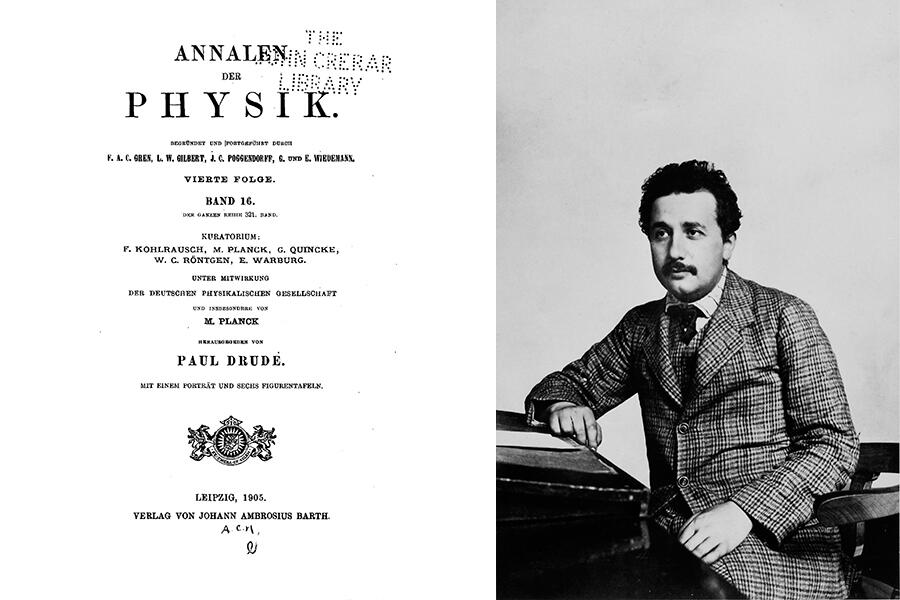
He nevertheless began a first thesis on molecular forces, but eventually abandoned it, probably because he was at a scientific dead end. He continued his research on Ludwig Boltzmann’s thermodynamic theory, and in 1904 published an article on energy fluctuation in Annalen der Physik. Reading between the lines of this article, it seems clear that Einstein already had the idea of what will later become photons.
What is the origin behind this idea of light quanta?
C.B. The difficulty for the historian is that Einstein did not leave traces of his drafts or thoughts from the time, aside from the letters he wrote to Mileva Marić, whom he met at the Federal Polytechnic School in Zurich and married in 1903, or to his great friend Michele Besso.
Via the latter, we know that as early as 1895, Einstein was interested, among other things, in 17th-century debates on the nature of light: Newton thought it consisted of corpuscles, while Christian Huygens argued it was made of waves. In the late 19th century, the wave nature of light was accepted. Yet it seems that Einstein kept Newton’s idea in mind, possibly because the atomic theory of matter was advancing, and it was also then that the electron was discovered.
An important source for Einstein’s article on quanta was Max Planck’s work on black-body radiation.3 What precisely did it involve?
C.B. In the late 19th century, it was known that matter emitted radiation, whose characteristics in the case of a so-called ‘black’ body depend exclusively on temperature. The typical example is the inside of an oven as it heats up: it must be possible to calculate how the radiation energy spreads, based on its wavelength. Yet physicists had not found the formula that functions for all wavelengths, and that matches experimental results.


In October 1900, Planck proposed a general law, and in December an explanation, doing so for the first time by introducing quanta, which is to say energy packets that are discrete, in the mathematical sense of the term. It is worth noting, however, that he did not think that light itself was made discrete, as Einstein did. Light still acts like a wave, but the inside of the oven is seen as a series of small antennae (Hertzian ‘resonators’) over which light energy spreads via energy packets. In April 1901, Einstein wrote to Marić that he was struggling to make the resonator hypothesis his own. In May, he read Philipp Lenard’s article on the photoelectric effect.
What does the photoelectric effect consist of?
C.B. Physicists have observed that by lighting a metal cathode, they could create an electric current. Through his experiments conducted in a vacuum, which were published in 1900, Lenard irrefutably showed that electrons are dislodged from the metal when the light frequency exceeds a certain threshold, which depends on the material. In a May 1901 letter to Marić, Einstein was thrilled by this interpretation. He had probably understood that this evidenced something he was thinking about.
Indeed, the photoelectric effect calls the wave theory of light into question, for if the source is moved further away, the wave’s energy should be too weak to dislodge electrons. On the contrary, if light arrives in packets whose energy depends on the frequency, then one can deduce it communicates its energy to electrons, thereby producing a current above a certain threshold (corresponding to the extraction of electrons from the metal). However, nobody thought of this in 1901, except for Einstein, who had original ideas, and established links between the research of the various authors he was studying.
How was Einstein’s 1905 article on quanta received by the scientific community?
C.B. In the article Einstein reasons by analogy between black-body radiation and a perfect gas described by Boltzmann, showing that light seemingly consists of a particle gas whose energy is proportional to the frequency. The photoelectric effect is an application for which Einstein formulated a prediction. He did not interpret the complete law previously found by Planck, but only an approximation valid for short wavelengths (Wien’s law of 1896).
He knew his hypothesis was revolutionary. Numerous scientists, including Planck, did not accept light quanta at the time. However, in 1913 Niels Bohr used them for his model, which describes the electrons on stable orbits around an atom. These electrons make energy jumps by absorbing and emitting quanta of light. Known as ‘quantified’ levels of energy, the model can be used to determine the experimental values of emission rays for hydrogen atoms. This was one of the first important results of the emerging field of quantum physics.


Then in 1916, Robert Millikan’s experiments on the photoelectric effect confirmed the law proposed by Einstein. In 1923, Arthur Compton showed that light quanta indeed carry a quantity of motion that they can transmit to matter. They become particles in their own right, which are today referred to as ‘photons’.
Einstein received the 1922 Nobel Prize in Physics ‘for his services to Theoretical Physics, and especially for his discovery of the law of the photoelectric effect’.
Did Einstein make other contributions to quantum mechanics?
C.B. Yes. In 1916, Einstein used quanta to introduce the stimulated emission effect – when a photon with sufficient energy interacts with an excited atom, the latter emits a rigorously identical photon in the same direction. Fifty years later, this effect would serve as the basis for how lasers function.


In 1924, Bose-Einstein statistics made it possible to describe the state of bosons, the particle family that includes photons. It predicted that at low temperature, atoms behaving like bosons can all end up in the same state. These ‘Bose-Einstein condensates’ are now observed in laboratories, and represent a purely quantum state of matter.
Einstein seems to have moved away from quantum mechanics afterwards. Why?
C.B. He had already turned to other subjects, such as general relativity. He did not directly participate in developing this quantum mechanics, whose centenary we are celebrating this year. This was the work of scientists such as Born, Heisenberg, Jordan, Schrödinger, and Dirac, all of whom had a highly mathematical approach that Einstein found unsatisfying.
Without challenging their results, he criticised them on the grounds that quantum mechanics remained incomplete. For example, in 1935 he contributed to an article showing that in certain two-particle systems, quantum mechanics made it such that measuring one particle instantly affected the property of the other, apparently contradicting the finite nature of the speed of propagation of information. This is the Einstein-Podolsky-Rosen (EPR) paradox, today known as ‘entanglement’, as shown by experiments including that of Alain Aspect (co-winner of the 2022 Nobel Prize in Physics).
Even while criticising the development of quantum physics, Einstein helped give rise to a new concept central to current research on quantum technology. ♦
Further reading
Solace of quantum
Cryptography faces the threat of quantum technology
- 1. Senior Lecturer at the Université Côte d’Azur, researcher at the LTE laboratory (CNRS / Observatoire de Paris-PSL / Sorbonne Université), and author of "When Albert Became Einstein" (EDP Sciences, April 2024).
- 2. On the years 1895-1902, see also doi.org/10.4081/scie.2018.663
- 3. Black body: body that absorbs all of the electromagnetic energy it receives.
Explore more