

You are here
Black holes
Article
01.16.2026

One hundred years after the death of the French astronomer and populariser of science Camille Flammarion, the CNRS physicist Jean-Philippe Uzan follows in the footsteps of his predecessor’s...
Article
11.03.2025

On 14 September, 2015, the international LIGO/Virgo collaboration detected the very first gravitational wave signal, a tiny distortion of spacetime predicted by Einstein, in this case produced by the...
Article
09.12.2025

With large-scale observation campaigns, innovative data analysis methods and theoretical advances on all fronts, astrophysics and cosmology are entering a high-precision era with the potential to...
01.29.2025
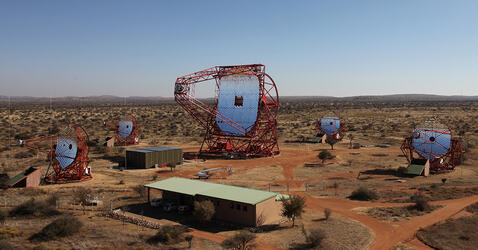
Based in Namibia, the H.E.S.S. telescope array monitors the showers of particles produced when the highest-energy cosmic rays ever observed in the Universe impact the Earth's atmosphere.
03.13.2024
As opposed to black holes, white holes are thought to eject matter and light while never absorbing any. Detecting these as yet hypothetical objects could not only provide evidence of quantum gravity...
Article
10.26.2021
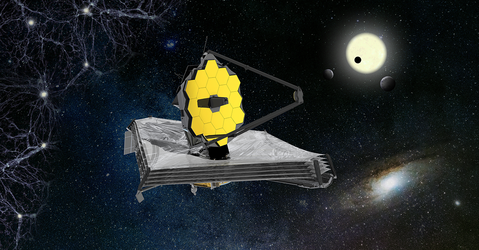
After a series of delays, the James Webb Space Telescope is at last scheduled for launch on 25 December. Its instruments have been designed to observe the most distant objects in the Universe.