

You are here
Space

In April, the researchers involved in the French-Chinese SVOM space mission presented an update on its initial findings. These provided a number of interesting insights into events that took place in the very earliest days of the Universe. CNRS News takes a...
Article
06.29.2026

The Ramses mission to asteroid Apophis is set to launch in 2028. It forms the cornerstone of a planetary defence programme designed to protect our planet from the risk of collision with near-Earth objects.
Article
04.23.2026

One hundred years after the death of the French astronomer and populariser of science Camille Flammarion, the CNRS physicist Jean-Philippe Uzan follows in the footsteps of his predecessor’s celebrated book Popular Astronomy, providing us with an accessible...
Article
01.16.2026

On 14 September, 2015, the international LIGO/Virgo collaboration detected the very first gravitational wave signal, a tiny distortion of spacetime predicted by Einstein, in this case produced by the merger of two black holes. The CNRS astrophysicist Marie-...
Article
11.03.2025
Article
02.12.2024
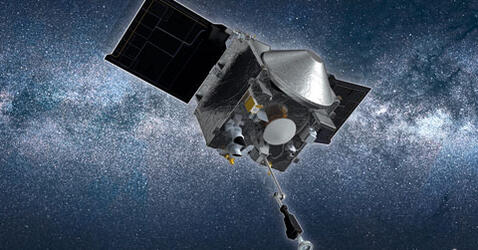
On 24 September, 2023, material collected three years earlier from the surface of asteroid Bennu was successfully returned to Earth by the OSIRIS-REx mission. Some thirty laboratories around the...
10.17.2023
How do planets form? How did life emerge from lifeless matter? Does it exist elsewhere? These are just some of the questions that the multidisciplinary Origins programme will attempt to answer.
09.15.2023
Following the disappointing results from other candidates for explaining dark matter, a particle hypothesised over 40 years ago, the axion, has come back to the forefront.