

You are here
Space

In April, the researchers involved in the French-Chinese SVOM space mission presented an update on its initial findings. These provided a number of interesting insights into events that took place in the very earliest days of the Universe. CNRS News takes a...
Article
06.29.2026

The Ramses mission to asteroid Apophis is set to launch in 2028. It forms the cornerstone of a planetary defence programme designed to protect our planet from the risk of collision with near-Earth objects.
Article
04.23.2026

One hundred years after the death of the French astronomer and populariser of science Camille Flammarion, the CNRS physicist Jean-Philippe Uzan follows in the footsteps of his predecessor’s celebrated book Popular Astronomy, providing us with an accessible...
Article
01.16.2026

On 14 September, 2015, the international LIGO/Virgo collaboration detected the very first gravitational wave signal, a tiny distortion of spacetime predicted by Einstein, in this case produced by the merger of two black holes. The CNRS astrophysicist Marie-...
Article
11.03.2025
Article
07.21.2023

Blind since her teenage years, Wanda Diaz-Merced has developed a technique called “sonification” to convert astrophysical signals into sounds. Building on the success of this impressive tool for...
06.08.2023
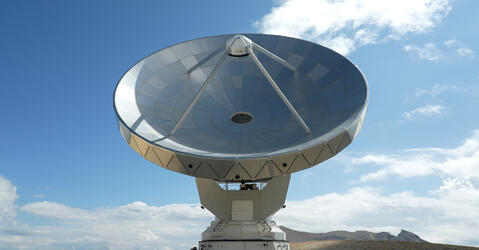
Located at an altitude of 2,500 metres on the Bure plateau in the Alps, the Noema international observatory is the most powerful radio telescope in the northern hemisphere. Thanks to the data...
Article
04.24.2023
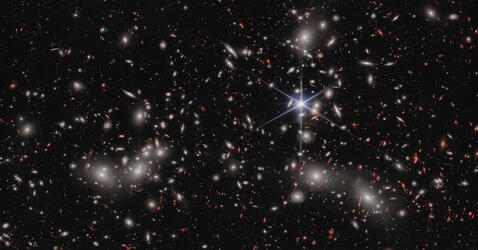
Two separate measurements of the Hubble constant, a parameter that describes the expansion rate of the Universe, have yielded conflicting results. The discrepancy could lead to the overthrow of the...