

You are here
Science one step ahead
Climate change, pandemics, digital revolution… The factors having a lasting impact on our societies are plentiful. Does this transform our future into an unreadable horizon? Not quite. Scientists at research institutes are trying to anticipate the consequences of these disruptions, with one tool garnering broad support in the effort: foresight.
“It is an entirely different exercise to forecasting, with which it is often confused,” points out Franck Lecocq, an academic at the CIRED centre for international research on environment and development1. Forecasting focuses on the short term, similar to what can be done in meteorology, for example. Foresight, on the other hand, projects over longer periods of time, and often explores multiple possible scenarios.
Avoiding to “run after a moving train”
“It is, in fact, an analytical tool that helps us anticipate the future with the data we have available. Foresight enables us to build a strategy so we do not have to run after a moving train,” explains Catherine Dargemont, head of the CNRS’s Impact Mission2, which reports to the organisation’s presidency.
Scientific foresight is most often based on digital models. “For instance, it involves developing a framework that represents a structure such as the Paris urban area, and then adding multiple dynamic elements, including evolution in urban development. By coupling this data with climate projections, you can obtain different possible scenarios for changes to living conditions in Paris in 2050,” Lecocq explains.



Transcribing a form of reality
In the business world, such foresight models are sometimes very useful, reveals Josselin Thuilliez, research professor at the Centre for Research in Economics and Management (CREM)3: “Most often we build standards based on behavioural equations that aim to transcribe a certain reality.”
To this end, Thuilliez uses models that seek to replicate the results found in research data. His teams, along with those from the Aix-Marseille School of Economics (AMSE)4 and Bocconi University in Milan (Italy), recently established a pattern exploring the effects of lockdowns (during the Covid pandemic) on mobility, mental health, and citizen confidence in public policy.
“If the data from our model correlates well with reality, we can begin to develop various scenarios that address public policy issues,” the economist indicates.
Providing recommendations
Far from the image of the scientist seeking to predict the future with certainty, “the idea is to explore a broad range of possible futures, whether they be desirable or not. In the latter case, foresight can help us reflect on strategies to avoid the darkest scenarios becoming reality", stresses Lecocq, who is also a coordinating lead author of the Sixth Assessment Report of the International Panel on Climate Change (IPCC), the organisation tasked with assessing the scope and consequences of climate change. This can in particular enlighten policy decisions.
“These models enable us for instance to provide recommendations regarding the balance between the cost of a measure and its effectiveness,” Thuilliez adds. “Policymakers can rely on our research, which is often available in free access, in order to have indicators.”
For all that, the purpose of foresight chiefly involves advancing science. “Our research essentially serves to improve knowledge on a precise topic, step by step,” Thuilliez observes.
Assessing the amount of uncertainty
Often conducted over the long term, this research is in general not particularly compatible with quick decision-making. Freeing oneself from constraints connected to the short term can nevertheless present a genuine advantage. “This opens interesting and new spaces for discussing policy. The co-construction of scenarios pools knowledge, and leads to a shared understanding of the issues,” Lecocq believes.

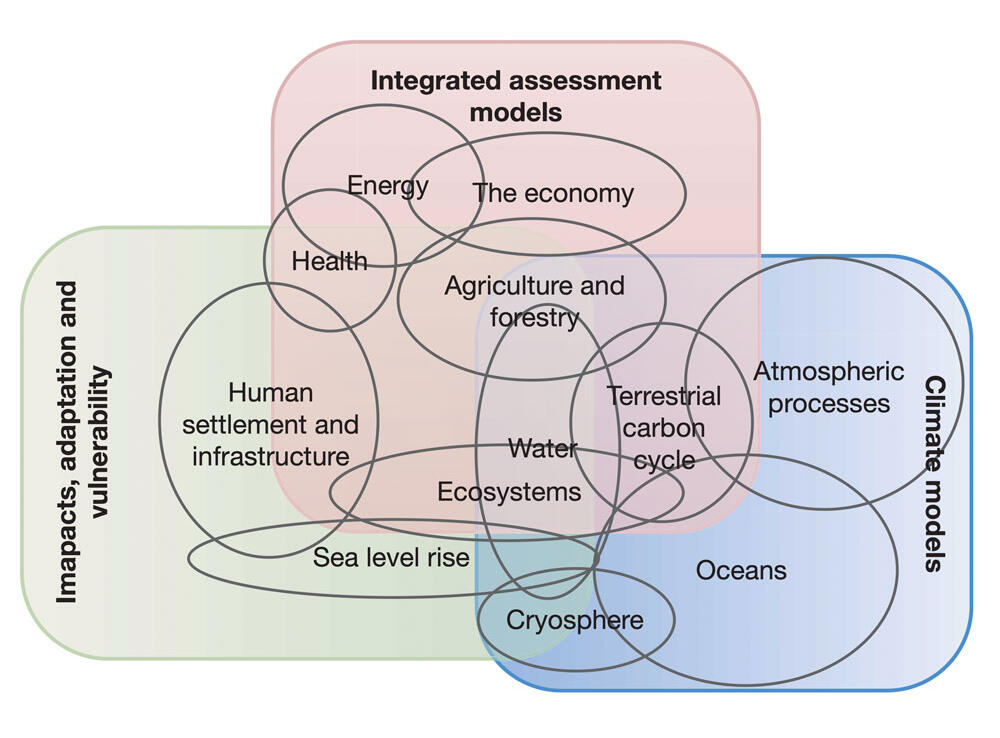
However, foresight faces a major challenge: how to assess the share of uncertainty hiding behind these models? “It is impossible to ascribe probabilities to different possible futures. In addition, parameters such as the evolution of technological progress, or the occurrence of disruptive events such as the Covid crisis, remain difficult to anticipate,” Lecocq concedes.
To reduce uncertainty, scientists have used numerous tests and scenarios to assess the robustness of their models. “To determine how our model reacts to various situations, we use what are known as ‘counterfactual’ setups,” Thuilliez explains. “This partially addresses uncertainty, as it gives answers to a very large number of different cases, which, as might be imagined, are practically infinite.”
Adopting transdisciplinary perspectives
Some mathematical models, such as game theory (based on decisions made simultaneously by different individuals), are sometimes used in foresight. When scientists lack data, they can also use generic models. “When the coronavirus crisis broke out,” Thuilliez notes, “epidemiologists initially used simplified frameworks derived from available evidence and the evolution of other respiratory diseases of the same type. But afterwards the models were calibrated in real time, as we learned more about this emerging virus.”
In order to remain relevant, “foresight must also adopt comparative and transdisciplinary views”, points out Dargemont. “When we work on a more specific field, we tend to not consider data and parameters outside our area of study. To counter this bias, we must engage in collective thinking and writing. Foresight must not be the work of a small group of individuals, it should be genuinely collegial in nature.”
Foresight modelling is “a tool that promotes dialogue between what looks like very different disciplines”, Lecocq rejoyces. “As an economist, this exercise leads me to work with epidemiologists and psychologists, for example,” Thuilliez adds.
Vigilance is the watchword
Thuilliez nevertheless stresses that it is essential to explain the limits of these tools and make them clear: “We can test many things with these methods. But we must be vigilant, and avoid making them say what they do not say.” As for Lecocq, he deplores that “The scenarios established by the IPCC have sometimes been taken out of context, which can lead to serious misunderstandings.”
Finally, foresight is a specific approach with its own rules and codes. “It is an occupation in its own right,” he insists, adding that foresight analysis calls for substantial human resources: “It requires bringing a large number of specialists in various fields together within the same working group or structure, and doing so over a sufficiently long period of time.” An essential collective effort in more serenely preparing our future.
See also
Simulating and Modelling: Less is More
- 1. CNRS / AgroParisTech Paris-Saclay / CIRAD / École des Ponts.
- 2. See: https://tinyurl.com/cnrs-impact
- 3. CNRS / Université de Caen Normandie / Université de Rennes.
- 4. CNRS / Aix-Marseille Université.
Explore more