

You are here
Space

In April, the researchers involved in the French-Chinese SVOM space mission presented an update on its initial findings. These provided a number of interesting insights into events that took place in the very earliest days of the Universe. CNRS News takes a...
Article
06.29.2026

The Ramses mission to asteroid Apophis is set to launch in 2028. It forms the cornerstone of a planetary defence programme designed to protect our planet from the risk of collision with near-Earth objects.
Article
04.23.2026

One hundred years after the death of the French astronomer and populariser of science Camille Flammarion, the CNRS physicist Jean-Philippe Uzan follows in the footsteps of his predecessor’s celebrated book Popular Astronomy, providing us with an accessible...
Article
01.16.2026

On 14 September, 2015, the international LIGO/Virgo collaboration detected the very first gravitational wave signal, a tiny distortion of spacetime predicted by Einstein, in this case produced by the merger of two black holes. The CNRS astrophysicist Marie-...
Article
11.03.2025
10.16.2024

Interview with the linguist Frédéric Landragin, who recently published a short guide on interstellar communication.
Article
08.30.2024
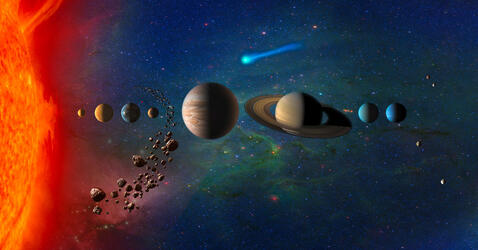
For nearly ten years, astronomers have been trying to demonstrate the existence of a massive object thought to be orbiting in the outer reaches of the Solar System. Although the hypothesis is widely...
Slideshow
07.12.2024
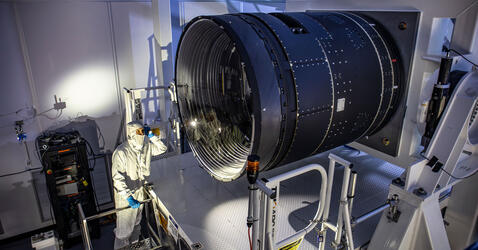
It took hundreds of scientists worldwide, including several CNRS teams, to produce the world’s largest digital camera, the LSST (Legacy Survey of Space and Time), which has finally arrived in Chile....