

You are here
Seeing life in purple
07.17.2025, by
The early 20th-century artist Robert Delaunay began painting at a pivotal moment in art history, namely during the chemical industry revolution, when the number of pigments available on the market increased. Today scientists are trying to solve the mystery of the painter’s colours, his purples in particular. One of the objectives of this research is to generate knowledge essential to conserving the works.

1
Slideshow mode
This self-portrait (partial view) of Robert Delaunay, painted during the winter of 1905-1906, is conserved at the Pompidou Centre in Paris. Take careful note, this is a “collage”: at left, what visitors can see in the museum in natural light; at right, what scientists observe using ultraviolet radiation. The instruments employed are non-invasive, and reveal chemical contrasts and colour nuances invisible to the naked eye.
Cyril Frésillon / PPSM / IPANEMA / CNRS Images

2
Slideshow mode
Two cultural heritage chemists install a fairly unusual camera: a multispectral imager of photoluminosity. Mathieu Thoury (IPANEMA European photonic institute for non-destructive analysis of ancient materials – CNRS / MNHM / Ministère de la Culture / UVSQ) and Victor Gonzalez (PPSM supamolecular and macromolecular photophysics and photochemistry laboratory – CNRS / ENS Paris-Saclay) used this instrument to expose the painting to light of different wavelengths, ranging from ultraviolet to infrared. The camera captures a luminescence image for each one, revealing a diversity of materials that are otherwise imperceptible.
Cyril Frésillon / PPSM / IPANEMA / CNRS Images
3
Slideshow mode
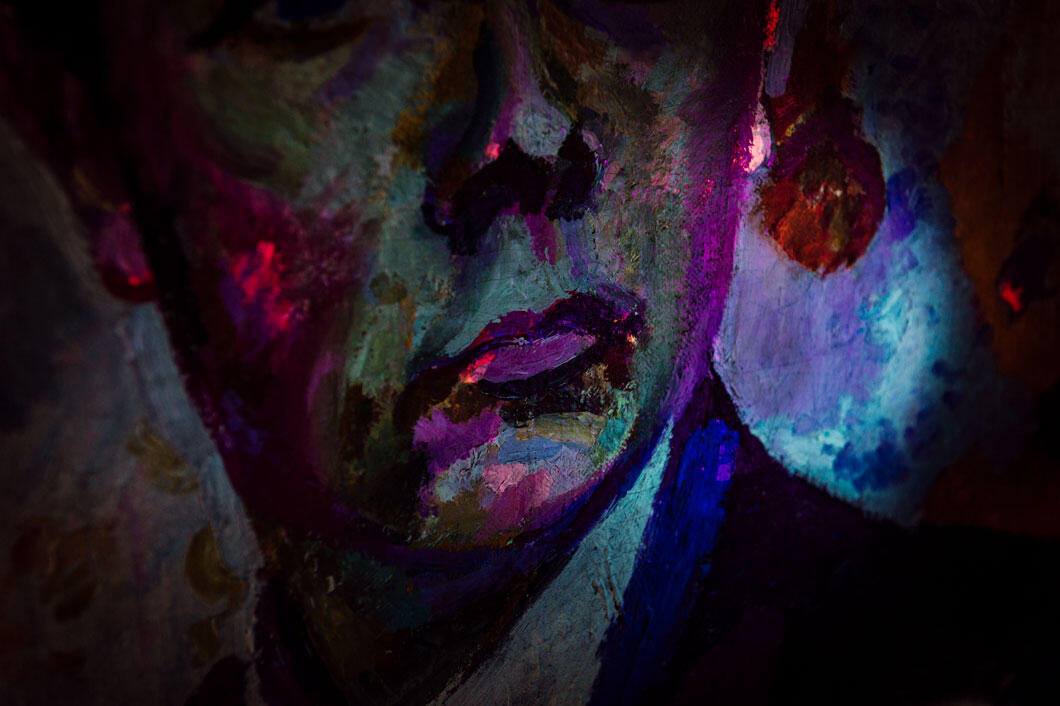
The purple widely used by Delaunay is of special interest to the scientists. In the early 20th century, advances in chemistry expanded the chromatic range available to painters, thanks to the creation of dozens of new pigments.
Cyril Frésillon / PPSM / IPANEMA / CNRS Images

4
Slideshow mode
Hours of analysis are needed to image the entire painting for each wavelength. This did not deter the scientists from scrutinising two other works also conserved at the Pompidou Centre.
Cyril Frésillon / PPSM / IPANEMA / CNRS Images

5
Slideshow mode
To find out more about the structure of the pigments found in Delaunay’s works, the researchers visited the European Synchrotron Radiation Facility (ESRF) in Grenoble (southeastern France). With the help of this particle accelerator, the chemist Victor Gonzalez will continue his study of the French painter’s colour palette.
Cyril Frésillon / PPSM / ESRF / CNRS Images

6
Slideshow mode
Gonzalez fills a thin glass tube with a mauve pigment made of cobalt synthesised in the laboratory (at left), and then seals it using a torch. The goal is to compare the chemical signature of these model materials with those used by Delaunay.
Cyril Frésillon / PPSM / ESRF / CNRS Images

7
Slideshow mode
Once the glass tube is installed in front of one of the synchrotron’s light sources (at left), it is bombarded with X-rays (at right), which allows for very close analysis of the crystalline structure of the pigments that it contains.
Cyril Frésillon / PPSM / ESRF / CNRS Images

8
Slideshow mode
The researchers revealed that Delaunay used multiple cobalt-based purple pigments thanks to experiments conducted on the French master’s works, for instance here with “Self-portrait” (winter 1905-1906) and “Landscape with Disk” (1906), two oil paintings on the same canvas, the first on the back, the second on the front (Pompidou Centre, donated by Sonia and Charles Delaunay). The “origin” of one of the two, which turned out to be a Roberson purple (named after the manufacturer from the time), was also identified. This is important information for the conservation and restoration of paintings at the Pompidou Centre.
Cyril Frésillon / PPSM / IPANEMA / CNRS Images
Explore more
Matter

Article
09/17/2026

Slideshow
02/25/2026

Article
10/27/2025

Article
07/07/2025

Article
03/26/2025
Chemistry

Article
11/15/2024
Video
03/18/2024

Video
07/20/2023

Article
04/24/2023
Slideshow
11/21/2022