You are here
Searching the Milky Way for bits of Mars

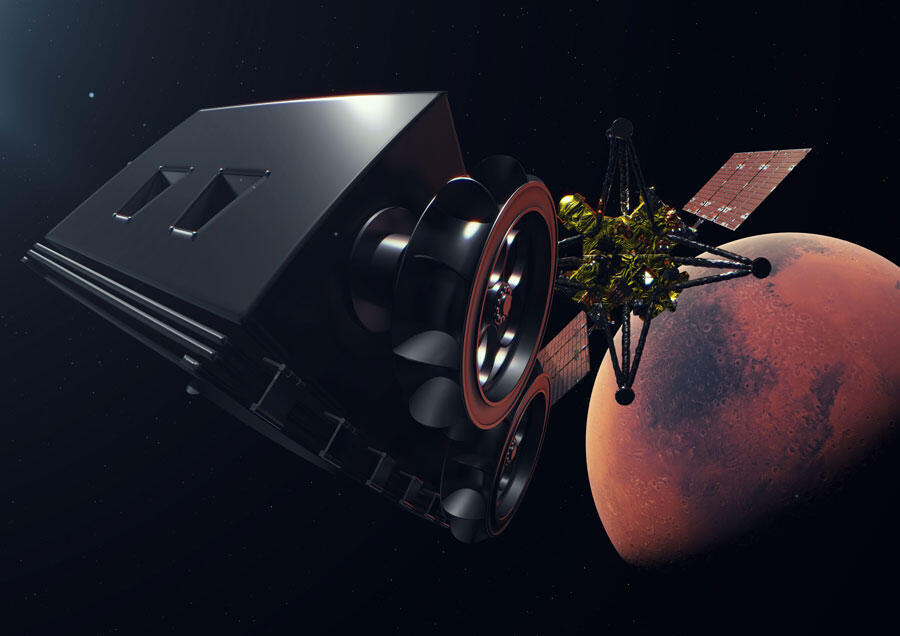
The MMX (Martian Moons eXploration) mission successfully launched on 19 October, 2026 from Tanegashima (an island in southern Japan) bound for Phobos, Mars's largest moon. It was mounted atop an H3 rocket, the heavy launcher developed by the Japan Aerospace Exploration Agency (JAXA). The payload of the mission is made up of a space probe and a mini-rover dubbed Idefix.
MMX is the result of close collaboration between JAXA and the French and German space agencies, CNES1 and DLR. The Japanese can draw on their expertise gained from collecting samples from asteroids with the Hayabusa probes, and intend to repeat this feat on Phobos, while France and Germany have designed several major scientific instruments, including the exploration rover Idefix.
But what's so interesting about Phobos? Until now, only a few measurements and photographs have been taken of this irregularly-shaped Martian moon, which is barely 26 km in diameter. Most missions prefer to head to the more intriguing planet Mars and its promises of water reserves and evidence of ancient life. Not to mention the failure of Russia's sample-return mission Phobos-Grunt, which crashed back to Earth a few weeks after its launch in 2012, possibly dampening enthusiasm.


Moons with mysterious origins
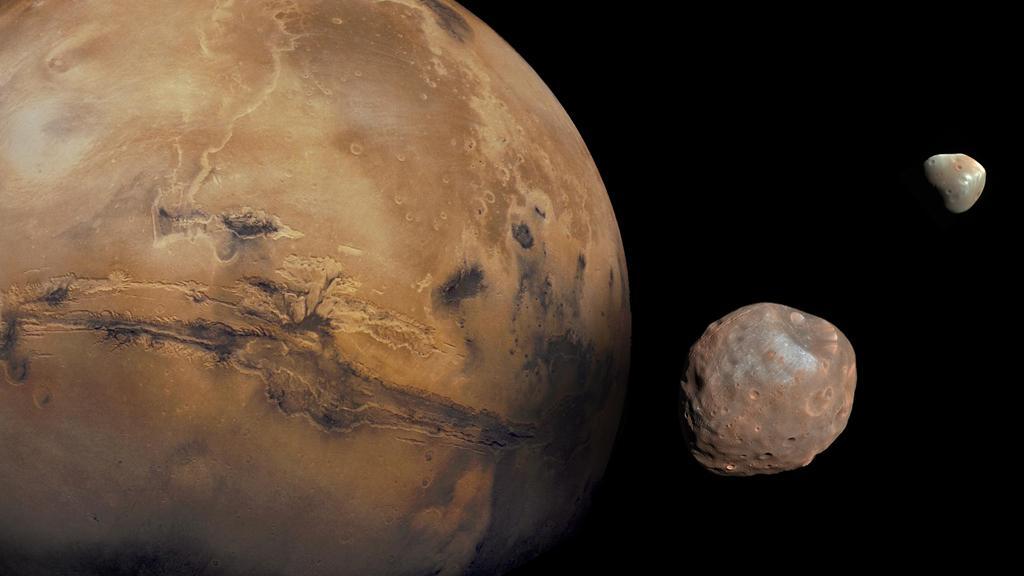
The reason Phobos continues to trigger scientists’ interest is that its origin remains a mystery, just like that of Deimos, Mars's other, smaller, and strangely similar moon.
"There are two theories," explains the astrophysicist Patrick Michel, CNRS senior researcher at the Côte d'Azur Observatory (OCA). "Phobos and Deimos resemble asteroids, and may therefore have been captured by Mars's gravitational pull. However, their trajectories appear rather odd. Another possibility therefore is that they are the result of a giant impact, although that is not what current observations of their composition suggest."
To obtain higher-quality data, a host of instruments on board MMX will examine Phobos from every angle, hopefully making it possible to determine which of the two scenarios is correct. "We will definitely be able to characterise the surface," says Maria-Antonietta Barucci, of the Paris Observatory2. "We will be in a position to tell if there's water, for example, which would suggest it's a captured asteroid. On the other hand, if we find materials that form at high temperatures, that would be evidence of an ancient impact, and therefore an indication that Phobos is a chunk torn off Mars."


Three years exploring the Mars system
Barucci was involved in the development of the MMX Infrared Spectrometer (MIRS) instrument. This imaging spectrometer captures data in the near infrared, and will be used to determine the composition of Phobos once the spacecraft arrives in its vicinity. "Over a period of three years it will scan the surface and tell us what chemical elements are present. It will also carry out observations during descents down to an altitude of 400 m, all of which will make it possible to choose the best landing site."
However, MIRS's role is not limited to these two tasks: in addition, it will perform a number of observations of Mars. The spacecraft's unusual equatorial orbit will enable it to monitor the storms that sweep across the Red Planet, whose clouds will also be closely scrutinised, as well as the way in which they vary over a period of several months.
"Some data will be sent directly back to Earth," Barucci adds, "while other information will be stored, ready to be analysed once the probe returns."
The odyssey of Idefix
Yet before the return journey comes the crucial part of the MMX mission, namely, landing on Phobos. This is a daunting task that will require the utmost care, starting with reconnaissance by MIRS, followed by the deployment of an important component of the mission, Idefix.
Developed by CNES and DLR, this small rover weighs a mere 23 kg and is not designed to travel over long distances. MMX will descend to around a hundred metres above Phobos before dropping Idefix onto the surface.

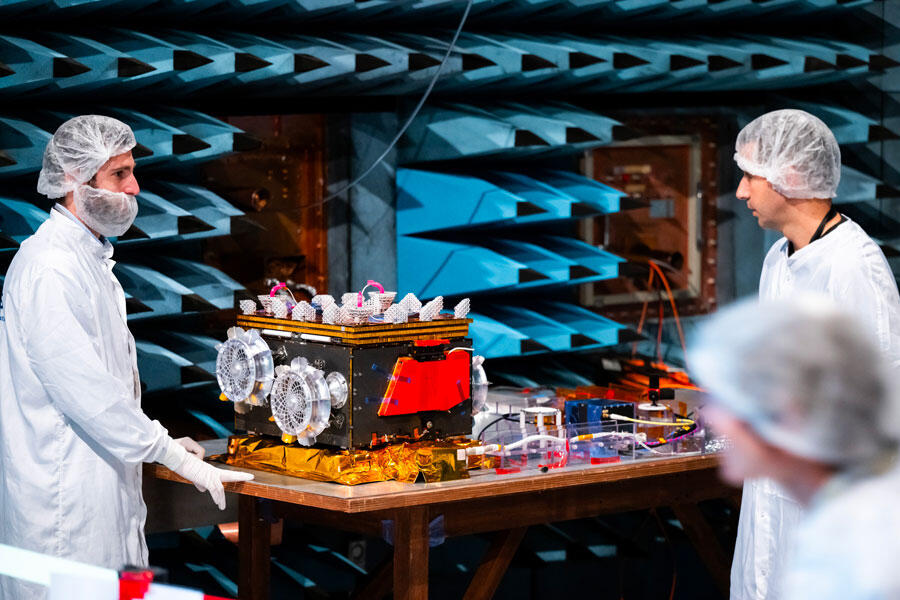
"It will act as a scout," Michel explains. "It will tell us what the surface is like, for instance whether the ground is hard or soft. This information is vital for a safe touchdown. Observation is important, but it is only by making direct contact that you can really predict how a landing will turn out."
The descent of Idefix nonetheless remains risky. On a body like Phobos, which is very small and has no atmosphere, there is always a possibility of failure since the manoeuvres are so complex. Fortunately, if things should go wrong, the mission could still go ahead even without the mini-rover.
First samples from the Mars system
If all goes to plan, Idefix will land on the surface and take a few measurements. MMX will then join it about six weeks later to proceed with the first sample collection. The landing will be slightly different from the one carried out by JAXA during the Hayabusa2 mission. The method used then involved a “touch and go” manoeuvre, in which the spacecraft landed on the asteroid Ryugu for just a few seconds and subsequently departed. This time, MMX will remain on Phobos for two or three hours, long enough to perform analyses, collect a few grams of rock, and return to orbit.
Unlike Idefix, which will be left behind, MMX's mission will not yet be over. Once the first samples are stored safely, the spacecraft will travel to the other side of Phobos, which does not face Mars. There, it will carry out a second collection, this time without the aid of the rover.
Michel explains the reasoning behind this strategy: "We want to make sure our samples are representative of Phobos as a whole, and that we haven't accidentally collected material from an area that is different from the rest. In addition, we believe that fragments from Mars may have ended up on just one of the moon's faces, which could prove to be of great interest scientifically."

Back to Earth in 2031
It is only after the second sample has been collected that MMX will bid a final farewell to Idefix and set off back to Earth, on the way making a close flyby of Deimos to take a few images. The return to our planet is scheduled for 2031, with a planned landing somewhere in the Australian desert, a sparsely populated area where it will be easy to collect samples without contaminating them. This is similar to the manoeuvre carried out when JAXA's Hayabusa2 mission brought back rocks from the asteroid Ryugu.
The mission is ambitious, and if everything goes according to plan, Europe will be the first to obtain samples from the Mars system, ahead of China and the US.
Besides the competitive aspect of the mission, these few grams of material could offer some clues to help unravel the mystery of the origin of Phobos and Deimos. "Above all, this will be an opportunity to broaden our understanding of the Mars system," Michel concludes. "For the moment, our simulations of the formation of our own Moon remain incomplete, so we have high hopes for the findings MMX may provide us with."
See also:
Investigating the origins of life
Heading for Jupiter
From popular astronomy to astrophysics
- 1. See: https://cnes.fr/en/projects/mmx
- 2. CNRS / Observatoire de Paris-PSL.
Explore more