
You are here
Rebel with a cause
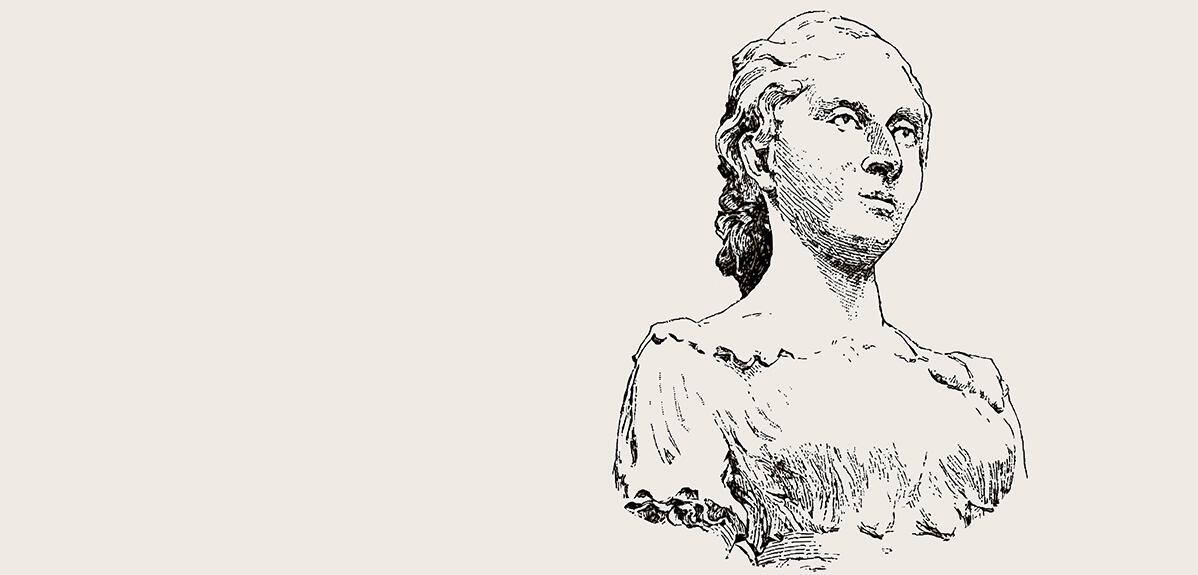
1 April 2026 marked the 250th anniversary of the birth of the mathematician Sophie Germain. “We know very little about her life, but we do know she had tremendous difficulty working and gaining recognition for her work,” relates Hervé Pajot, a professor at Université Grenoble Alpes1 and author of the comic book Les Audaces de Sophie Germain (“Sophie Germain, a bold mathematician” – in French). The young woman’s talent, which long remained unsung, will soon be consecrated: by 2027, her name will be engraved on the first floor of the Eiffel Tower, alongside those of 71 other female scientists.
Germain discovered mathematics in the midst of the French Revolution. Cloistered at home during the revolutionary events, she found refuge in the library of her father Ambroise-François Germain, a wealthy shopkeeper and representative of the Third Estate. She notably came across l’Histoire des mathématiques (“history of mathematics”) by the Frenchman Jean-Étienne Montucla; captivated by this narrative, she developed a passion for mathematics and began teaching herself.
Her parents were apparently concerned that one of their daughters was studying mathematics, and tried to stop her. “At the time people said it could make women lose their mind,” recounts Pajot. Faced with the young mathematician’s perseverance, her parents gave in and instead supported her efforts.
Mathematician with a pseudo
Unable to enrol at Polytechnique – a prestigious higher-education institution established in 1794 to train the nation’s engineers, and reserved for men (until 1972) – Germain managed to lay her hands on the courses taught there right from its inauguration. She did so by borrowing the name of Antoine Auguste Leblanc, a student who no longer attended classes.


As teaching was based on distance learning, students were encouraged to correspond with their professors, in order to share their comments or questions. “The professor of mathematics, Joseph-Louis Lagrange, observed that a certain Mr Leblanc solved problems very well. He asked to meet him, and instead came face to face with Sophie Germain,” Pajot adds. Lagrange was not offended by the young woman’s ruse, and on the contrary encouraged her efforts.
Four years later, Germain discovered number theory thanks to Adrien-Marie Legendre’s Essai sur la théorie des nombres (“essay on number theory”). This branch of mathematics, which studies whole numbers, emerged in the late eighteenth century. “Before the Disquisitiones arithmeticae by Carl Friedrich Gauss in 1801, arithmetic was not yet an organised branch of mathematics with a community studying well-defined problems,” explains Olivier Fouquet, professor at Université Marie et Louis Pasteur2.
When the book was published, Germain once again used her pseudonym to correspond with Gauss. The German mathematician shared his admiration when he discovered his correspondent’s true identity.
A solitary effort
Aside from this intermittent correspondence, Germain was very isolated. “She was hardly read in her day, and had little influence – because of sexism, but also because theory community was too small,” says Fouquet. To complicate matters, arithmetic enjoyed its initial glory during the 1820s, but in areas that the mathematician had not explored.
This did not deter her from trying to tackle one of the field’s most emblematic (and difficult) problems, Fermat’s Last Theorem. This formulation, made by Pierre de Fermat in the seventeenth century, remained a conjecture when she took an interest in it.
It involves a relation between three whole numbers. We know that there exist whole numbers x, y and z such that x²+y²=z². For example, 3 (9 squared), 4 (16 squared), and 5 (25 squared, or 9+16). Fermat wondered whether three whole numbers exist such that xn+yn=zn, where n is greater than 2. “The question involves the not uncommon cases in which none of the whole numbers is zero,” points out Fouquet. Fermat suspected that finding these x’s, y’s, and z’s was impossible.
Promising lead
When Germain discovered this topic, no mathematician had come up with an approach taking on all of the exponents (all of the n’s) at the same time. “Germain proposed a change in paradigm by introducing a concrete strategy to fully demonstrate the theorem,” Fouquet explains.

The mathematician’s idea was to construct “auxiliary prime numbers” associated with n (prime numbers linked to n and specifically chosen to help study the equation). She proved that the existence of an auxiliary prime number of n made it possible to demonstrate a weaker but nonetheless interesting version of the theorem. In addition, Fermat’s theorem is true if n has an infinite number of auxiliary prime numbers. “Her framework was credible. But she and Legendre realised that many whole numbers do not have unlimited auxiliary numbers,” explains Fouquet. We now know that no prime number has endless auxiliary prime numbers.
Germain’s work remained little-known for a long time, for she did not publish any arithmetic articles during her lifetime. It was only in the early twentieth century that the mathematician Leonard Eugene Dickson from the United States rediscovered her strategy, and adapted it to the new arithmetic formalism. Fermat’s theorem was finally proved by Andrew Wiles in 1994, using different methods.
His work nevertheless draws on “Sophie Germain’s prime numbers” – prime numbers p such that 2×p+1 is also a prime number. In this case, 2×p+1 is one of the auxiliaries of p. This category includes 5 for example, as it is a prime number, and (5x2)+1 equals 11, which is also a prime number.
A detour via analysis
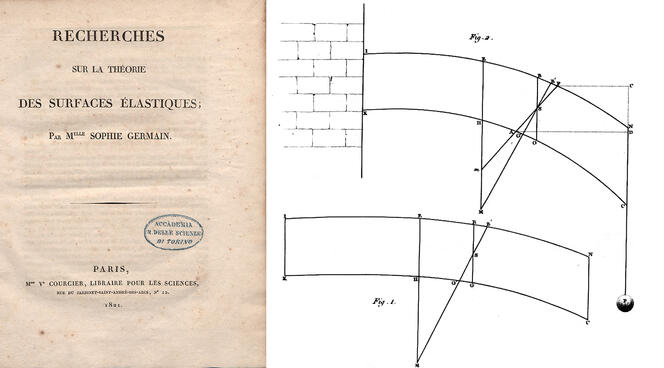
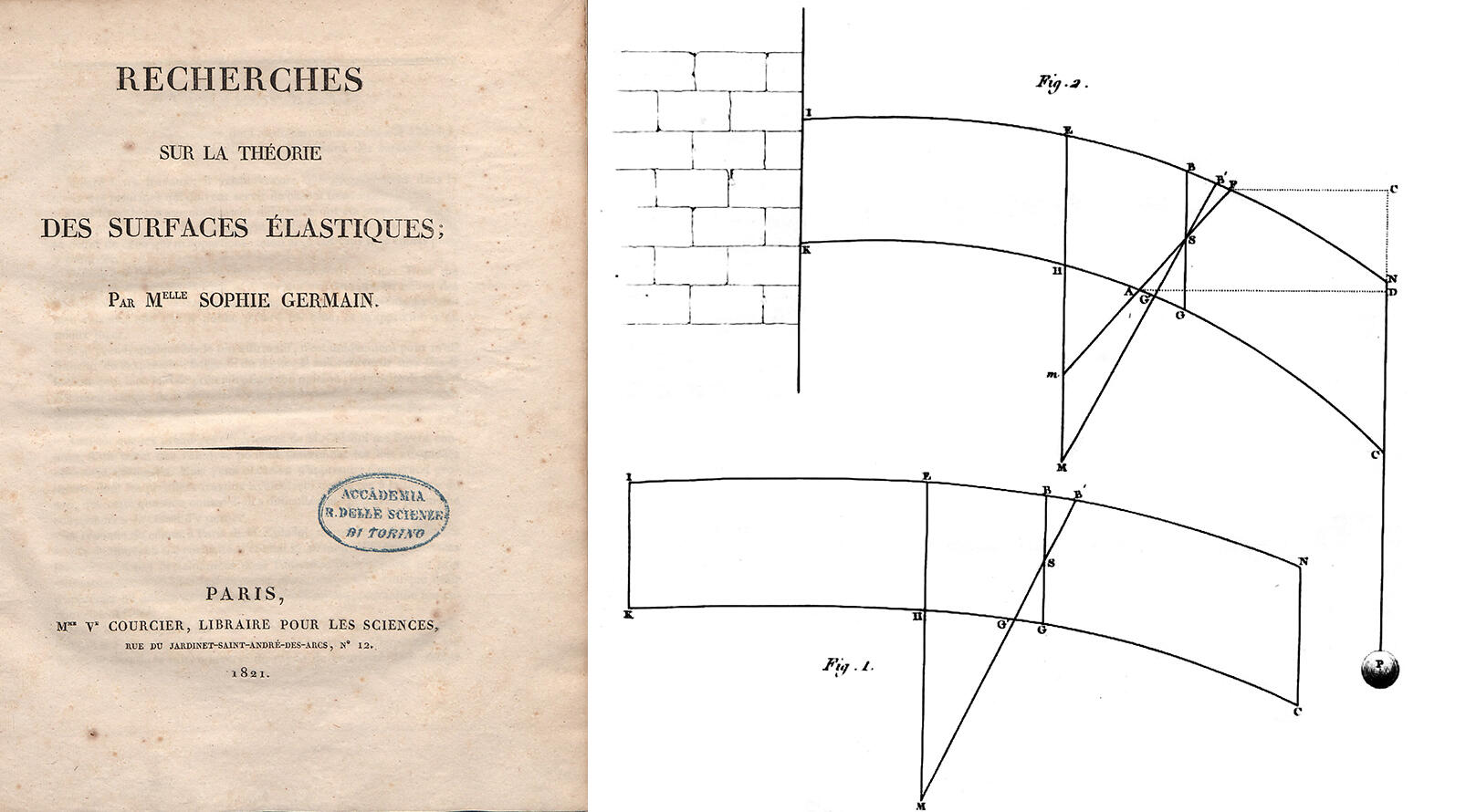
Beginning in 1811, Germain studied an entirely different question, that of vibrating plates. In 1809, the German musician and physicist Ernst Chladni made a striking demonstration before Napoleon in Paris: when a thin copper plate covered with sand is made to vibrate, pretty geometric figures appear on its surface. The emperor decided that an award should be granted to whoever could explain the phenomenon. The Academy of Science subsequently launched a contest, with Germain participating three years in a row: the first two her work was not recognised, but the third time she was finally awarded the prize, making her the first woman to receive it.
“We are not sure exactly what happened, but Sophie Germain did not attend the award ceremony. It is possible she was not informed of it,” indicates Pajot. Or it could be that the mathematician did not wish to receive a distinction from an institution that had never considered her work.
A symbol
Indeed, her entire career was marked by isolation. Germain was not invited to take part in discussions with the mathematicians of her time, she struggled to keep up with advances in the field, and her work was not published.
“It was quite difficult for her. This may be why she turned to philosophy at the end of her life,” suggests Pajot. Her writing notably inspired positivism, a current of thought advocating a rigorous approach to building knowledge.
Germain died of breast cancer in Paris in June 1831. “She has become a symbol to show young girls that mathematics are for women,” stresses Pajot. “However, even though females are encouraged to pursue mathematics today, the situation remains critical.”
In 2021, only 21% of senior lecturer positions and 22.4% of professor positions in mathematics were held by women in France. The same is true at the CNRS, despite rising numbers and notable efforts, with research professors in mathematics representing only 21.5% of staff. And this is true 250 years after Germain’s inspiring career.
Further reading
Les Audaces de Sophie Germain, by Adriana Fillipini and Elena Tartaglini, scientific coordination by Hervé Pajot, Petit à Petit, 2021, 144 p. (in French).
Also see
Stéphane Mallat, a pioneer bridging mathematics and computer science
Solace of quantum
Mathematics – a typically French passion?
Explore more