
You are here
A pioneer wiped off the map

There's a map that every Earth science student has studied at least once in their lifetime. Unlike the ways in which the Earth's surface is usually represented, the planisphere below shows the relief of the ocean floor rather than that of the continents.
While it might appear unremarkable today, its scientific value is huge. Completed in 1977, it is one of the tools that helped establish the principles of continental drift and plate tectonics. The scientific message it conveys now serves as the foundation for all research carried out in the Earth sciences. It was produced in large part thanks to the tireless work of a woman who long remained in the shadows. Her name was Marie Tharp.


Signed “Heezen and Tharp”, the map marks the conclusion of a vast, highly ambitious programme to chart the relief of the seabed, set up in the late 1940s by the American geophysicist Maurice Ewing. The development of the first echo sounders during the Second World War led to believe that the ocean floor was nothing like as flat and monotonous as it was then thought to be.
Among the talented young scientists who set off on a series of oceanographic campaigns was Bruce Heezen, a student recently taken on as a PhD student at the New-York-based Lamont Geological Observatory (now the Lamont-Doherty Earth Observatory). He was the first to present the findings of this meticulous mapping work and the idea of a separation of the oceanic crust at mid-ocean ridges. As a result, Heezen was credited with the discovery, obscuring the fact that a considerable part of the research and ideas put forward was actually the work of Marie Tharp, his assistant cartographer.
The first diagrams of the Atlantic Ocean floor
Tharp was born in 1920. Her mother was a teacher, while her father was a surveyor who, throughout her childhood, transmitted his passion for mapmaking to the young Marie. She was able to take advantage of the opening up of scientific training to women due to the enlistment of men during World War II, and signed up for university courses in geology and mathematics. Although she graduated with two degrees, that wasn't enough to earn her a permanent position at the Lamont Observatory, where she was employed as a technician under a series of fixed-term contracts.
Once there, Ewing asked her to work with Heezen, who was responsible for collecting data at sea. Tharp was given the task of compiling the information acquired by echo sounding. She then used this to plot bathymetric profiles, which enabled her to produce the very first diagrams of the Atlantic Ocean floor. "The method she used was very interesting, because, unlike traditional maps with contour lines, it helps visualise the relief," explains Mathilde Cannat, a CNRS emeritus research professor in the Marine Geosciences unit at the IPGP in Paris1.


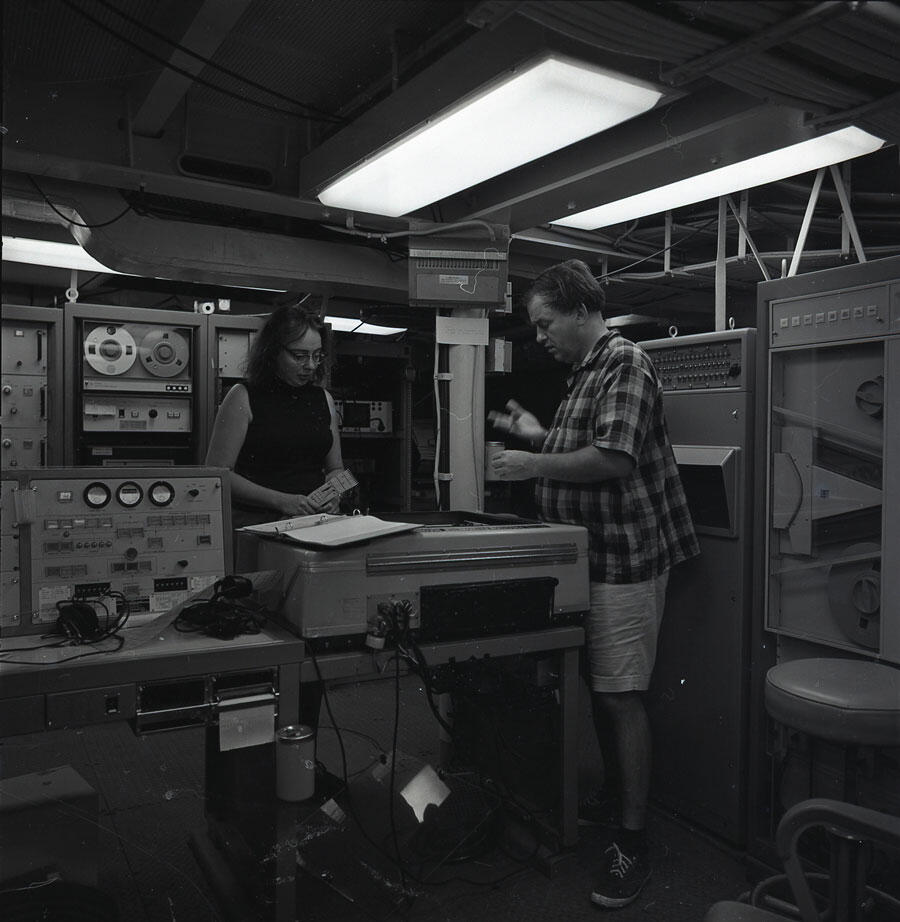
This was the early 1950s and computers didn't yet exist. Everything from data conversion and compilation, to drawings and so on was done by hand. This involved a huge amount of work, but Tharp had the necessary thoroughness and intuition that would enable her to make a major discovery, one that was to change the course of the Earth sciences.
Pangaea and continental drift
In the mid-20th century, the theory of plate tectonics as we know it today had not yet been formulated. However, as early as 1912, Alfred Wegener, a German meteorologist, had put forward the highly innovative hypothesis of continental drift, which was based mainly on geographical, geological and palaeontological evidence.
Wegener had noticed that the shape of most present-day continents was such that, rather like the pieces of a jigsaw puzzle, they could all be fitted together to form a single supercontinent, which he named Pangaea. Moreover, joining the continents together in this way made it possible to explain the continuity of certain large rock formations, as well as matching fossil records of animals, on opposite sides of the Atlantic. Wegener believed that these arguments were robust enough to show that, around 200 million years ago, Pangaea had broken up into separate continents which had been slowly drifting apart ever since.
However, his theory met with fierce opposition. This wasn't really surprising because although Wegener's observations were entirely valid, there was nothing in his postulate to explain the physical process that could set continental landmasses in motion. As a result, Wegener's thesis appeared fatally flawed, because ultimately it lacked a fundamental element, namely the driving force behind continental drift.
The discovery of mid-ocean ridges
Regarded as far-fetched, the "continental drift" theory remained dormant for forty years. Until one day, while processing bathymetric data collected by Heezen and his colleagues, Tharp realised that there was a huge undersea mountain range (now called "mid-ocean ridge") running from north to south down the middle of the Atlantic Ocean. She believed that the relief of this vast ridge showed that it was actually a rift zone, in other words a deep valley where the Earth's crust was being pulled apart.
However, she had a hard time convincing Heezen, who initially dismissed her ideas as "old wives’ tale". In fact, it took Tharp a whole year to persuade her male colleague that she was right, by showing the correlation between her bathymetric maps and that of earthquakes recorded in the Atlantic – quakes whose epicentres were aligned all along the underwater ridge, demonstrating that it was indeed an area where the Earth's crust was being stretched apart.


The first presentation of Tharp and Heezen's findings on mid-ocean ridges in 1956, followed in 1957 by the publication of the first bathymetric map of the Atlantic Ocean, sent shock waves through the entire Earth sciences community. However, all the credit went to Heezen, whose name was always given precedence over that of Tharp.
"Tharp's lack of recognition can be explained by institutional considerations: Heezen was a PhD student, while Tharp was merely a technician. So it was he who had the authority to defend their findings in conferences," Cannat explains. But underpinning this situation lay the issue of sexism. "Being a woman, she wasn't at that time allowed to embark on oceanographic vessels, or earn a PhD in the discipline, or, consequently, take up an academic position. No matter what she did, she was stuck in her condition."
Belated recognition
Tharp and Heezen's findings paved the way for new research, especially into the symmetry of magnetic anomalies recorded in the rocks of the oceanic crust. In the 1960s these studies definitively validated the theory of seafloor spreading (which explains how tectonic plates diverge at mid-ocean ridges, causing magma to rise to the surface and creating fresh oceanic crust that gradually moves away from the ridge), and subsequently led to the quantification of the speeds at which oceans open up. The geodynamic model of plate tectonics was finally completed when mid-ocean ridges were identified in every ocean.


Despite her key contribution to the emergence of plate tectonics theory, Tharp long remained in the shadows. "She continued to be employed under fixed-term contracts for her entire career," Cannat laments. She wasn't authorised to take part in an oceanic expedition until 1968, and only received full recognition for her work in the 1990s, when she was 70, at a ceremony held at the Lamont-Doherty Earth Observatory.
"Things are changing though," Cannat rejoyces. "The European Geosciences Union's award for outstanding contributions to tectonics and structural geology has now been named the Marie Tharp Medal." ♦
See also
When beauty overshadows scientific genius
- 1. CNRS / IPGP / Université Paris Cité.
Explore more