
You are here
Cervantes, an influencer of his time

You recently discovered an unpublished Cervantes sonnet. Can tell us how it happened.
Roland Béhar1: As part of an EU research project2 I’m involved in, I was studying the celebrations held in Naples in 1612 after the proclamation of the Franco-Spanish double marriage agreement, to unite the young Louis XIII of France with the Spanish Infanta, the famous Anne of Austria, and her sister Elisabeth with the future Philip IV of Spain. This dual wedding marked a strategic about-face two years after the death of Henry IV.
Just before he was assassinated, the King of France had initiated the alliances and logistical preparations needed for a Europe-wide war against Spain. So these festivities marked a milestone, and the capital cities tried to outdo each other with lavish celebrations. Paris was the first to hail the event, with the inauguration of Place Royale, the future Place des Vosges, in April 1612. In response, festivals were then held in Naples, which at the time was the capital of the Spanish viceroyalty that governed all of southern Italy with the exception of Sicily.

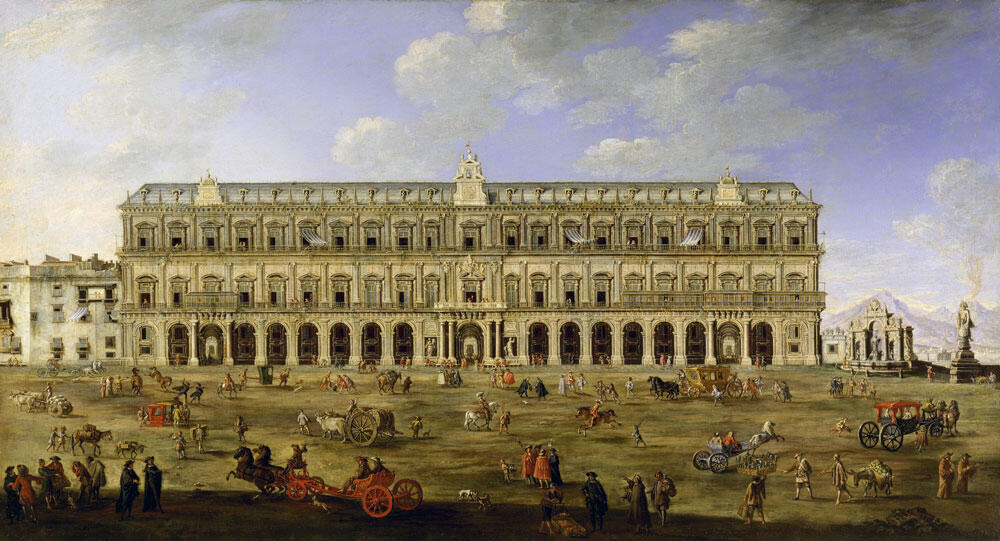
While investigating the latter I found, in the archives of the Salamanca university library, an account of the celebrations that was thought to have been lost since the late 19th century. And at the beginning of the booklet, published in August 1612, features a hitherto unnoticed laudatory sonnet written by Miguel de Cervantes in honour of his patron, the Count of Lemos, the powerful viceroy of Naples and one of the most influential figures in the court of Madrid3.
What does this sonnet tell us about the socio-professional status of the author of Don Quixote?
R. B.: Cervantes’s situation is not particularly representative of the writers of his time. Most of them enjoyed greater security than he did, working either as secretaries to the elite or as members of religious orders. Luis de Góngora, the most important early 17th-century Spanish poet, was a canon of the Cathedral of Cordoba, which provided him an income and free time to write. The playwright Lope de Vega, one of Cervantes’s biggest rivals, was a secretary to high-ranking nobles, and later an inquisitor and priest, a status that afforded him some autonomy.


A writer who had earned many degrees and distinctions could hope to become a historian, in other words the official chronicler of a city or kingdom, and be guaranteed steady employment and a very good income – a position to which Lope de Vega aspired in vain.
Unlike his contemporaries, Cervantes failed almost all his life to achieve what he wanted. He initially hoped to distinguish himself in the military, but lost the use of his left arm at the Battle of Lepanto in 1571 (hence his nickname El Manco de Lepanto – 'the one-armed man of Lepanto') and ended up a prisoner of the Barbary States in Algiers from 1575 to 1580. He later sought the protection of patrons, but ultimately ended up as a tax collector to finance, among other things, the Invincible Armada in 1588.
It was only starting in 1605 that he won fame, nearly by chance, with his novel Don Quixote. Writing in what was then a marginal genre, Cervantes achieved huge success in a relatively short time, including in other countries through translations released in rapid succession.
However, despite the success of his subsequent books, Cervantes never managed to earn a lot of money. He spent his final years in a small modest house in Madrid: having renounced any ambition of becoming a member of the court, he likewise forsook any upward social mobility and the associated expenses.
In what sense was Cervantes an ‘influencer’, as you call him?
R. B.: The word ‘influencer’ is currently in fashion to describe important people in politics, thought or the arts, even from eras in the more or less distant past. But in the case of Cervantes he is a true ‘influencer’ as defined by French law, namely a ‘natural or legal person who, for a fee, wields their reputation by communicating content to an audience with the goal of promoting, directly or indirectly, goods, services or any type of cause’ and thus ‘engages in an activity of commercial influence’4. The only aspect that cannot be taken into account in this definition is the use of digital media – for obvious reasons.



By gaining success with a novel in 1605, the author of Don Quixote acquired a level of notoriety independent of any political or religious cause, unlike the epic poems that he admired. He earned a literary reputation dissociated from any propaganda, prefiguring what took place in France starting in the 1630s, as described by the literary historian Alain Viala.
The sonnet from 1612 thus reveals the existence of a sort of bargain between Cervantes and the Count of Lemos: in exchange for a small regular annuity (about which there is unfortunately no detailed written record), Cervantes associated the Count with each of his future successes, from 1612 through 1616, the most productive years of his writing career.
Cervantes was certainly not the first writer to forge a link between literary reputation and financial remuneration. As early as the 16th century, the Venetian author L’Arétin saw the potential monetary value of writing when he threatened to defame Charles V unless the monarch granted him an imperial pension!
What’s different with Cervantes is that never before had someone with a writing notoriety so far removed from the defence of a political or religious cause use his fame for material gain. It’s in this sense that Cervantes can be seen as an influencer, in other words a person who depended on a powerful figure to monetise his artistic freedom, all while asserting his autonomy.


How did the Spanish monarchy judge these private practices of influence?
R. B.: We must keep in mind what the royal court was like under King Philip III. During his reign (1598-1621), it was the valido – the favourite, the equivalent of a prime minister – who governed in place of the king himself. In 1612 the valido was the Duke of Lerma, uncle and father-in-law of the Count of Lemos. However, the court was far from unified: multiple factions competed for the king’s favours, constantly striving to make an impression.
The Count of Lemos himself aspired to become the king’s next favourite, which never happened, and for that reason needed to cultivate his image, both within the palace itself and in terms of the nascent phenomenon of public opinion. And what better way to do that than by resorting to a famous author like Cervantes?! ♦
- 1. Senior lecturer (HDR) at the École Normale Supérieure-PSL, within the ITEM institute of modern texts and manuscripts (CNRS / ENS-PSL / Université de Poitiers).
- 2. ERC project “TextDiveGlobal - Textuality and Diversity: A Literary History of Europe and its Global Connections, 1529-1683”. See https://tinyurl.com/45fw7cjd
- 3. The discovery was published this year in « Criticón » ("Del cartel a la fama de Villamediana: noticias sobre la ‘Relación’ de Juan de Oquina de las fiestas de Nápoles de 1612 (con un soneto desconocido de Cervantes, dos poemas del contador Pedro de Morales, y notas al ‘Viaje del Parnaso’)”), and later translated into French in « Le Grand Continent » (“Cervantès inédit : un sonnet retrouvé de l’auteur du Quichotte (première traduction française)"). See https://doi.org/10.4000/13okk (in Spanish) and https://tinyurl.com/inedit-cervantes (in French), respectively
- 4. Article 1 of French Law No. 2023-451 of 9 June 2023 for the purpose of regulating commercial influence and combating abuses by influencers on social networks. See https://tinyurl.com/loi-influenceurs (in French)
Explore more