CNRS News
Published on CNRS News (https://news.cnrs.fr)

Home > Hottest news from the Sun's corona

Hottest news from the Sun's corona

You are here

Home [1]
Lire en français [2]
Space [3]
astrophysics [4]
-A [5] +A [5]
article

Hottest news from the Sun's corona

10.09.2025, by
Mehdi Harmi [6]
Reading time: 7 minutes
Image Nasa / GSFC / Solar Dynamics Observatory
Why is the outermost part of the Sun's atmosphere, the corona, so much hotter than its surface? Ten years after formulating a hypothesis based on a numerical model, CNRS researchers have now used direct observations of the star's surface to confirm their theory.

Imposing, bright and above all extremely hot, the Sun reigns supreme at the centre of our Solar System. Although observed for thousands of years with the help of ever more sophisticated instruments, our star still holds many secrets. However, one of these mysteries has now been partially elucidated.

Tahar Amari, at the Center for Theoretical Physics (CPHT)1 and his colleagues have recently published a paper in The Astrophysical Journal Letters2 on the enigma surrounding the temperature of the solar corona.

While that of the Sun's surface is only a few thousand degrees, astonishingly, the outermost part of its atmosphere, the corona – approximately 2,200 km to several tens of millions of kilometres above the surface – reaches temperatures of around one million degrees. This long-known paradox is thought to be caused by “magnetic flux ropes” that ascend from the Sun's surface and heat the corona.


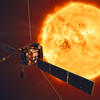
Montage photo de la sonde Parker devant une image du Soleil. Image Nasa / Johns Hopkins APL / Steve Gribben
Artist's impression of the Parker Solar Probe, launched by NASA in 2018 to observe the Sun. At the end of 2024, it came within just over 6.1 million kilometres of our star.
CNRS News
Montage photo de la sonde Parker devant une image du Soleil. Image Nasa / Johns Hopkins APL / Steve Gribben
Artist's impression of the Parker Solar Probe, launched by NASA in 2018 to observe the Sun. At the end of 2024, it came within just over 6.1 million kilometres of our star.
Image Nasa / Johns Hopkins APL / Steve Gribben
Share
Share
[7] [8] [9]

Temperature gradient

Nowhere in the Solar System does the heat exceed that found at the centre of the Sun, which acts as a huge nuclear fusion reactor nearly 1.4 million kilometres across. "In the Sun's core, temperatures easily reach over ten million kelvins (K)3. And like the Earth, the Sun is made up of several layers," Amari explains. "By the time the radiation from the core reaches the bottom of the layer called the convection zone, after travelling 200,000 km of the 700,000 km (of the Sun's radius, Editor's note) needed to reach the surface, the temperature of the plasma that makes up the Sun has already fallen to 2 million kelvins. And in the final 500,000 km it drops dramatically, falling to around 6,000 K." 

So far, so normal. The temperature gradient behaves in a way that could be described as classic: the further away from the primary heat source, the more the temperature tends to decrease. But it's then that things get complicated.

An atmosphere hotter than the surface 

The Sun's atmosphere is made up of several different layers, just like the Earth's. The innermost layer, the photosphere, extends from the surface to an altitude of 500 km. Next comes the chromosphere, which goes up to an elevation of some 2,200 km. These two layers already exhibit heat levels higher than those found at the Sun’s surface – on the order of 4,000 K for the photosphere and as much as 25,000 K for the chromosphere.

chromosphère » solaire, Image Hinode Jaxa / Nasa / PPARC
This image captured on 11 November 2006 by the Japanese Hinode satellite reveals the structure of the chromosphere, which lies above the convection cells (or “granules”) that constitute the Sun’s visible surface and rise up to the top of the photosphere.
CNRS News
chromosphère » solaire, Image Hinode Jaxa / Nasa / PPARC
This image captured on 11 November 2006 by the Japanese Hinode satellite reveals the structure of the chromosphere, which lies above the convection cells (or “granules”) that constitute the Sun’s visible surface and rise up to the top of the photosphere.
Image Hinode Jaxa / Nasa / PPARC
Share
Share
[7] [10] [9]

Above them lies the corona, with a temperature of around one million kelvins. So, strangely, up to a certain point the further you move away from the Sun, the hotter things become.

This can be observed right from the bottom of the corona, which is strongly coupled to the underlying layers, suggesting that the different layers are connected by whatever causes this phenomenon. How can this be explained?

"The solar corona is governed by the magnetic field"

"Today, two theories are frequently put forward, both of them based on magnetism," Amari explains.“The first involves magnetic waves." Unlike sound waves, these don’t become weaker as the density of matter in the surrounding medium decreases. The second theory is also based on magnetic fields, in particular on the fact that they are constantly undergoing rearrangement (known as “reconnection”), which can cause solar flares.

As Amari points out, "The solar corona is governed by the magnetic field, due to the large number of collisions between atoms, as well as to the fact that the corona is an electrically conductive medium." This makes the magnetic field visible, because of the way matter is organised within it. The spectacular solar flares are a perfect example of this.

"However, we still didn't understand how energy moves from the photosphere to the chromosphere, and then to the rest of the corona nearest to the Sun," the researcher adds.

Éruptions solaires. Image Nasa / GSFC / Solar Dynamics Observatory
Coronal loops photographed on 12 July, 2012. Originating at the base of the corona, these loops are magnetic fields that extend across the Sun's atmosphere.
CNRS News
Éruptions solaires. Image Nasa / GSFC / Solar Dynamics Observatory
Coronal loops photographed on 12 July, 2012. Originating at the base of the corona, these loops are magnetic fields that extend across the Sun's atmosphere.
Image Nasa / GSFC / Solar Dynamics Observatory
Share
Share
[7] [11] [9]

The magnetic flux rope hypothesis confirmed

In 2015, Amari and his colleagues had already designed a numerical model and put forward a hypothesis about the formation of magnetic flux ropes on the surface of the Sun, even when the latter is quiet4. As he explains, "In our model we realised that a whole bunch of small, twisted eruptive magnetic flux ropes were emerging from the Sun's surface, coupling with larger structures to form a network similar to a mangrove forest."

This “magnetic mangrove forest” was therefore able to heat the chromosphere via numerous micro-flares which, by coupling with the large structures extending up into the corona, excited a particular type of wave called Alfvén waves5. However, the physicists still needed to understand what could cause the formation of these waves. Thanks to their model, they realised that, at the base of the magnetic flux ropes, something was driving an energy transfer large enough to heat the corona.

Modélisation d’une corde magnétique pendant une éruption solaire
Simulation of a magnetic flux rope during a solar flare, when it breaks the “magnetic cage” that confines it in the hours preceding the flare.
CNRS News
Modélisation d’une corde magnétique pendant une éruption solaire
Simulation of a magnetic flux rope during a solar flare, when it breaks the “magnetic cage” that confines it in the hours preceding the flare.
Tahar Amari et al. 2018 / Centre de physique théorique (CNRS/École Polytechnique)
Share
Share
[7] [12] [9]

"Magnetic fields are like guitar strings: if you pluck them at the bottom, at the level of the Sun's surface, the energy should travel all the way up the 'string',"  Amari explains. Thus, little by little, the energy should reach the corona and eventually heat it up.

Using their model, the researchers also discovered that the Sun's surface is in motion at the base of the magnetic flux ropes. They believe that this is indirect evidence that something deeper down is affecting what happens at the surface.

"In the top 1,000 km beneath the surface, there is a zone made up of convection cells, rather like at the bottom of a heated pan of water," says Amari by way of illustration. "The heat coming from below is transported upwards by these cells, eventually warming the rest of the water in the pan. It is this process beneath the Sun's surface that is thought to contribute to the transfer of heat, and to the creation of this magnetic field and its flux ropes." 

Evidence from observations

Compelling evidence confirming this hypothesis has now been provided by data from direct observations of the Sun's surface by the Japanese Hinode satellite, which can measure the magnetic field using a magnetic imaging technique. These images enabled the researchers to identify for the first time magnetic flux ropes in a quiet area of the Sun, thus validating their model and the predictions they had made a decade earlier.

Cordes magnétiques, figure extraite de la publication © Tahar Amari et al. 2025
Magnetic flux ropes in the quiet Sun, produced before and during a flare, revealed by a high-resolution simulation including the thin layer beneath the solar surface.
CNRS News
Cordes magnétiques, figure extraite de la publication © Tahar Amari et al. 2025
Magnetic flux ropes in the quiet Sun, produced before and during a flare, revealed by a high-resolution simulation including the thin layer beneath the solar surface.
Tahar Amari et al. 2018 / Centre de physique théorique (CNRS/École Polytechnique)
Share
Share
[7] [13] [9]

So, whether the Sun is quiet or active, both large and small magnetic flux ropes transport enough energy to the corona to heat it to around one million kelvins. This discovery is only a first step in understanding the coronal heating process. Instruments such as the Parker Solar Probe [14] and the Daniel K. Inouye Solar Telescope (DKIST) in Hawaii (US) should refine the direct observation of magnetic flux ropes, shedding fresh light on their interaction with the Sun's magnetic environment. ♦

See also

Solar storms ahead [15]
Those stars that come and go [16]

Footnotes
  • 1. CNRS / École polytechnique.
  • 2. Tahar Amari et al., "The Ubiquity of Twisted Flux Ropes in the Quiet Sun," ApJL 984 L37, April 2025: https://doi.org/10.3847/2041-8213/adb74f [17]
  • 3. The temperature in kelvins (K) is equal to the temperature in degrees Celsius (°C) + 273. Thus, 0 °C = 273 K, 100 °C = 373 K, 1000 °C = 1273 K, etc.
  • 4. Amari T., Canou A. and Aly J.-J., "Characterizing and predicting the magnetic environment leading to solar eruptions", Nature 514, 465–469 (2014): https://doi.org/10.1038/nature13815 [18]
  • 5. Alfvén waves: magnetohydrodynamic waves found in plasmas. They are responsible for energy transport in various astrophysical systems, such as the magnetosphere.

Explore more

Space
This illustration shows the merger of two black holes and the gravitational waves that ripple outward as the black holes spiral toward each other.
[19]
Article
11/03/2025
Gravitational wave detections spark great expectations [19]
Vera C. Rubin observatory © RubinObs / NSF / DOE / NOIRLab / SLAC / AURA / H. Stockebrand
[20]
Article
09/12/2025
The Big Bang within the reach of telescopes [20]
[21]
Article
07/09/2025
1905: Einstein initiates the quantum age [21]
Mont-Saint-Michel © GLAZ / Mathieu Rivrin / Hemis.fr
[15]
Article
03/18/2025
Solar storms ahead [15]
Illustration Nasa / ESA L. Hustak (STScI)
[16]
Article
02/06/2025
Those stars that come and go [16]
astrophysics
This illustration shows the merger of two black holes and the gravitational waves that ripple outward as the black holes spiral toward each other.
[19]
Article
11/03/2025
Gravitational wave detections spark great expectations [19]
Illustration Nasa / ESA L. Hustak (STScI)
[16]
Article
02/06/2025
Those stars that come and go [16]
[22]
Article
01/29/2025
On the trail of cosmic cataclysms [22]
[23]
Article
12/04/2024
James Webb illuminates the grey areas of astrophysics [23]
Photo Jacqueline Ramseyer Orrell / SLAC National Accelerator Laboratory
[24]
Slideshow
07/12/2024
Largest-ever digital camera set to scan the Universe [24]
Sun
Illustration Nasa / ESA L. Hustak (STScI)
[16]
Article
02/06/2025
Those stars that come and go [16]
[25]
Article
02/07/2020
Solar Orbiter Blasts Off for the Sun [25]
[26]
Article
10/17/2018
BepiColombo: Two Orbiters Head to Mercury [26]
[27]
Slideshow
09/18/2018
Spotlight on Heritage [27]
[14]
Article
07/02/2018
A Mission to Touch the Sun [14]

Keywords

Sun [28] Solar Corona [29] Solar System [30] magnetic flux ropes [31] photosphere [32] chromosphere [33] magnetic waves [34] solar flares [35] Magnetic field [36] Alfvén waves [37] Hinode satellite [38] Parker Solar Probe [39] DKIST [40]

Share this article

[41]
[42]
[7]
[9]

Source URL:https://news.cnrs.fr/articles/hottest-news-from-the-suns-corona

Links
[1] https://news.cnrs.fr/ [2] https://lejournal.cnrs.fr/articles/couronne-solaire-ses-temperatures-revelent-leur-mystere [3] https://news.cnrs.fr/space [4] https://news.cnrs.fr/astrophysics [5] https://news.cnrs.fr/javascript%3A%3B [6] https://news.cnrs.fr/authors/mehdi-harmi [7] https://twitter.com/intent/tweet?url=https%3A//news.cnrs.fr/print/2207%2F&text=Hottest news from the Sun's corona [8] http://www.facebook.com/sharer/sharer.php?s=100&p%5Burl%5D=https%3A//news.cnrs.fr/print/2207&p%5Btitle%5D=Hottest%20news%20from%20the%20Sun%26%23039%3Bs%20corona&p%5Bimages%5D%5B0%5D=https%3A//news.cnrs.fr/sites/default/files/styles/lightbox-hd/public/assets/images/2_spp_observingsun2_72dpi.jpg%3Fitok%3D08-S1D3D&p%5Bsummary%5D= [9] https://bsky.app/intent/compose?text=Hottest news from the Sun's corona%0Ahttps%3A//news.cnrs.fr/print/2207 [10] http://www.facebook.com/sharer/sharer.php?s=100&p%5Burl%5D=https%3A//news.cnrs.fr/print/2207&p%5Btitle%5D=Hottest%20news%20from%20the%20Sun%26%23039%3Bs%20corona&p%5Bimages%5D%5B0%5D=https%3A//news.cnrs.fr/sites/default/files/styles/lightbox-hd/public/assets/images/3_fine-scale_structure_of_the_chromosphere_72dpi.jpg%3Fitok%3DIs9brH8L&p%5Bsummary%5D= [11] http://www.facebook.com/sharer/sharer.php?s=100&p%5Burl%5D=https%3A//news.cnrs.fr/print/2207&p%5Btitle%5D=Hottest%20news%20from%20the%20Sun%26%23039%3Bs%20corona&p%5Bimages%5D%5B0%5D=https%3A//news.cnrs.fr/sites/default/files/styles/lightbox-hd/public/assets/images/4_ar1520_beauty_still_1_72dpi.jpg%3Fitok%3D9WdqRku2&p%5Bsummary%5D= [12] http://www.facebook.com/sharer/sharer.php?s=100&p%5Burl%5D=https%3A//news.cnrs.fr/print/2207&p%5Btitle%5D=Hottest%20news%20from%20the%20Sun%26%23039%3Bs%20corona&p%5Bimages%5D%5B0%5D=https%3A//news.cnrs.fr/sites/default/files/styles/lightbox-hd/public/assets/images/5_41586_2018_article_bfnature24671_fig13_esm_72dpi.jpg%3Fitok%3Dx112QpLq&p%5Bsummary%5D= [13] http://www.facebook.com/sharer/sharer.php?s=100&p%5Burl%5D=https%3A//news.cnrs.fr/print/2207&p%5Btitle%5D=Hottest%20news%20from%20the%20Sun%26%23039%3Bs%20corona&p%5Bimages%5D%5B0%5D=https%3A//news.cnrs.fr/sites/default/files/styles/lightbox-hd/public/assets/images/6_apjladb74ff4_900px.jpg%3Fitok%3DPmgFsDGd&p%5Bsummary%5D= [14] https://news.cnrs.fr/articles/a-mission-to-touch-the-sun [15] https://news.cnrs.fr/articles/solar-storms-ahead [16] https://news.cnrs.fr/articles/those-stars-that-come-and-go [17] https://doi.org/10.3847/2041-8213/adb74f [18] https://doi.org/10.1038/nature13815 [19] https://news.cnrs.fr/articles/gravitational-wave-detections-spark-great-expectations [20] https://news.cnrs.fr/articles/the-big-bang-within-the-reach-of-telescopes [21] https://news.cnrs.fr/articles/1905-einstein-initiates-the-quantum-age [22] https://news.cnrs.fr/articles/on-the-trail-of-cosmic-cataclysms [23] https://news.cnrs.fr/articles/james-webb-illuminates-the-grey-areas-of-astrophysics [24] https://news.cnrs.fr/slideshows/largest-ever-digital-camera-set-to-scan-the-universe [25] https://news.cnrs.fr/articles/solar-orbiter-blasts-off-for-the-sun [26] https://news.cnrs.fr/articles/bepicolombo-two-orbiters-head-to-mercury [27] https://news.cnrs.fr/slideshows/spotlight-on-heritage [28] https://news.cnrs.fr/sun [29] https://news.cnrs.fr/solar-corona [30] https://news.cnrs.fr/solar-system [31] https://news.cnrs.fr/magnetic-flux-ropes [32] https://news.cnrs.fr/photosphere [33] https://news.cnrs.fr/chromosphere [34] https://news.cnrs.fr/magnetic-waves [35] https://news.cnrs.fr/solar-flares [36] https://news.cnrs.fr/magnetic-field [37] https://news.cnrs.fr/alfven-waves [38] https://news.cnrs.fr/hinode-satellite [39] https://news.cnrs.fr/parker-solar-probe [40] https://news.cnrs.fr/dkist [41] http://www.facebook.com/sharer/sharer.php?s=100&p%5Burl%5D=https%3A//news.cnrs.fr/print/2207&p%5Btitle%5D=Hottest%20news%20from%20the%20Sun%26%23039%3Bs%20corona&p%5Bimages%5D%5B0%5D=&p%5Bsummary%5D= [42] https://news.cnrs.fr/printmail/2207