A supernumerary discoverer
You are here
 Lire en français [2]
Born in 1925, Marthe Gautier entered medical school in Paris in 1942 with the goal of becoming a paediatrician. What can you tell us about her student years?
Julie Batut1: In the early 1950s, Marthe Gautier was one of only two women in the class of 80 interns in the Paris hospitals. She studied with the paediatrician Robert Debré, one of the founders of modern paediatrics. In 1955 she became the first woman to receive a scholarship in paediatric cardiology at Harvard University in the United States. She spent a year overseas and learned a number of different in vitro cell culture techniques, some of which were not used in France. These methods would later allow her to produce a karyotype, which separates the chromosomes clearly enough to count them, making it possible to identify the supernumerary chromosome of trisomy 21.
What happened upon her return to France?
J. B.: Back in Paris in 1956, she discovered that during her absence a male colleague had been given the position of head clinician that she had been originally been promised. She then joined the paediatric department at Trousseau Hospital, headed by Professor Raymond Turpin who conducted research on Down syndrome. With him, she hypothesised that the syndrome then called ‘Mongolism’ was caused by a chromosomal anomaly. At Trousseau, Gautier established the very first cytogenetics laboratory, using the in vitro cell culture techniques that she had learned at Harvard to observe, isolate and count the chromosomes in cells.


What were her working conditions like at the time?
J. B.: She had to do her research with no funding – or in any case as little funding as possible, and a lot of elbow grease! She began by studying cells from the blood plasma of a rooster that she had purchased herself. She then analysed the serum of her own blood and trained the lab technicians in cytogenetic techniques for separating and counting chromosomes. Ultimately, after analysing the tissues of healthy subjects, she noted that their cells had 46 chromosomes. while those from a patient with Down syndrome contained 47…
The extra chromosome was difficult to see and her laboratory did not have the equipment needed to prove it presence. So Marthe Gautier took her slides to Jérôme Lejeune…
J. B.: That’s right. She did not have a microscope capable of taking a clear photograph of her discovery. Doctor Jérôme Lejeune, a CNRS medical intern on Professor Turpin’s team, offered to photograph the samples for her in a better-equipped laboratory. In 1958, the supernumerary chromosome 21 of Down syndrome was identified.
And Lejeune then received sole credit for the discovery, leaving Marthe Gautier in the shadows?
J. B.: The rest of the story is disputed. In 1958 Lejeune decided to announce the discovery, by himself, during a seminar at McGill University, in Canada, without telling Gautier. A paper was then published in 1959 in the Comptes Rendus de l'Académie des Sciences. Lejeune was listed as lead author and not Gautier, as should have been the custom. Professor Turpin signed the paper last. Moreover, her name was even misspelled, appearing as ‘Gauthier’… That was the first ‘invisibilisation’ of her work, since both physicians – Gautier with the chromosomal preparation and Lejeune with the imaging – contributed to the discovery.



What impact did this finding have on Lejeune and Gautier’s respective careers?
J. B.: Lejeune’s career took off. He was awarded the first chair in human genetics at the University of Paris in 1964, and won many distinctions for the discovery of the supernumerary chromosome (including the Kennedy Prize in 1962), never offering to share the honours with Gautier. He died in 1994.
Meanwhile, Gautier continued all her life to seek recognition as the co-finder of the supernumerary chromosome 21 in Down syndrome. However, she ended up abandoning research on trisomy 21 and returned to paediatric cardiology. She always considered herself to be a ‘forgotten discoverer’.
How did her indispensable contribution to the discovery of trisomy 21 finally come to be recognised?
J. B.: It took 50 years. In 2009, for the 50th anniversary of the breakthrough, Gautier published an article in Médecine/Sciences to offer her side of the story. Referring to the detection of chromosome 21 in 1958, she wrote, ‘I was aware of what was surreptitiously taking shape, but I didn’t have enough experience or authority in the world of medicine. At the time I didn’t understand how it worked and didn’t know how to deal with it. I suspected political manoeuvring… And I wasn’t wrong.’
From then on, Gautier was gradually recognised – or at least cited! – as having participated in the discovery of the chromosome. She began to give lectures on the topic, but the exact origins of the finding are still hotly debated. For example, in 2014 when the French federation of human genetics awarded the paediatrician its grand prize, her presentation was cancelled at the last minute because the organisers feared legal repercussions. Marthe Gautier died in 2022, an obvious victim of the so-called ‘Matilda effect’: the invisibilisation of women’s scientific accomplishments.


What is the Matilda effect?
J. B.: The term was posited in 1933 by the American science historian Margaret W. Rossiter, who died in 2025. She had noted the widespread denial and anonymisation of women’s contributions in scientific research. Any work or breakthrough by a woman was almost always attributed to one of their male colleagues. Scientific achievements by women were repeatedly downplayed, and they were severely underrepresented among Nobel Prize laureates, for example. The expression pays homage to Matilda Joslyn Gage, a feminist who championed the abolition of slavery in the United States, who had previously theorised the phenomenon of men taking credit for or minimising women’s intellectual achievements.
What are the most striking examples of the Matilda effect in the history of science?
J. B.: The story of the British physical chemist Rosalind Franklin is no doubt the best-known case. Along with her team, she was responsible for ‘photo 51’, a fundamental contribution to the discovery of the double helix structure of DNA. Her role was totally overshadowed by Wilkins, Watson and Crick, who won the Nobel Prize in 1962, precisely for elucidating the structure of DNA. Another example of the Matilda effect in physics is Lise Meitner [13], who discovered nuclear fission. But ultimately it was her collaborator Otto Hahn – and only he – who was awarded the Nobel Prize for this breakthrough in 1944.
What can be done to combat the phenomenon?
J. B.: We must uphold the role of women in science and take action in their favour, as Pierre Curie did in his time. At first, only Henri Becquerel and Pierre Curie had been nominated for the Nobel, overlooking Curie’s wife Marie. When he found out from a Swedish academician, Pierre announced that he would refuse the prize if Marie were not reinstated as a candidate. He fought to be a joint recipient, and Marie Curie thus became the first woman to win the Nobel Prize.
Do you think that the Matilda effect still exists in scientific research today?
J. B.: Yes, and I think that every researcher should bear this in mind: keep a record of the progress of your work, and mention everyone who makes a contribution to the advancement of science. Today, only 29% of all university professors are women – a figure that drops to 9% in basic mathematics, for example. It’s up to us, as researchers and institutions, to take action in favour of inclusive, rich, diversified science.

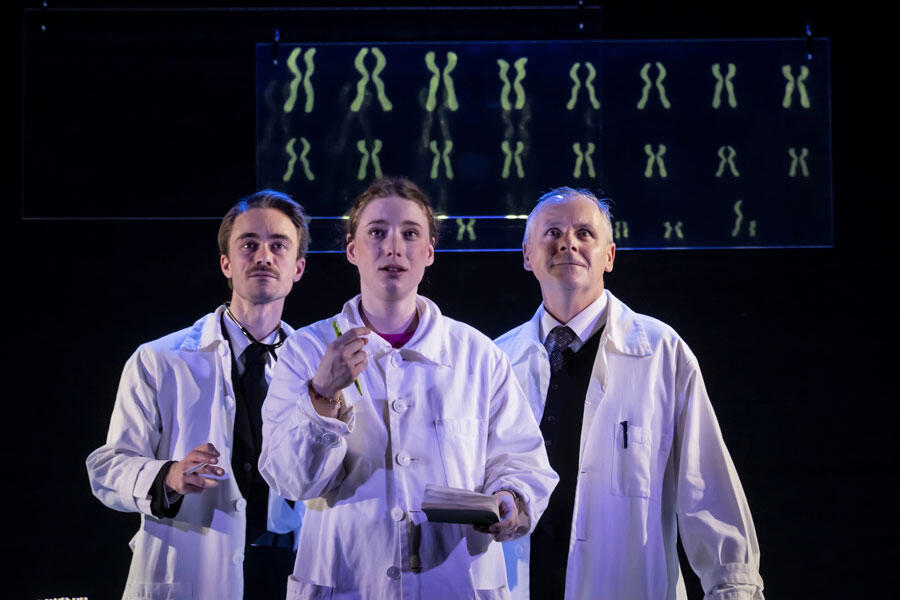
By 2027, the name of Marthe Gautier, along with 71 other women scientists, will be inscribed on the Eiffel Tower. What does this mean to you?
J. B.: It represents the restoration of equality enshrined on the Eiffel Tower [15]. Until now, only the names of 72 men – scientists, engineers and industrialists – have been displayed on the monument since its construction in 1889. In fact, as early as 1913, John Augustine Zahm, the author of the book Woman in Science, expressed his surprise that the list of honourees included no women of genius, like the mathematician Sophie Germain [16], whose work was essential to the construction of the Eiffel Tower.
The inscription of 72 women’s names, a project initiated by the City of Paris, the company that operates the Eiffel Tower and the non-profit organisation Femmes & Sciences, shows that scrupulous equality is possible. We are trying to make these women and their names better known because, through their work, like that of Marthe Gautier, they have achieved progress for all of society.
For further reading
Lisa M. Thomann and Julie Batut, “Equity, Diversity and Inclusion: Four women whose pioneering contributions to science have been largely overlooked,” 2026:
https://doi.org/10.7554/eLife.110644 [17]
See also
Hedy Lamarr. When beauty overshadows scientific genius [18]
A pioneer wiped off the map [19]
Rebel with a cause [16]
- 1. CNRS senior researcher at the Molecular, Cellular and Developmental Biology Unit, (MCD – CNRS / Université de Toulouse).
Explore more