On the trail of cosmic cataclysms
You are here
 Lire en français [2]
On the trail of cosmic cataclysms

The most violent and explosive events in the Universe, such as black holes and pulsars, behave like huge particle accelerators. The interaction between cosmic rays and matter forms what is known as secondary radiation, which is partly made up of gamma rays – the focus of the High Energy Stereoscopic System telescope (H.E.S.S.)1 . All this radiation is detected indirectly by observing a phenomenon called the Cherenkov effect: this is the blue light produced when charged particles move through a medium such as the atmosphere at a speed greater than that of light in this same medium.
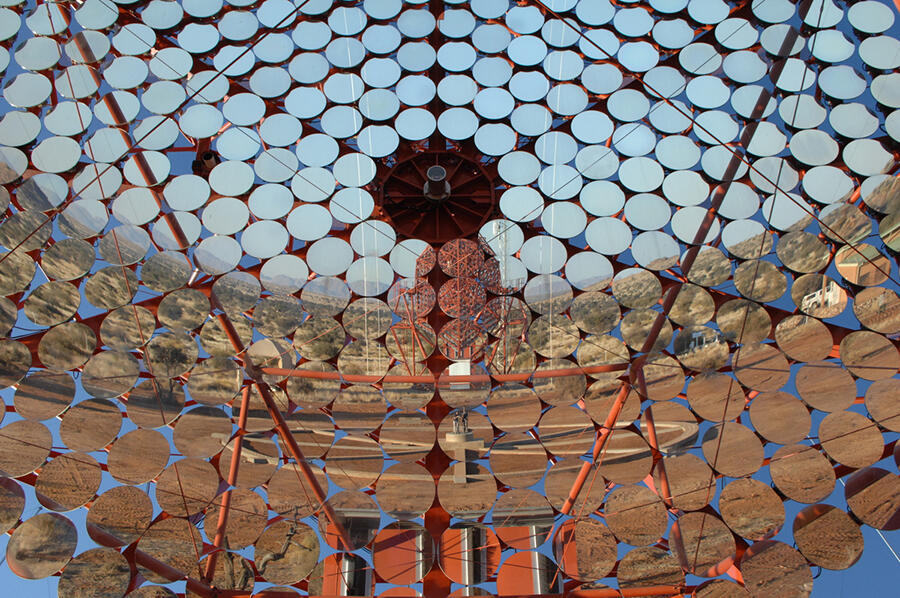
The telescope's name refers to Victor Franz Hess (1883-1964), an Austrian physicist who in 1912 demonstrated the existence of extraterrestrial radiation capable of ionising the atmosphere. His discovery of cosmic rays earned him the 1936 Nobel Prize in Physics, shared with the American particle physicist Carl Anderson. H.E.S.S. is made up of five detectors: four telescopes with mirrors 12 metres in diameter arranged as a square with 120 m sides, surrounding a larger telescope with a 28 m mirror. The array benefits from the exceptional conditions of the Khomas Plateau, near the Gamsberg Mountains in Namibia.
In the right place and at the right time
"The region is very dry, with a remarkably transparent atmosphere and practically no light pollution," explains Anne Lemière, a researcher at the APC astroparticle and cosmology laboratory2. "Its altitude of 1800 metres also makes it easier to observe gamma rays indirectly. What's more, the fact that H.E.S.S. is positioned on the Tropic of Capricorn means that the central regions of the Milky Way, located at the zenith of the sky over Namibia, can be seen under optimum conditions." Lemière studies the centre of our Galaxy, where H.E.S.S. has detected an exceptional density of cosmic rays.

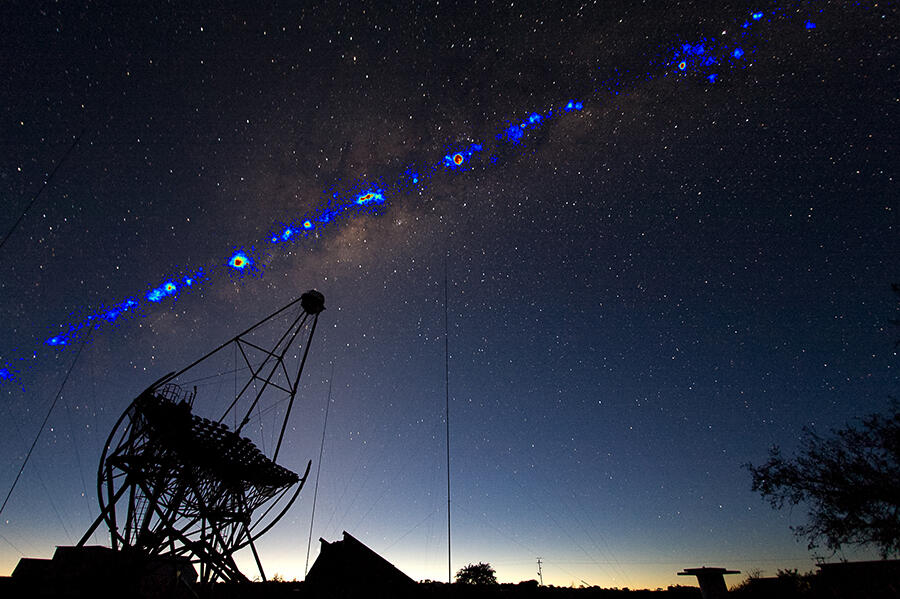
"This emission could be related to the past activity of the black hole at the centre of our Galaxy, Sagittarius A*, which is currently quieter than other known active galactic nuclei," the researcher explains. "The cosmic rays come from an area with an abundance of matter, where stars are born and die. As they originate in a zone relatively close to the Earth, we can use spatial resolution to locate and study the morphology of the objects that emit them and thus better understand their physics."
The fact that gamma rays always travel in a straight line makes it much easier to determine their source. Some satellites, such as NASA's Fermi Gamma-ray Space Telescope, can detect gamma rays from Earth orbit, albeit at lower energies than H.E.S.S. Fortunately, our atmosphere filters out this radiation.
A fleeting blue light
The H.E.S.S. array finds and measures the radiation using an indirect method. Although nothing travels faster than light in a vacuum, this is not necessarily the case in other media. For instance, in the atmosphere, light is very slightly slowed down – by 0.01% compared to its speed in a vacuum. When gamma rays enter the atmosphere they collide with atoms, particularly of nitrogen and oxygen. These impacts trigger a cascade of reactions that produce electromagnetic showers of millions of particles extending over many kilometres.
In these showers, some charged particles travel faster than light does in air, causing them to emit blue light. This is known as the Cherenkov effect. It is the same phenomenon that can be seen in cooling ponds housing spent nuclear fuel rods, where the water emits a bluish glow. However, the Cherenkov effect produces a flash that lasts no more than a few nanoseconds, and is invisible to the naked eye. Thanks to its ultra-high-speed, extremely sensitive cameras, H.E.S.S. is able to detect this fleeting, faint glow, and can do so from several angles at once.

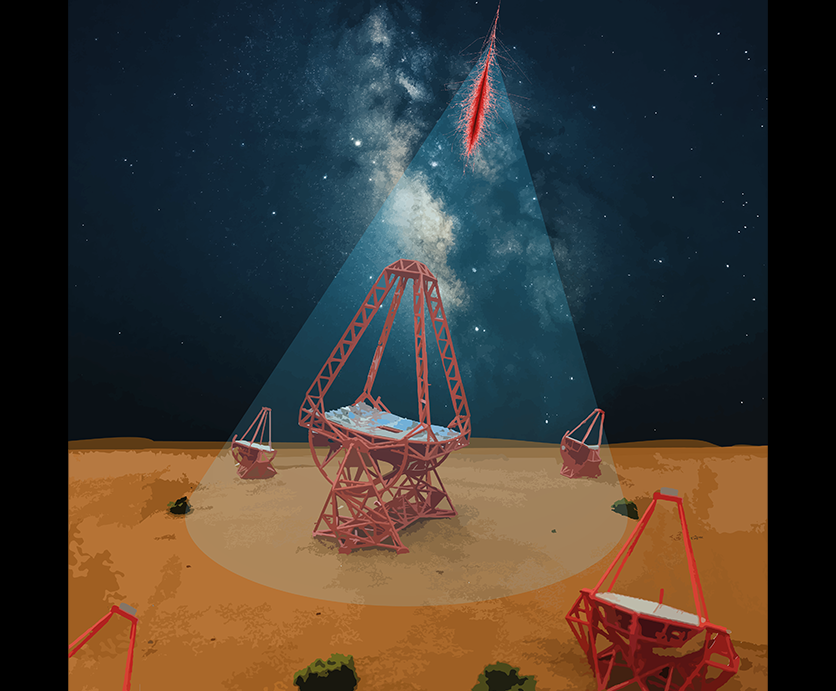
All the data collected is used to reconstruct the entire shower, pinpoint the source of the radiation, and measure its energy and wavelength. Researchers can then map the radiation in order to identify the type of celestial object that emitted it. H.E.S.S. is the world's largest gamma-ray telescope array, and can spot radiation with an energy ranging from 0.03 to 100 teraelectronvolts (TeV), which is as much as one hundred trillion times the energy of visible light. By way of comparison, the Large Hadron Collider (LHC) at CERN accelerates protons to maximum energies of 6.5 TeV.
"At ground level, the Cherenkov radiation covers an area the size of a football pitch," explains Mathieu de Naurois, senior researcher at the Laboratoire Leprince-Ringuet (LLR)3 and deputy director of H.E.S.S. “Roughly 5,000 showers of this kind fall around you every second. Despite the fleeting nature of the event, H.E.S.S. relies on its sensors to detect occurrences that last a mere five billionths of a second. The telescope uses the atmosphere as a calorimeter in order to determine the energy of the incident gamma radiation. The researchers process the resulting images and, in order to identify the source of the radiation, compare them to a whole taxonomy of phenomena, such as supermassive black holes, pulsars, binary star systems, and so on."
The Universe as a laboratory
These gamma rays come not only from sources that are relatively stable and long-lasting on human scales, such as supernova remnants and active galactic nuclei, but also from more sudden events. Halim Ashkar, a postdoctoral researcher at the LLR, studies transient events, that is to say those that don't result from a stable, constant source, but from violent, brief phenomena such as the explosion of a star. To monitor such fleeting episodes, H.E.S.S. has been equipped with telescopes that can point to a region of the sky in just a few tens of seconds as soon as an alert is issued, whereas other telescopes can take several minutes to line up on the target.

"I try to detect gamma rays from merging neutron stars or black holes, anything explosive in the sky," Ashkar says. "This helps us to get a better understanding of the physics underpinning such events. Gamma rays give us information about the most energetic phenomena in the Universe, at energies that we are incapable of reproducing on Earth. It's as if the Universe were carrying out an experiment and we were watching it to learn as much as possible about an area of physics that would otherwise remain inaccessible."
Since its first findings in 2004, H.E.S.S. has continued to enrich astrophysics research. This year, for instance, the telescope spotted the most energetic cosmic-ray electrons and positrons ever observed. Their source remains unknown even though any processes able to accelerate them to such high speeds by the time they reach the Earth must be incredibly violent. H.E.S.S. has also discovered very high-energy gamma-ray bursts, as well as equally high-energy radiation from a recurrent nova in our own Galaxy: a white dwarf that accretes matter from a binary companion star, repeatedly triggering a thermonuclear reaction that accelerates the particles.
Final curtain call?
"H.E.S.S. has enabled us to identify large numbers of objects, leading to the publication of about ten papers per year," de Naurois points out. "I could also mention the recent discovery of the microquasar SS433, made up of a star and a black hole." One could think that such high-energy events would have been detectable a long time ago, but in fact it was only with the inauguration of H.E.S.S. in 2002 that this whole region of the energy spectrum of the Universe was opened up to research.
"Before H.E.S.S., we had only discovered ten or so gamma-ray sources in the sky," Lemière recalls."The telescope boosted the development of serious gamma-ray astronomy, and we have now identified around 300 sources in the Universe. Gamma rays provide us with information about these very violent objects, which are subject to strong gravitational, electrical and magnetic fields. The areas where particles are being accelerated are not readily detectable at the usual wavelengths."



Despite these successes and the fact that it is the only gamma-ray telescope array in the Southern Hemisphere, H.E.S.S. is nearing the end of its life. The Cherenkov Telescope Array Observatory (CTAO), currently under construction in Chile and the Canary Islands, will soon take over. Since this major international programme won't be operational by the time H.E.S.S. is scheduled to wind down in 2025, a request has been made for an extension until 2028 to ensure uninterrupted observations. Enough to keep an eye on these events that, paradoxically, are too violent to be detected by anything but a telescope of this kind. ♦
Explore more