CNRS News
Published on CNRS News (https://news.cnrs.fr)

Home > Mathematical models combine art and science

Mathematical models combine art and science

You are here

Home [1]
Lire en français [2]
slideshow
-A [3] +A [3]
Digital [4]
Mathematics [5]

Mathematical models combine art and science

05.22.2025, by
Maxime Lerolle [6]
Since 1928, the Institut Henri Poincaré in Paris has been home to more than 600 mathematical models. Designed in the late 19th century for teaching purposes, they also inspired the Surrealists. Now digitised, the collection, one of the world’s largest, is partly on exhibit at the Institute’s Maison Poincaré museum.
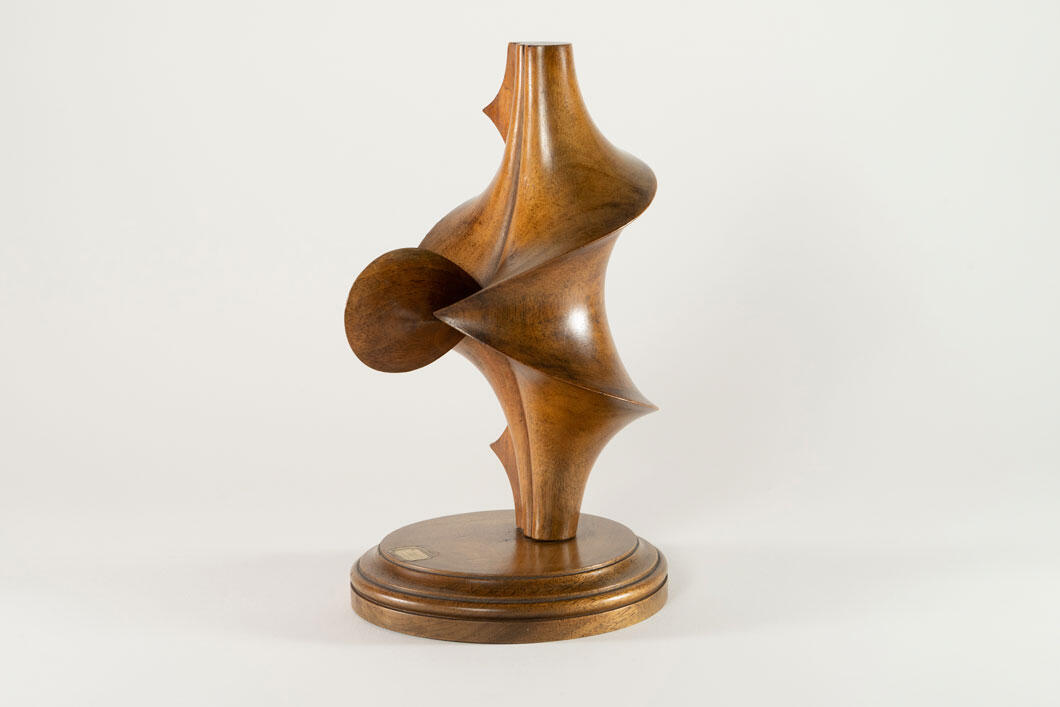
Kuen surface in wood, Henri Duvillard / Collections de l’Institut Henri-Poincaré, Paris (CC BY-NC-SA)
1
The vast majority of the collection’s models are from German manufacturers, initially Ludwig Brill and later Martin Schilling. Their industrial production of wooden and plaster models revolutionised the teaching of descriptive geometry, which had previously been based on educational aids produced by the instructors themselves. With nearly 300 objects from their catalogue, the Institut Henri Poincaré (IHP –CNRS / Sorbonne Université) has the world’s largest and best-preserved collection. This wooden model represents a Kuen surface, with a constant negative curvature. (Coll. Brill-Schilling, Ct-Neg-009.)
Henri Duvillard / Collections de l’Institut Henri-Poincaré, Paris (CC BY-NC-SA)
Slideshow mode
Share
Share
[7]
[8]
[9]
Villarceau circle, photo Henri Duvillard © Collections de l’Institut Henri-Poincaré, Paris (CC BY-NC-SA)
2
A small French industry emerged alongside its German counterpart in the late nineteenth century. The IHP possesses one hundred objects from the catalogue of the French geometrician Charles Muret, such as these plaster Villarceau circles. These figures represent two circles obtained by cutting a torus along a diagonal bitangent plane passing through its centre. (Coll. Muret, Cy-Tor-003.)
Henri Duvillard / Collections de l’Institut Henri-Poincaré, Paris (CC BY-NC-SA)
Slideshow mode
Share
Share
[7]
[10]
[9]
Model of the 27 lines on a cubic surface. Photo Henri Duvillard © Collections de l’Institut Henri-Poincaré, Paris (CC BY-NC-SA)
3
The industrialisation of mathematical models did not bring an end to their artisanal production. The IHP is home to a unique and extremely well conserved collection of some sixty objects. This non-ruled cubic surface and its 27 real straight lines were handmade by the mathematician Joseph Caron at the request of his colleague Gaston Darboux. (Coll. Caron, Cu-Dro-003.)
Henri Duvillard / Collections de l’Institut Henri-Poincaré, Paris (CC BY-NC-SA)
Slideshow mode
Share
Share
[7]
[11]
[9]
Reuleaux triangles. Photos Henri Duvillard © Collections de l’Institut Henri-Poincaré, Paris (CC BY-NC-SA)
4
Some models were primarily used for demonstrations. These three volumes generalise a figure known as a Reuleaux triangle, which is notably quite common in the rose windows of Gothic cathedrals. While different in form, they have the same diameter, which is equal to the distance between the two brass plates. (Coll. Brill-Schilling, Sg-Lgc-001/002/003.)
Henri Duvillard / Collections de l’Institut Henri-Poincaré, Paris (CC BY-NC-SA)
Slideshow mode
Share
Share
[7]
[12]
[9]
Curved surface of light. Photo Henri Duvillard © Collections de l’Institut Henri-Poincaré, Paris (CC BY-NC-SA)
5
Other models tackle the challenge of representing invisible phenomena in material form. This volume represents the curved surface of light that can be observed, for instance, in the patches of light at the bottom of a pool. (Coll. Brill-Schilling, Gd-Cau-001.)
Henri Duvillard / Collections de l’Institut Henri-Poincaré, Paris (CC BY-NC-SA)
Slideshow mode
Share
Share
[7]
[13]
[9]
Galton's model. Photos Henri Duvillard / Collections de l’Institut Henri-Poincaré, Paris (CC BY-NC-SA)
6
While models fell into disuse and lost their utility for teaching during the 1930s, marginal production continued in the ensuing decades for scientific mediation purposes. During the 1980s, the Paris-based Palais de la découverte scientific museum produced numerous objects, which were transferred to the IHP, such as this Galton board (named after the English scientist Francis Galton) representing a statistical analysis showing the correlation between the size of fathers and their sons. (Coll. modèles mathématiques, Od-004.)
Henri Duvillard / Collections de l’Institut Henri-Poincaré, Paris (CC BY-NC-SA)
Slideshow mode
Share
Share
[7]
[14]
[9]
Photo Henri Duvillard © Collections de l’Institut Henri-Poincaré, Paris (CC BY-NC-SA)
7
While the models lost their original educational purpose, they quickly drew another audience after the opening of the IHP, namely artists, and the Surrealists in particular. Initiated by the painter Max Ernst, Man Ray was struck by these objects, and drew inspiration from them for both his photographs and his Shakespearean Equations series of paintings, which made the collection famous across the world and ensured their conservation. Depicted here is a model of a developable surface on the paraboloid of revolution order 12 class 10, which reminded the artist of the story of Romeo and Juliette. (Coll. Brill-Schilling, Qd-005.)
Henri Duvillard / Collections de l’Institut Henri-Poincaré, Paris (CC BY-NC-SA)
Slideshow mode
Share
Share
[7]
[15]
[9]
Gomboc 1928. Photos Henri Duvillard © Collections de l’Institut Henri-Poincaré, Paris (CC BY-NC-SA)
8
While visualisation software has replaced geometric models in both teaching and research, numerous mathematicians continue to produce such objects on their own in order to visualise them in real space, and for the pleasure of creating and handling them. In the 2010s, the IHP received, from the Hungarian mathematician Gábor Domokos and the engineer Péter Várkonyi, this “Gömböc,” an especially rare form with a single stable equilibrium point and a single unstable equilibrium point, such that it always returns to the same position. This one is numbered “1928” in reference to the year of the Institute’s founding. (Coll. modèles mathématiques, Sg-Sta-001)
Henri Duvillard / Collections de l’Institut Henri-Poincaré, Paris (CC BY-NC-SA)
Slideshow mode
Share
Share
[7]
[16]
[9]
Bookshelf. Photo Henri Duvillard © Collections de l’Institut Henri-Poincaré, Paris (CC BY-NC-SA)
9
Rediscovered in the 1980s, the collection’s more than 600 mathematical models became an emblem of the Institute, and were the subject of a new exhaustive inventory completed in 2022 after three years of work. Photographed and scientifically described, all of them can now be viewed on the IHP website. Nearly 300 are exhibited in the library, and about 40 as part of a permanent exhibition at the Maison Poincaré since its opening in 2023.
Henri Duvillard / Collections de l’Institut Henri-Poincaré, Paris (CC BY-NC-SA)
Slideshow mode
Share
Share
[7]
[17]
[9]

À propos

Further information

Visit

La Maison Poincaré, 11 rue Pierre-et-Marie-Curie, 75005 Paris: http://www.ihp.fr/fr/musee-maison-poincare [18]

View

IHP Heritage Collection: https://patrimoine.ihp.fr/ [19] (in French)

View

The beauty behind the math  [20](slideshow)


Explore more

Digital
 metamorworks / iStock.com
[21]
Article
12/02/2025
Science one step ahead [21]
[22]
Article
10/28/2025
Does AI care about us? [22]
Stephane Mallat at work
[23]
Article
09/10/2025
Stéphane Mallat, a pioneer bridging mathematics and computer... [23]
Les Linceuls de David Cronenberg 2024 © Prospero Pictures / SBS Productions / Saint Laurent / Collection ChristopheL
[24]
Article
07/22/2025
Dying with the times [24]
[25]
Article
07/02/2025
Solace of quantum [25]
Mathematics
Stephane Mallat at work
[23]
Article
09/10/2025
Stéphane Mallat, a pioneer bridging mathematics and computer... [23]
[26]
Article
11/29/2024
Alexandre Grothendieck, a committed genius [26]
© benjaminec / stock.adobe.com
[27]
Article
05/30/2024
Enter the matrices! [27]
[28]
Article
07/05/2022
A Fields Medal for Hugo Duminil-Copin [28]
[29]
Article
02/16/2022
Order within disorder [29]
Henri Poincaré Institute
Man facing a blackboard full of equations.
[20]
Slideshow
10/22/2015
The Beauty behind the Math [20]

Keywords

Henri Poincaré Institute [30] mathematical models [31] Surrealists [32] Man Ray [33] Max Ernst [34] Kuen surface [35] Villarceau circles [36] Torus [37] Reuleaux triangle [38] Galton board [39] Gömböc [40]

Share this article

[41]
[42]
[7]
[9]

Source URL:https://news.cnrs.fr/slideshows/mathematical-models-combine-art-and-science

Links
[1] https://news.cnrs.fr/ [2] https://lejournal.cnrs.fr/diaporamas/une-collection-de-modeles-mathematiques-entre-art-et-science [3] https://news.cnrs.fr/javascript%3A%3B [4] https://news.cnrs.fr/digital [5] https://news.cnrs.fr/mathematics [6] https://news.cnrs.fr/authors/maxime-lerolle [7] https://twitter.com/intent/tweet?url=https%3A//news.cnrs.fr/print/2176%2F&text=Mathematical models combine art and science [8] http://www.facebook.com/sharer/sharer.php?s=100&p%5Burl%5D=https%3A//news.cnrs.fr/print/2176&p%5Btitle%5D=Mathematical%20models%20combine%20art%20and%20science&p%5Bimages%5D%5B0%5D=https%3A//news.cnrs.fr/sites/default/files/styles/lightbox-hd/public/assets/images/1_ct-neg-009_72dpi.jpg%3Fitok%3DrQrZv_1G&p%5Bsummary%5D= [9] https://bsky.app/intent/compose?text=Mathematical models combine art and science%0Ahttps%3A//news.cnrs.fr/print/2176 [10] http://www.facebook.com/sharer/sharer.php?s=100&p%5Burl%5D=https%3A//news.cnrs.fr/print/2176&p%5Btitle%5D=Mathematical%20models%20combine%20art%20and%20science&p%5Bimages%5D%5B0%5D=https%3A//news.cnrs.fr/sites/default/files/styles/lightbox-hd/public/assets/images/2_cy-tor-003_72dpi.jpg%3Fitok%3DxVvFwOOe&p%5Bsummary%5D= [11] http://www.facebook.com/sharer/sharer.php?s=100&p%5Burl%5D=https%3A//news.cnrs.fr/print/2176&p%5Btitle%5D=Mathematical%20models%20combine%20art%20and%20science&p%5Bimages%5D%5B0%5D=https%3A//news.cnrs.fr/sites/default/files/styles/lightbox-hd/public/assets/images/3_cu-dro-003_72dpi.jpg%3Fitok%3DIceUSiI8&p%5Bsummary%5D= [12] http://www.facebook.com/sharer/sharer.php?s=100&p%5Burl%5D=https%3A//news.cnrs.fr/print/2176&p%5Btitle%5D=Mathematical%20models%20combine%20art%20and%20science&p%5Bimages%5D%5B0%5D=https%3A//news.cnrs.fr/sites/default/files/styles/lightbox-hd/public/assets/images/4_montage_3volumes.jpg%3Fitok%3DlymRfhIX&p%5Bsummary%5D= [13] http://www.facebook.com/sharer/sharer.php?s=100&p%5Burl%5D=https%3A//news.cnrs.fr/print/2176&p%5Btitle%5D=Mathematical%20models%20combine%20art%20and%20science&p%5Bimages%5D%5B0%5D=https%3A//news.cnrs.fr/sites/default/files/styles/lightbox-hd/public/assets/images/5_gd-cau-001_72dpi.jpg%3Fitok%3DcorlnI0p&p%5Bsummary%5D= [14] http://www.facebook.com/sharer/sharer.php?s=100&p%5Burl%5D=https%3A//news.cnrs.fr/print/2176&p%5Btitle%5D=Mathematical%20models%20combine%20art%20and%20science&p%5Bimages%5D%5B0%5D=https%3A//news.cnrs.fr/sites/default/files/styles/lightbox-hd/public/assets/images/6_montage_galton_l1451px.jpg%3Fitok%3Dmt8PwbIr&p%5Bsummary%5D= [15] http://www.facebook.com/sharer/sharer.php?s=100&p%5Burl%5D=https%3A//news.cnrs.fr/print/2176&p%5Btitle%5D=Mathematical%20models%20combine%20art%20and%20science&p%5Bimages%5D%5B0%5D=https%3A//news.cnrs.fr/sites/default/files/styles/lightbox-hd/public/assets/images/7_qd-005_72dpi.jpg%3Fitok%3DxjjWa3Js&p%5Bsummary%5D= [16] http://www.facebook.com/sharer/sharer.php?s=100&p%5Burl%5D=https%3A//news.cnrs.fr/print/2176&p%5Btitle%5D=Mathematical%20models%20combine%20art%20and%20science&p%5Bimages%5D%5B0%5D=https%3A//news.cnrs.fr/sites/default/files/styles/lightbox-hd/public/assets/images/8_montage_gombac_l1200px.jpg%3Fitok%3DmeomSdoI&p%5Bsummary%5D= [17] http://www.facebook.com/sharer/sharer.php?s=100&p%5Burl%5D=https%3A//news.cnrs.fr/print/2176&p%5Btitle%5D=Mathematical%20models%20combine%20art%20and%20science&p%5Bimages%5D%5B0%5D=https%3A//news.cnrs.fr/sites/default/files/styles/lightbox-hd/public/assets/images/9_img_1568hd_decadre.jpg%3Fitok%3D-lgvkVsI&p%5Bsummary%5D= [18] http://www.ihp.fr/fr/musee-maison-poincare [19] https://patrimoine.ihp.fr/ [20] https://news.cnrs.fr/slideshows/beauty-behind-math [21] https://news.cnrs.fr/articles/science-one-step-ahead [22] https://news.cnrs.fr/articles/does-ai-care-about-us [23] https://news.cnrs.fr/articles/stephane-mallat-a-pioneer-bridging-mathematics-and-computer-science [24] https://news.cnrs.fr/articles/dying-with-the-times [25] https://news.cnrs.fr/articles/solace-of-quantum [26] https://news.cnrs.fr/articles/alexandre-grothendieck-a-committed-genius [27] https://news.cnrs.fr/articles/enter-the-matrices [28] https://news.cnrs.fr/articles/a-fields-medal-for-hugo-duminil-copin [29] https://news.cnrs.fr/articles/order-within-disorder [30] https://news.cnrs.fr/henri-poincare-institute [31] https://news.cnrs.fr/mathematical-models [32] https://news.cnrs.fr/surrealists [33] https://news.cnrs.fr/man-ray [34] https://news.cnrs.fr/max-ernst [35] https://news.cnrs.fr/kuen-surface [36] https://news.cnrs.fr/villarceau-circles [37] https://news.cnrs.fr/torus [38] https://news.cnrs.fr/reuleaux-triangle [39] https://news.cnrs.fr/galton-board [40] https://news.cnrs.fr/gomboc [41] http://www.facebook.com/sharer/sharer.php?s=100&p%5Burl%5D=https%3A//news.cnrs.fr/print/2176&p%5Btitle%5D=Mathematical%20models%20combine%20art%20and%20science&p%5Bimages%5D%5B0%5D=&p%5Bsummary%5D= [42] https://news.cnrs.fr/printmail/2176