CNRS News
Published on CNRS News (https://news.cnrs.fr)

Home > Vampires combine fear, laughter and entertainment

Vampires combine fear, laughter and entertainment

You are here

Home [1]
Lire en français [2]
Society [3]
Interview [4]
-A [5] +A [5]
article

Vampires combine fear, laughter and entertainment

01.15.2025, by
Maxime Lerolle [6]
Reading time: 5 minutes
 Focus Features - Maiden Voyage - Stillking Films - Studio 8 / Collection ChristopheL
Lily-Rose Depp in the Nosferatu remake directed by Robert Eggers.
Focus Features - Maiden Voyage - Stillking Films - Studio 8 / Collection ChristopheL
As a remake of the 1922 film Nosferatu was recently released, the sociologist Arnaud Esquerre takes a new look at the vampire – a figure that, from its emergence in the 18th century to the present day, has questioned the organisation between the dead and the living.

In 2022 you published the book Ainsi se meuvent les vampires (“How Vampires Operate”). Why would a sociologist take an interest in these fictional creatures?
Arnaud Esquerre1: Generally speaking, sociologists are expected to study contemporary social groups rather than fantasy creatures, as though the latter were reserved for comparative literature or anthropology. But they can also be studied from a sociological angle. It’s a question of knowing how. I became interested in vampires because they combine various aspects of my previous projects: the relationship between human remains and funerary practices (Bones, Ashes and the State, 2011), the fantasy narrative based on eyewitness reports of unidentified aerial phenomena (Theory of Extraterrestrial Events. An Essay on Fantasy Narratives, 2016), film censorship (Banning from View. Sex, Violence and Freedom of Expression in Film, 2019), and more specifically films about vampires for a 2019 exhibition at the Cinémathèque Française2.


Collection ChristopheL © Hammer Production
Christopher Lee is probably the best-known Count Dracula, having played the character in ten films (shown here in Dracula Has Risen from the Grave by Freddie Francis, 1968).
CNRS News
Collection ChristopheL © Hammer Production
Christopher Lee is probably the best-known Count Dracula, having played the character in ten films (shown here in Dracula Has Risen from the Grave by Freddie Francis, 1968).
Hammer Production / Collection ChristopheL
Share
Share
[7] [8] [9]

How would you define vampires?
A. E.: Even though the meaning of the word varies from era to era, one constant factor remains: the couple formed by the vampire and the vampirised person. A vampire is never envisioned alone, but always in the context of an asymmetrical relationship involving differences in life force. Unlike a vampire, a ghost can disturb the inhabitants of a haunted house without draining their vital energy, as in the stories of mid-20th-century England studied by the anthropologist Grégory Delaplace [10].

In what context did the figure of the vampire emerge?
A. E.: The term appeared in the early 18th century in the easternmost regions of the Habsburg Empire. It cropped up first not in literature, but in a series of texts including medical investigations, military reports, diplomatic correspondence and ecclesiastical texts mentioning villages where dead people would terrorise the living. These stories, which quickly caught the attention of European newspapers, immediately drew the ridicule of Enlightenment philosophers like Voltaire and Rousseau, who scoffed at the existence of such superstition at the height of the Age of Reason.

Vampires emerged at a time when doctors and architects in Europe were raising questions about the organisation of the dead and the living: how cemeteries could be moved away from city centres, how to transform communal graves into green spaces for strolling, how to determine the moment of death so as to avoid burying someone alive…

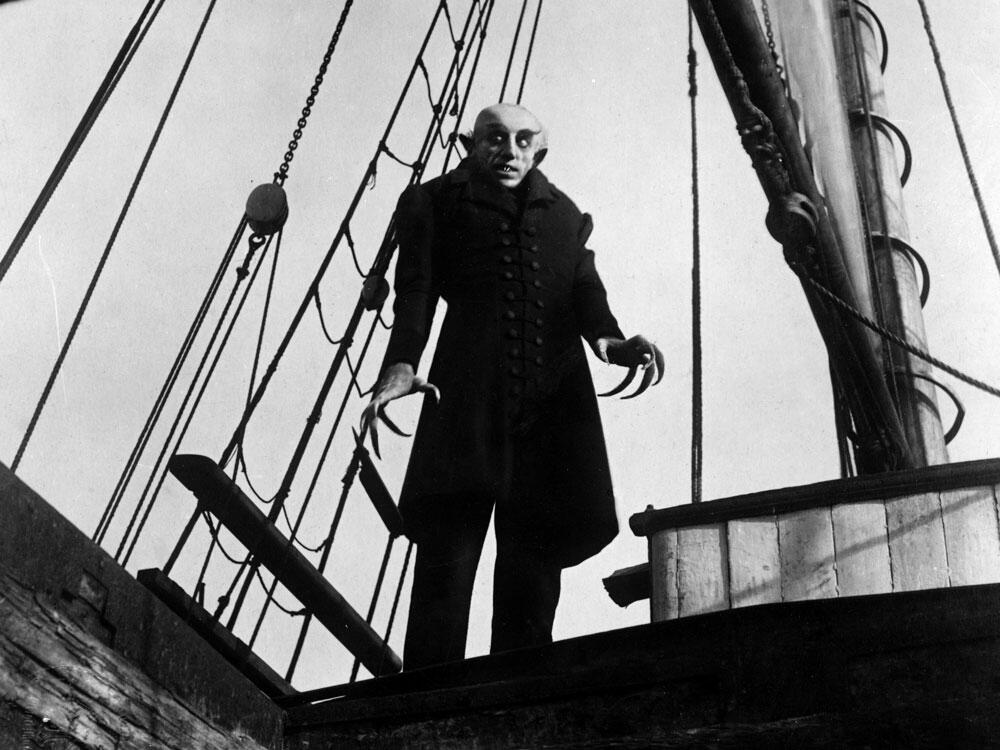
Collection ChristopheL © World History Archive
The first Nosferatu dates from 1922, with Max Schreck portraying Count Orlock. Directed by F. W. Murnau, this silent film is a masterpiece of German expressionism.
CNRS News
Collection ChristopheL © World History Archive
The first Nosferatu dates from 1922, with Max Schreck portraying Count Orlock. Directed by F. W. Murnau, this silent film is a masterpiece of German expressionism.
World History Archive / Collection ChristopheL
Share
Share
[7] [11] [9]

How have the meaning and representations of vampires evolved?
A. E.: During the 19th century the word ‘vampire’ underwent several important changes in meaning. The main one was a complete reversal of position: instead of dead people terrorising the living, vampires could be living humans attacking the dead. This came about largely due to the so-called ‘Sergeant Bertrand Affair’: between 1848 and 1849, the French public was shocked to learn that an officer named François Bertrand had been violating graves to engage in sex with the corpses. Seizing on the popularity of the term, which had entered European literature in 1819 with the very famous character of Lord Ruthven in a short story entitled The Vampyre by the British writer John William Polidori, the press immediately nicknamed Bertrand ‘the vampire of Montparnasse’. Today he would be called a necrophile.

Other uses of the word ‘vampire’ surfaced in the 19th century. One came from Karl Marx himself, who in Das Kapital depicts capitalism as ‘dead labour, that, vampire-like, only lives by sucking living labour, and lives the more, the more labour it sucks’. The vampire takes an anti-Semitic turn in Bram Stoker’s novel Dracula (1897), whose main character is described as being tight-fisted and having the smile of Judas, at a time when the word ‘anti-Semite’, coined in the 1880s, was spreading through Europe.

Starting with Friedrich Murnau’s Nosferatu: A Symphony of Horror in 1922, vampires have invaded the cinema screen. How do you explain their popularity?
A. E.: First of all by the malleable character of the vampire, which can take on different characteristics depending on the context. Murnau’s Nosferatu transposed the novel Dracula to Bremen in the context of post-WWI Germany, and had a lasting influence on the representations of vampires in film.

Collection ChristopheL © Recorded Picture Company / Pandora Filmproduktion
Tilda Swinton in Only Lovers Left Alive by Jim Jarmusch, 2014.
CNRS News
Collection ChristopheL © Recorded Picture Company / Pandora Filmproduktion
Tilda Swinton in Only Lovers Left Alive by Jim Jarmusch, 2014.
Recorded Picture Company / Pandora Filmproduktion / Collection ChristopheL
Share
Share
[7] [12] [9]

In addition, unlike other fantasy creatures, the vampire produces effects that can be at once terrifying, comical and sexually desirable. Jim Jarmusch’s Only Lovers Left Alive (2013) is a good example of this: a poetic, romantic film that plays on the hallmarks of vampire movies, namely fear, humour and amorous passion. Many vampire films involve a fusion of horror, comedy and entertainment.

More than a century after Murnau’s German expressionist film, the American filmmaker Robert Eggers has created a remake of Nosferatu. How has the treatment of vampires changed between the 1920s and the present day? What do vampires say about today’s society?
A. E.: In one century, the portrayals of vampires in films and on television have become extremely diversified. The proliferation of works has generated a multiplication of characters, to the point that a remake of Murnau’s Nosferatu depicting the traditional figure of the bloodsucker attacking ‘decent society’ can coexist with the vampires of the novelist Anne Rice, especially in Interview with a Vampire, or those in the TV series True Blood, both of which explore the concurrence of human and vampiric societies. Each new opus, in the way it represents the dichotomy between vampires and vampirised people, offers a different treatment of the social relations at work. ♦


Footnotes
  • 1. CNRS research professor at the IRIS institute for interdisciplinary research on social issues (CNRS / EHESS / INSERM / Université Sorbonne-Paris Nord).
  • 2. www.cinematheque.fr/exposition/vampires.html [13] (in French).

Explore more

Society
Two women stand on the remains of a house destroyed by erosion on the banks of the Padma River, Bangladesh.
[14]
Article
02/13/2026
Citizens of the world on the same wavelength [14]
[15]
Article
02/10/2026
How the piano set the world in tune [15]
Detail of The Harvesters, by Pieter Brueghel The Elder, 1565. New York, The Metropolitan Museum of Art.
[16]
Article
01/23/2026
The eternal quest for healthy eating [16]
 metamorworks / iStock.com
[17]
Article
12/02/2025
Science one step ahead [17]
adoption of a historic global warming pact at the COP21 Climate Conference in Le Bourget, north of Paris, on December 12, 2015
[18]
Article
11/09/2025
Ten years on, mixed results for the Paris Agreement [18]
Interview
[19]
Article
01/20/2025
Telescopes face down-to-earth challenges [19]
[20]
Article
11/07/2024
Friends, the robot that adapts in the blink of an eye [20]
 Tallandier / Bridgeman Images
[10]
Article
07/22/2024
Anthropology tracks the Invisible [10]
[21]
Article
06/24/2024
Russian propaganda floods Europe's social networks [21]
[22]
Article
06/20/2024
Astronomy through the back door [22]
Vampire
[23]
Article
08/28/2018
Shelley’s Frankenstein: a Feminist Novel? [23]

Keywords

Vampire [24] Anthropology [25] ghosts [26] Enlightenment [27] Age of reason [28] Sergeant Bertrand [29] necrophilia [30] Karl Marx [31] anti-semitism [32] Nosferatu [33] Dracula [34] Friedrich Murnau [35] Anne Rice [36]

Share this article

[37]
[38]
[7]
[9]

Source URL:https://news.cnrs.fr/articles/vampires-combine-fear-laughter-and-entertainment

Links
[1] https://news.cnrs.fr/ [2] https://lejournal.cnrs.fr/articles/les-vampires-entrelacent-faire-peur-faire-rire-et-faire-jouir [3] https://news.cnrs.fr/society [4] https://news.cnrs.fr/interview [5] https://news.cnrs.fr/javascript%3A%3B [6] https://news.cnrs.fr/authors/maxime-lerolle [7] https://twitter.com/intent/tweet?url=https%3A//news.cnrs.fr/print/2148%2F&text=Vampires combine fear, laughter and entertainment [8] http://www.facebook.com/sharer/sharer.php?s=100&p%5Burl%5D=https%3A//news.cnrs.fr/print/2148&p%5Btitle%5D=Vampires%20combine%20fear%2C%20laughter%20and%20entertainment&p%5Bimages%5D%5B0%5D=https%3A//news.cnrs.fr/sites/default/files/styles/lightbox-hd/public/assets/images/christophel_nz_chlnzd_002429_72dpi.jpg%3Fitok%3DKiq4dewu&p%5Bsummary%5D= [9] https://bsky.app/intent/compose?text=Vampires combine fear, laughter and entertainment%0Ahttps%3A//news.cnrs.fr/print/2148 [10] https://news.cnrs.fr/articles/anthropology-tracks-the-invisible [11] http://www.facebook.com/sharer/sharer.php?s=100&p%5Burl%5D=https%3A//news.cnrs.fr/print/2148&p%5Btitle%5D=Vampires%20combine%20fear%2C%20laughter%20and%20entertainment&p%5Bimages%5D%5B0%5D=https%3A//news.cnrs.fr/sites/default/files/styles/lightbox-hd/public/assets/images/nosferatu_1922_72dpi.jpg%3Fitok%3DUVIVl-HL&p%5Bsummary%5D= [12] http://www.facebook.com/sharer/sharer.php?s=100&p%5Burl%5D=https%3A//news.cnrs.fr/print/2148&p%5Btitle%5D=Vampires%20combine%20fear%2C%20laughter%20and%20entertainment&p%5Bimages%5D%5B0%5D=https%3A//news.cnrs.fr/sites/default/files/styles/lightbox-hd/public/assets/images/christophel_bfonly_lovers_left_alive_2014_012_72dpi.jpg%3Fitok%3DJM-JffWn&p%5Bsummary%5D= [13] http://www.cinematheque.fr/exposition/vampires.html [14] https://news.cnrs.fr/articles/citizens-of-the-world-on-the-same-wavelength [15] https://news.cnrs.fr/articles/how-the-piano-set-the-world-in-tune [16] https://news.cnrs.fr/articles/the-eternal-quest-for-healthy-eating [17] https://news.cnrs.fr/articles/science-one-step-ahead [18] https://news.cnrs.fr/articles/ten-years-on-mixed-results-for-the-paris-agreement [19] https://news.cnrs.fr/articles/telescopes-face-down-to-earth-challenges [20] https://news.cnrs.fr/articles/friends-the-robot-that-adapts-in-the-blink-of-an-eye [21] https://news.cnrs.fr/articles/russian-propaganda-floods-europes-social-networks [22] https://news.cnrs.fr/articles/astronomy-through-the-back-door [23] https://news.cnrs.fr/articles/shelleys-frankenstein-a-feminist-novel [24] https://news.cnrs.fr/vampire [25] https://news.cnrs.fr/anthropology-0 [26] https://news.cnrs.fr/ghosts [27] https://news.cnrs.fr/enlightenment [28] https://news.cnrs.fr/age-of-reason [29] https://news.cnrs.fr/sergeant-bertrand [30] https://news.cnrs.fr/necrophilia [31] https://news.cnrs.fr/karl-marx [32] https://news.cnrs.fr/anti-semitism [33] https://news.cnrs.fr/nosferatu [34] https://news.cnrs.fr/dracula [35] https://news.cnrs.fr/friedrich-murnau [36] https://news.cnrs.fr/anne-rice [37] http://www.facebook.com/sharer/sharer.php?s=100&p%5Burl%5D=https%3A//news.cnrs.fr/print/2148&p%5Btitle%5D=Vampires%20combine%20fear%2C%20laughter%20and%20entertainment&p%5Bimages%5D%5B0%5D=&p%5Bsummary%5D= [38] https://news.cnrs.fr/printmail/2148