CNRS News
Published on CNRS News (https://news.cnrs.fr)

Home > Planktonic Encounters

Planktonic Encounters

You are here

Home [1]
Lire en français [2]
slideshow
-A [3] +A [3]
Life [4]
Marine biology [5]

Planktonic Encounters

03.10.2016, by
Audrey Diguet [6]
Plankton, which consists of microscopic organisms of plant or animal origin, comes in a wide variety of shapes—each more surprising than the next. Biologist John Dolan, who studies this fascinating diversity, shares a few specimens seen under his microscope in samples from the Mediterranean Sea and the Pacific and Southern Oceans.

John Dolan is Director of Research at the Laboratoire d'Océanographie de Villefranche-sur-Mer (CNRS / UPMC).
 

1
Our first encounter is with diatoms, plankton of plant origin (phytoplankton) from the waters of the Southern Ocean—the Amundsen Sea to be precise, on the west coast of Antarctica.
John DOLAN / LOV / CNRS Photothèque
Slideshow mode
Share
Share
[7]
[8]
[9]
2
Diatoms are unicellular algae contained in a silica house. Pictured here, the "Rhizosolenia sima forma silicea" (Amundsen Sea).
John DOLAN / LOV / CNRS Photothèque
Slideshow mode
Share
Share
[7]
[10]
[9]
3
"Climacodium sp." diatom (South Pacific Ocean).
John DOLAN / LOV / CNRS Photothèque
Slideshow mode
Share
Share
[7]
[11]
[9]
4
"Triceratium favus" diatom (Bay of Villefranche-sur-Mer, southern France).
John DOLAN / LOV / CNRS Photothèque
Slideshow mode
Share
Share
[7]
[12]
[9]
5
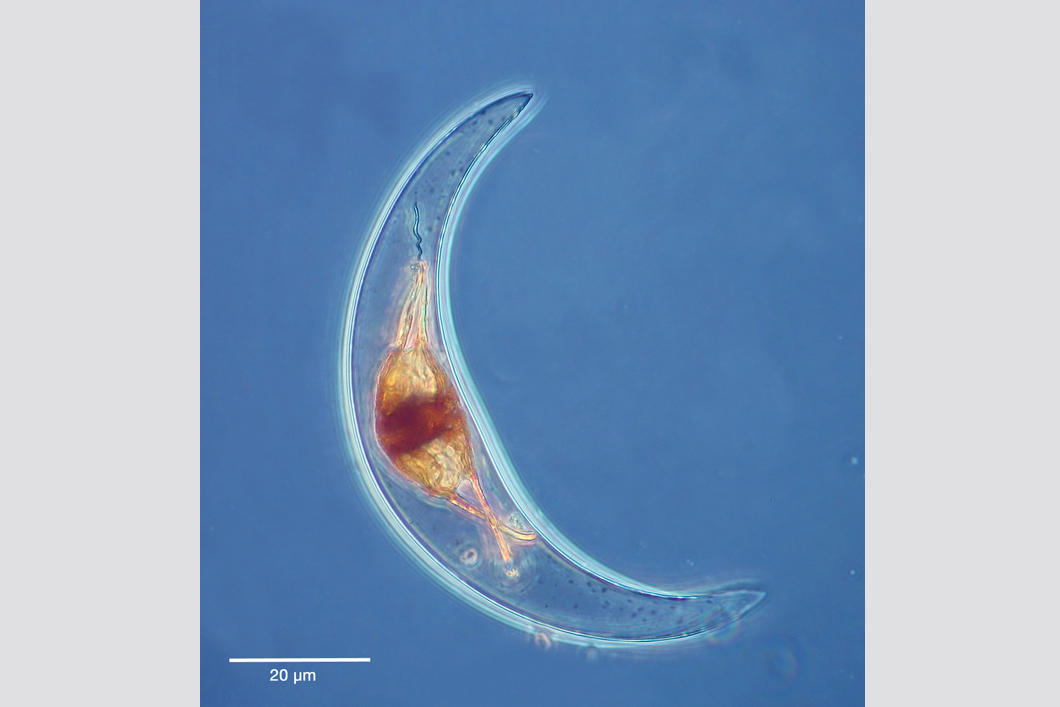
Pictured here is a dinoflagellate from the waters of the Bay of Villefranche, on the French Mediterranean coast. This area has a rich plankton biodiversity, due to the Ligurian-Provencal current that flows nearby. "Pyrocystis lunula" dinoflagellate (Bay of Villefranche-sur-Mer, southern France).
John DOLAN / LOV / CNRS Photothèque
Slideshow mode
Share
Share
[7]
[13]
[9]
6
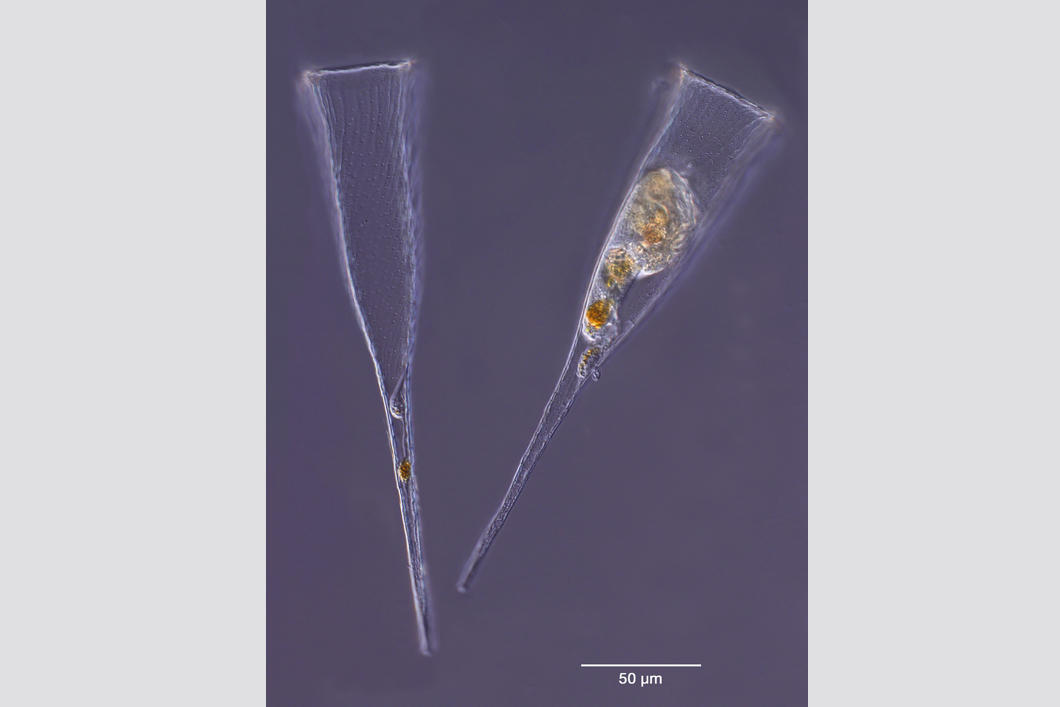
Tintinnids, a type of animal plankton (zooplankton). These are unicellular organisms that “graze” on microscopic algae. Ciliated tintinnid "Codonellopsis orthoceras" (South Pacific Ocean).
John DOLAN / LOV / CNRS Photothèque
Slideshow mode
Share
Share
[7]
[14]
[9]
7
In most cases, tintinnids create a shell that is transparent. The left shell is empty, while a living organism is still retracted into the right shell. Ciliated tintinnid "Rhabdonella spiralis" (Bay of Villefranche-sur-mer, southern France).
John DOLAN / LOV / CNRS Photothèque
Slideshow mode
Share
Share
[7]
[15]
[9]
8
This ciliated tintinnid from the genus "Cymatocylis” (Amundsen Sea) is only found in the Southern Ocean.
John DOLAN / LOV / CNRS Photothèque
Slideshow mode
Share
Share
[7]
[16]
[9]
9
Enter the world of radiolarians. As tintinnids, these animal organisms prey on microscopic algae. Pictured here, a "Challengeria balfouri" radiolarian (Amundsen Sea).
John DOLAN / LOV / CNRS Photothèque
Slideshow mode
Share
Share
[7]
[17]
[9]
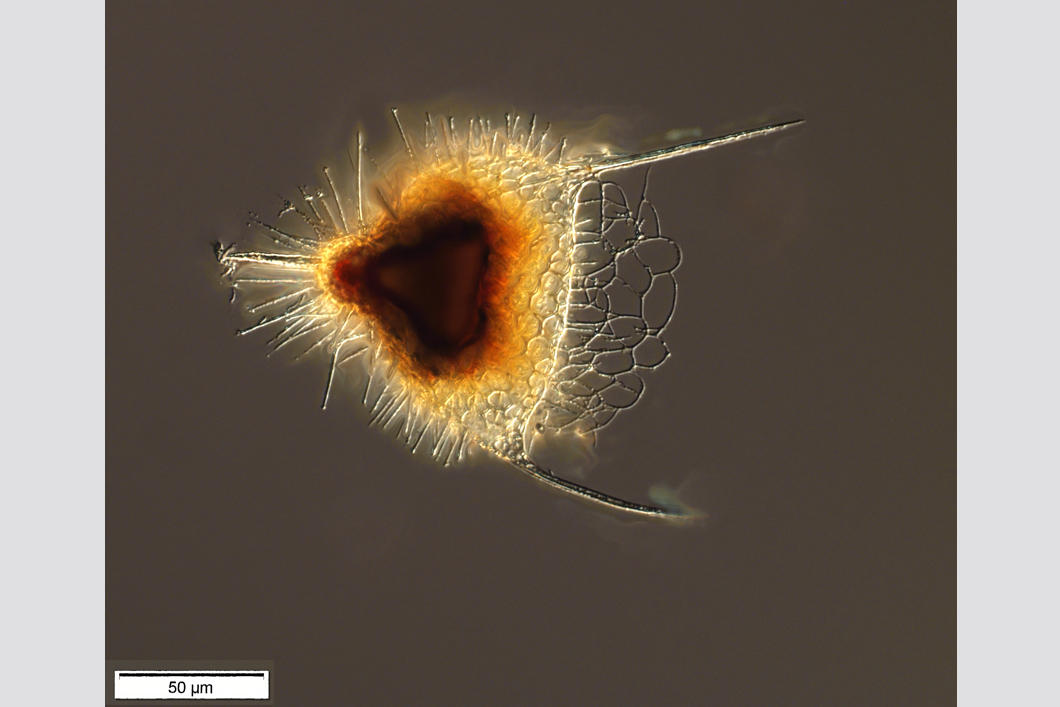
10
Animal plankton (zooplankton) consume and often control phytoplankton. "Rhizoplegma boreal" radiolarian (Amundsen Sea).
John DOLAN / LOV / CNRS Photothèque
Slideshow mode
Share
Share
[7]
[18]
[9]
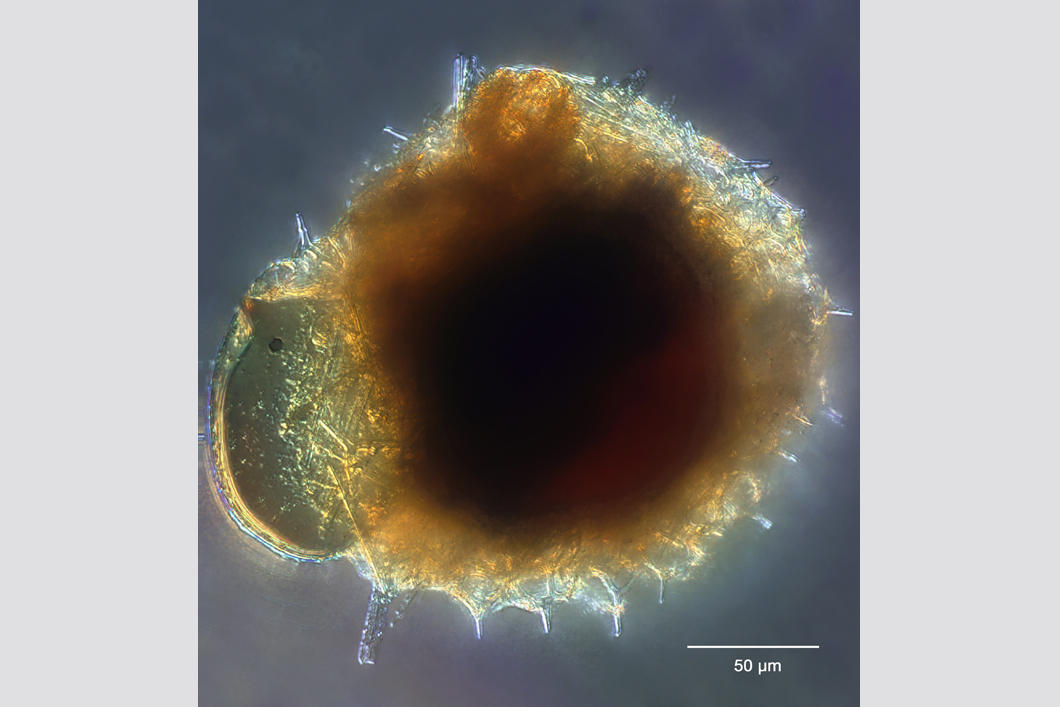
11
Like diatoms, radiolarians are contained in an external skeleton of silica. "Pterocanium sp.," radiolarian (South Pacific Ocean).
John DOLAN / LOV / CNRS Photothèque
Slideshow mode
Share
Share
[7]
[19]
[9]
12
Recently inaugurated, the oceanographic vessel Sagitta III will enable researchers to collect plankton off the Bay of Villefranche, up to 1000 m deep. This should allow for many new discoveries. "Phaeosphaera nucleolongata" radiolarian (Bay of Villefranche-sur-Mer, southern France).
John DOLAN / LOV / CNRS Photothèque
Slideshow mode
Share
Share
[7]
[20]
[9]

Explore more

Life
Bats on a tree
[21]
Article
11/26/2025
Bats, super virus busters [21]
A male zebra trying to wake a dead pregnant female zebra
[22]
Article
11/24/2025
Animals are no strangers to death [22]
[23]
Article
09/24/2025
When phytoplankton kills [23]
bacteriophage © University of Basel / Biozentrum / SPL
[24]
Article
09/01/2025
Medicine goes viral [24]
Illustration d’un Gastornis gigantea poursuivant une proie © Jaime Chirinos / SPL
[25]
Article
08/07/2025
Giants with feet of clay [25]
Marine biology
[26]
Article
10/10/2023
Unlocking the secrets of marine genomes [26]
© CNRS Images 2022
[27]
Video
02/23/2023
How do baby algae come into being ? [27]
[28]
Slideshow
12/07/2021
Sea urchins under threat [28]
[29]
Article
12/20/2020
Tracking the bluefin tuna [29]
[30]
Article
06/18/2018
An Albatross Colony Flies towards Danger [30]
Plankton
Eric Karsenti
[31]
Infographics
12/14/2015
Eric Karsenti, Explorer of the Living World [31]

Keywords

Plankton [32] Phytoplankton [33] Zooplankton [34] Biodiversity [35] Amundsen Sea [36] Mediterranean Sea [37] Pacific Ocean [38]

Share this article

[39]
[40]
[7]
[9]

Source URL:https://news.cnrs.fr/slideshows/planktonic-encounters

Links
[1] https://news.cnrs.fr/ [2] https://lejournal.cnrs.fr/diaporamas/rencontres-planctoniques [3] https://news.cnrs.fr/javascript%3A%3B [4] https://news.cnrs.fr/life [5] https://news.cnrs.fr/marine-biology [6] https://news.cnrs.fr/authors/audrey-diguet [7] https://twitter.com/intent/tweet?url=https%3A//news.cnrs.fr/print/919%2F&text=Planktonic Encounters [8] http://www.facebook.com/sharer/sharer.php?s=100&p%5Burl%5D=https%3A//news.cnrs.fr/print/919&p%5Btitle%5D=Planktonic%20Encounters%20%20&p%5Bimages%5D%5B0%5D=https%3A//news.cnrs.fr/sites/default/files/styles/lightbox-hd/public/assets/images/20120001_1765_bis.jpg%3Fitok%3DNAu98ES1&p%5Bsummary%5D= [9] https://bsky.app/intent/compose?text=Planktonic Encounters %0Ahttps%3A//news.cnrs.fr/print/919 [10] http://www.facebook.com/sharer/sharer.php?s=100&p%5Burl%5D=https%3A//news.cnrs.fr/print/919&p%5Btitle%5D=Planktonic%20Encounters%20%20&p%5Bimages%5D%5B0%5D=https%3A//news.cnrs.fr/sites/default/files/styles/lightbox-hd/public/assets/images/20120001_1777_bis.jpg%3Fitok%3DFLZJMgH3&p%5Bsummary%5D= [11] http://www.facebook.com/sharer/sharer.php?s=100&p%5Burl%5D=https%3A//news.cnrs.fr/print/919&p%5Btitle%5D=Planktonic%20Encounters%20%20&p%5Bimages%5D%5B0%5D=https%3A//news.cnrs.fr/sites/default/files/styles/lightbox-hd/public/assets/images/20150011_0009_bis.jpg%3Fitok%3DfR9Dnket&p%5Bsummary%5D= [12] http://www.facebook.com/sharer/sharer.php?s=100&p%5Burl%5D=https%3A//news.cnrs.fr/print/919&p%5Btitle%5D=Planktonic%20Encounters%20%20&p%5Bimages%5D%5B0%5D=https%3A//news.cnrs.fr/sites/default/files/styles/lightbox-hd/public/assets/images/20150001_0777_bis.jpg%3Fitok%3D8FxcB_CC&p%5Bsummary%5D= [13] http://www.facebook.com/sharer/sharer.php?s=100&p%5Burl%5D=https%3A//news.cnrs.fr/print/919&p%5Btitle%5D=Planktonic%20Encounters%20%20&p%5Bimages%5D%5B0%5D=https%3A//news.cnrs.fr/sites/default/files/styles/lightbox-hd/public/assets/images/20120001_1786_bis.jpg%3Fitok%3DX2o9rWtr&p%5Bsummary%5D= [14] http://www.facebook.com/sharer/sharer.php?s=100&p%5Burl%5D=https%3A//news.cnrs.fr/print/919&p%5Btitle%5D=Planktonic%20Encounters%20%20&p%5Bimages%5D%5B0%5D=https%3A//news.cnrs.fr/sites/default/files/styles/lightbox-hd/public/assets/images/20150001_0789_bis.jpg%3Fitok%3DR4_RqWNw&p%5Bsummary%5D= [15] http://www.facebook.com/sharer/sharer.php?s=100&p%5Burl%5D=https%3A//news.cnrs.fr/print/919&p%5Btitle%5D=Planktonic%20Encounters%20%20&p%5Bimages%5D%5B0%5D=https%3A//news.cnrs.fr/sites/default/files/styles/lightbox-hd/public/assets/images/20120001_1790_v3.jpg%3Fitok%3DwL4Eo9Kc&p%5Bsummary%5D= [16] http://www.facebook.com/sharer/sharer.php?s=100&p%5Burl%5D=https%3A//news.cnrs.fr/print/919&p%5Btitle%5D=Planktonic%20Encounters%20%20&p%5Bimages%5D%5B0%5D=https%3A//news.cnrs.fr/sites/default/files/styles/lightbox-hd/public/assets/images/20120001_1772_bis.jpg%3Fitok%3Dw07A63Ln&p%5Bsummary%5D= [17] http://www.facebook.com/sharer/sharer.php?s=100&p%5Burl%5D=https%3A//news.cnrs.fr/print/919&p%5Btitle%5D=Planktonic%20Encounters%20%20&p%5Bimages%5D%5B0%5D=https%3A//news.cnrs.fr/sites/default/files/styles/lightbox-hd/public/assets/images/20120001_1787_bis.jpg%3Fitok%3D-dWRm_EM&p%5Bsummary%5D= [18] http://www.facebook.com/sharer/sharer.php?s=100&p%5Burl%5D=https%3A//news.cnrs.fr/print/919&p%5Btitle%5D=Planktonic%20Encounters%20%20&p%5Bimages%5D%5B0%5D=https%3A//news.cnrs.fr/sites/default/files/styles/lightbox-hd/public/assets/images/20120001_1797_bis.jpg%3Fitok%3DXCJtZdIa&p%5Bsummary%5D= [19] http://www.facebook.com/sharer/sharer.php?s=100&p%5Burl%5D=https%3A//news.cnrs.fr/print/919&p%5Btitle%5D=Planktonic%20Encounters%20%20&p%5Bimages%5D%5B0%5D=https%3A//news.cnrs.fr/sites/default/files/styles/lightbox-hd/public/assets/images/20150011_0003_bis.jpg%3Fitok%3DKeyC1d7o&p%5Bsummary%5D= [20] http://www.facebook.com/sharer/sharer.php?s=100&p%5Burl%5D=https%3A//news.cnrs.fr/print/919&p%5Btitle%5D=Planktonic%20Encounters%20%20&p%5Bimages%5D%5B0%5D=https%3A//news.cnrs.fr/sites/default/files/styles/lightbox-hd/public/assets/images/cnrs_20120001_1788_bis.jpg%3Fitok%3DaU7Hv1Xy&p%5Bsummary%5D= [21] https://news.cnrs.fr/articles/bats-super-virus-busters [22] https://news.cnrs.fr/articles/animals-are-no-strangers-to-death [23] https://news.cnrs.fr/articles/when-phytoplankton-kills [24] https://news.cnrs.fr/articles/medicine-goes-viral [25] https://news.cnrs.fr/articles/giants-with-feet-of-clay [26] https://news.cnrs.fr/articles/unlocking-the-secrets-of-marine-genomes [27] https://news.cnrs.fr/videos/how-do-baby-algae-come-into-being [28] https://news.cnrs.fr/slideshows/sea-urchins-under-threat [29] https://news.cnrs.fr/articles/tracking-the-bluefin-tuna [30] https://news.cnrs.fr/articles/an-albatross-colony-flies-towards-danger [31] https://news.cnrs.fr/infographics/eric-karsenti-explorer-of-the-living-world [32] https://news.cnrs.fr/plankton [33] https://news.cnrs.fr/phytoplankton [34] https://news.cnrs.fr/zooplankton [35] https://news.cnrs.fr/biodiversity [36] https://news.cnrs.fr/amundsen-sea [37] https://news.cnrs.fr/mediterranean-sea [38] https://news.cnrs.fr/pacific-ocean [39] http://www.facebook.com/sharer/sharer.php?s=100&p%5Burl%5D=https%3A//news.cnrs.fr/print/919&p%5Btitle%5D=Planktonic%20Encounters%20%20&p%5Bimages%5D%5B0%5D=&p%5Bsummary%5D= [40] https://news.cnrs.fr/printmail/919