CNRS News
Published on CNRS News (https://news.cnrs.fr)

Home > Modelling the lungs for personalised medicine

Modelling the lungs for personalised medicine

You are here

Home [1]
Lire en français [2]
Life [3]
Biology [4]
-A [5] +A [5]
article

Modelling the lungs for personalised medicine

06.22.2023, by
Marc Fournet [6]
Reading time: 3 minutes
© Who is Danny / stock.adobe.com
Who is Danny / stock.adobe.com
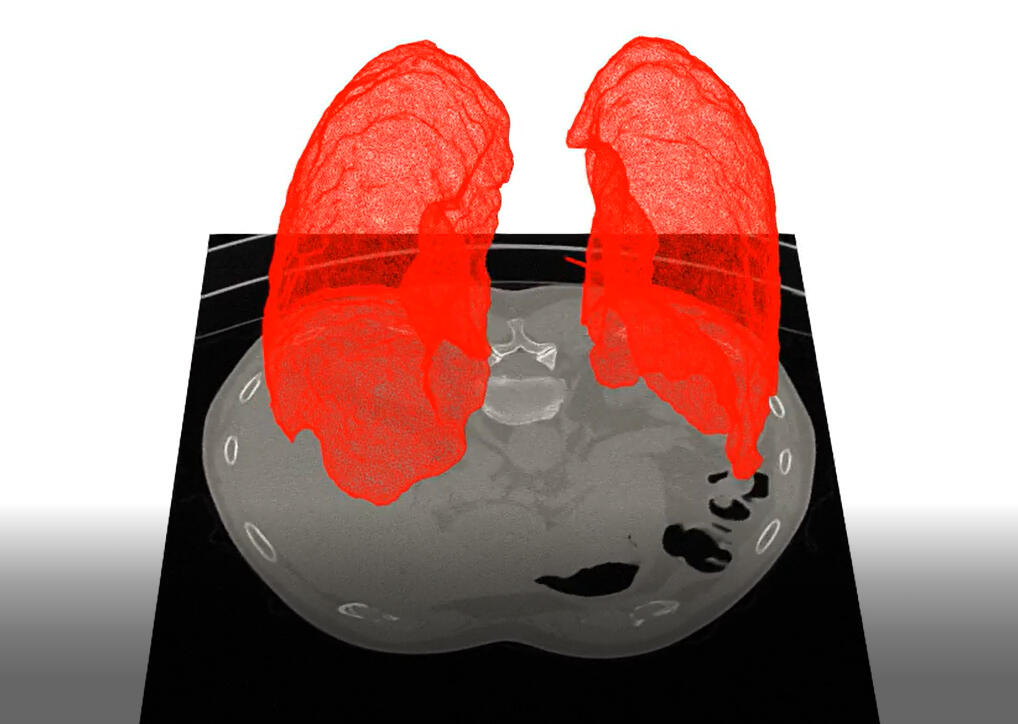
Modelling lung mechanics on all of the scales characteristic of the organ is currently lacking, especially when it comes to understanding the diagnosis and treatment of pulmonary fibrosis. To meet this need, researchers are developing an algorithm that can generate an actual digital twin of a patient’s lungs.

Today’s lung models are essentially single-scale and/or linear. However, the lungs are extremely complex organs, with strongly related phenomena occurring on different scales: for example, the lungs do not double in volume when twice the pressure is exerted on them. Martin Genet, an academic at École polytechnique, and his MEDISIM team at the Solid Mechanics Laboratory1 are developing new multi-scale, non-linear models and algorithms to generate more refined simulations of the lungs. The goal is to gain a better understanding of pulmonary fibrosis, as well as to promote medicine that is more personalised, objective, and quantitative. This research is funded by the French National Research Agency (ANR), whose goal is to support French research excellence and innovation at the national, European, and international level.

“Some idiopathic diseases, in other words whose causes and evolution are poorly understood, could have early warning signs that cannot be detected with current diagnostic approaches,” emphasizes Genet. “For instance, a model that can accurately estimate the rigidity of alveoli could improve our understanding and classification of different fibroses.” Thanks to their algorithm, the researchers can produce a faithful, precise, and personalised model, an actual “digital twin” of the organ. This algorithm is by necessity non-linear, which makes it more complex, but that is not the only difficulty researchers face in its development.
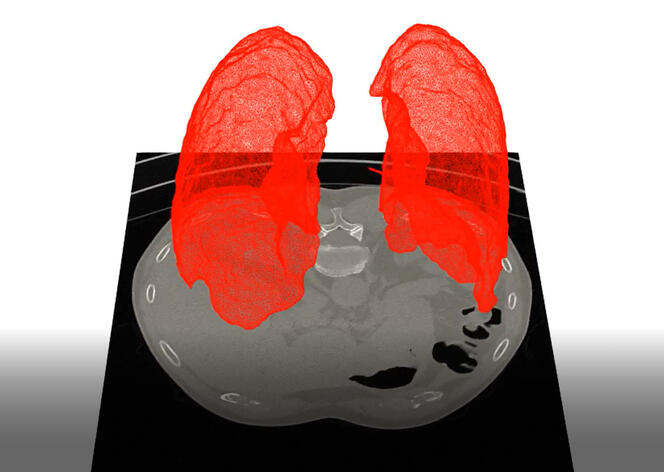

 

© Martin Genet
Lung modelling
CNRS News
© Martin Genet
Lung modelling
Martin Genet
Martin Genet
Share
Share
[7] [8] [9]

“Modelling is also a question of optimisation,” points out Genet. “Integrating physical phenomena is important, but it is not necessary to model all of the physics down to the lung’s atoms. You have to set limits to the approximation.” These optimisations allow for algorithms that consume less energy and computing resources, they can also have a direct impact on medical examinations. “If our algorithm remains effective with half the data, image acquisition time will be reduced by 50% as well, and hence the amount of radiation exposure during checkups.”

“Explainable AI” for optimised treatment

The MEDISIM team’s approach of coupling modelling and data shares similarities with the neural networks used by most of today’s AI, except that it requires much less information, but also more work to develop a specific model of the physics involved. Being able to operate with little input is a requirement of the medical sector: the model must include enough parameters to be precise and realistic, but not too many in order to be simulated quickly. Its development therefore entails a balance between these two necessities.

These multiple constraints nevertheless give this algorithm a rare advantage, namely that it is “explainable”. When a deep neural network is trained via machine learning on a large dataset, most of the time it is impossible to obtain precise details on how it functions, and hence to understand where its results come from. Digital twins “are based on a fine grasp of the physics involved, and each parameter has an explicit physical sense. This is a strength because we can understand the entire process that led up to the results”, stresses Genet.

The MEDISIM team’s algorithm can not only offer refined and precise models of a patient’s lungs – and create a “digital twin” – it can also provide its users with comprehensible decision-making, thereby helping to optimise medical examinations by reducing doses or examination times.


Footnotes
  • 1. LMS (CNRS / École polytechnique).

Explore more

Life
Bats on a tree
[10]
Article
11/26/2025
Bats, super virus busters [10]
A male zebra trying to wake a dead pregnant female zebra
[11]
Article
11/24/2025
Animals are no strangers to death [11]
[12]
Article
09/24/2025
When phytoplankton kills [12]
bacteriophage © University of Basel / Biozentrum / SPL
[13]
Article
09/01/2025
Medicine goes viral [13]
Illustration d’un Gastornis gigantea poursuivant une proie © Jaime Chirinos / SPL
[14]
Article
08/07/2025
Giants with feet of clay [14]
Biology
[12]
Article
09/24/2025
When phytoplankton kills [12]
[15]
Article
05/25/2025
Fukushima insects tested for cognition [15]
[16]
Article
03/26/2025
Space experiments aboard the ISS [16]
© Gulf MG / Shutterstock.com
[17]
Article
12/02/2024
Mosquitoes and their costly sting [17]
Flamants roses © Yva Momatiuk & John Eastcott / Minden / Naturepl.fr via EB Photo
[18]
Article
10/15/2024
Why birds do not fall while sleeping [18]
Lungs
[19]
Article
07/27/2021
A century on, does BCG have a future? [19]

Keywords

Lungs [20] modelling [21] personalised medicine [22]

Share this article

[23]
[24]
[7]
[9]

Source URL:https://news.cnrs.fr/articles/modelling-the-lungs-for-personalised-medicine

Links
[1] https://news.cnrs.fr/ [2] https://lejournal.cnrs.fr/nos-blogs/focus-sciences/modeliser-le-poumon-pour-une-medecine-personnalisee [3] https://news.cnrs.fr/life [4] https://news.cnrs.fr/biology [5] https://news.cnrs.fr/javascript%3A%3B [6] https://news.cnrs.fr/authors/marc-fournet [7] https://twitter.com/intent/tweet?url=https%3A//news.cnrs.fr/print/1978%2F&text=Modelling the lungs for personalised medicine [8] http://www.facebook.com/sharer/sharer.php?s=100&p%5Burl%5D=https%3A//news.cnrs.fr/print/1978&p%5Btitle%5D=Modelling%20the%20lungs%20for%20personalised%20medicine&p%5Bimages%5D%5B0%5D=https%3A//news.cnrs.fr/sites/default/files/styles/lightbox-hd/public/assets/images/modelisation_poumon_credit_martin_genet_72dpi.jpg%3Fitok%3DNmsoWIU_&p%5Bsummary%5D= [9] https://bsky.app/intent/compose?text=Modelling the lungs for personalised medicine%0Ahttps%3A//news.cnrs.fr/print/1978 [10] https://news.cnrs.fr/articles/bats-super-virus-busters [11] https://news.cnrs.fr/articles/animals-are-no-strangers-to-death [12] https://news.cnrs.fr/articles/when-phytoplankton-kills [13] https://news.cnrs.fr/articles/medicine-goes-viral [14] https://news.cnrs.fr/articles/giants-with-feet-of-clay [15] https://news.cnrs.fr/articles/fukushima-insects-tested-for-cognition [16] https://news.cnrs.fr/articles/space-experiments-aboard-the-iss [17] https://news.cnrs.fr/articles/mosquitoes-and-their-costly-sting [18] https://news.cnrs.fr/articles/why-birds-do-not-fall-while-sleeping [19] https://news.cnrs.fr/articles/a-century-on-does-bcg-have-a-future [20] https://news.cnrs.fr/lungs [21] https://news.cnrs.fr/modelling [22] https://news.cnrs.fr/personalised-medicine [23] http://www.facebook.com/sharer/sharer.php?s=100&p%5Burl%5D=https%3A//news.cnrs.fr/print/1978&p%5Btitle%5D=Modelling%20the%20lungs%20for%20personalised%20medicine&p%5Bimages%5D%5B0%5D=&p%5Bsummary%5D= [24] https://news.cnrs.fr/printmail/1978