CNRS News
Published on CNRS News (https://news.cnrs.fr)

Home > Archaeology goes galactic

Archaeology goes galactic

You are here

Home [1]
Lire en français [2]
Space [3]
Astronomy [4]
-A [5] +A [5]
article

Archaeology goes galactic

03.27.2024, by
Hugo Ruher [6]
Reading time: 7 minutes
The Milky Way seen above the summit of the Mauna Kea volcano on the island of Hawaii (US), home to several astronomical observatories, including the two W. M. Keck telescopes (right).
Photo Andrew R. Hara / W. M. Keck Observatory
Galactic archaeology uses state-of-the-art telescopes to reconstruct the history of our Milky Way, from the Big Bang to the present day.

“This is the beginning of a new chapter in astronomy,” commented the astronomer François Mignard, scientific director of the Gaia mission for France, on the release of its first catalogue of data in 2016. At the time, the Gaia space observatory had already determined the luminosity, distance and relative speed of around a billion stars with unparallelled precision, while the latest catalogue, published in June 2022, lists a whopping 1.8 billion stars.
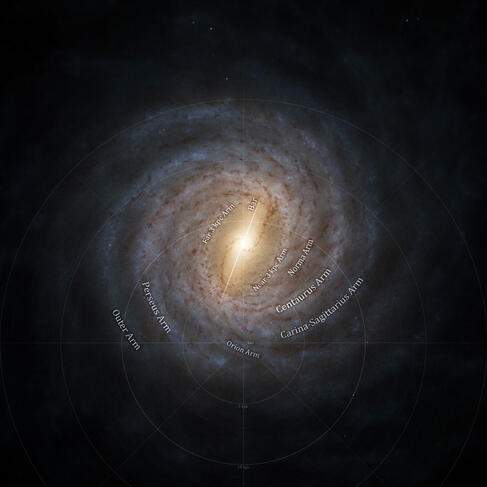
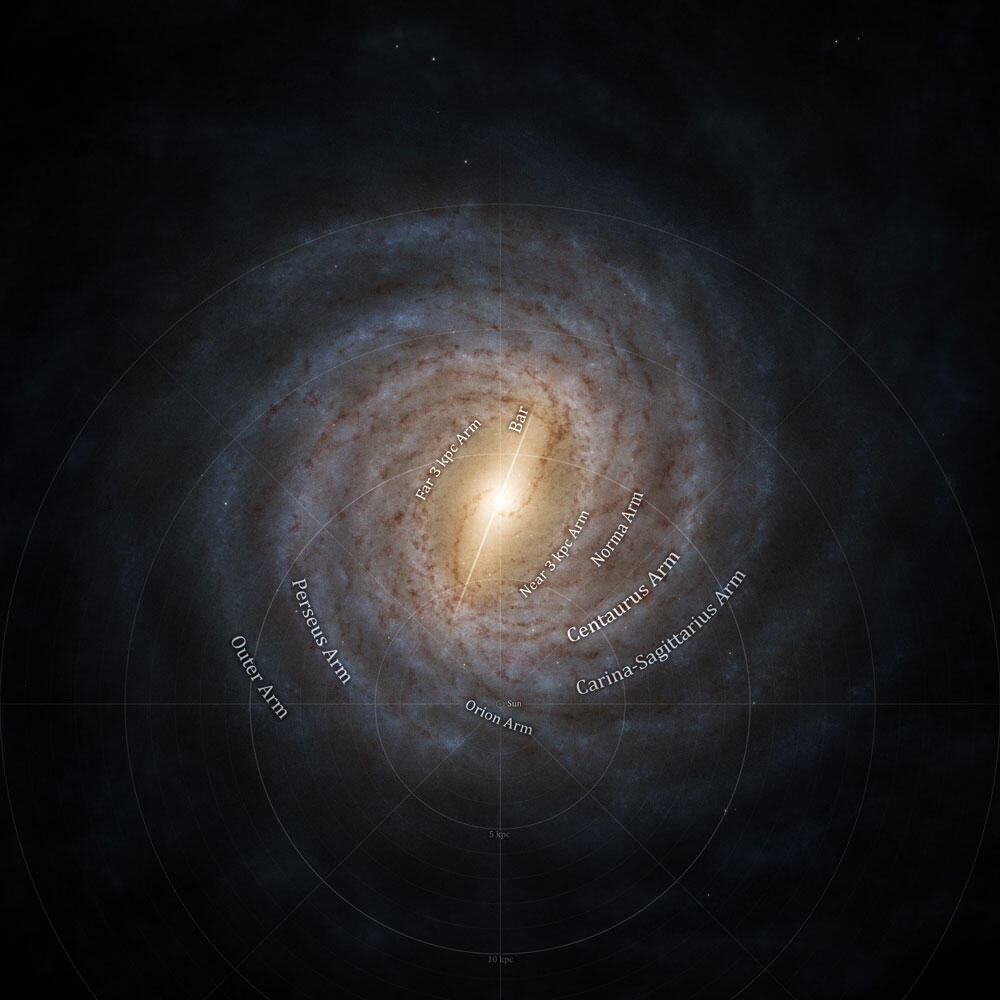
Artist's impression of the spiral structure of the Milky Way, with its bright central bar. The Sun lies towards its outer edge, some 26,600 light-years from the centre, near the bottom of the image.
CNRS News
Artist's impression of the spiral structure of the Milky Way, with its bright central bar. The Sun lies towards its outer edge, some 26,600 light-years from the centre, near the bottom of the image.
ESA/Gaia/DPAC, Stefan Payne-Wardenaar, CC BY-SA 4.0 IGO
Share
Share
[7] [8] [9]

All this data will not only provide us with an increasingly detailed map of the Milky Way, but also help us determine why these stars are where they are. “Our Galaxy, as we know it today, first began to form around 13 billion years ago,” says Alejandra Recio-Blanco1, an astronomer at the Côte d'Azur observatory. “With Gaia, we hope to find out what happened throughout the course of its history, and how we got to this point.”  Just like its Earth-based counterpart, galactic archaeology’s goal is to go back in time in order to understand the evolution of the Milky Way and paint a picture of what it looked like billions of years ago.

From cosmology to galactic archaeology

Large telescopes such as the W. M. Keck Observatory, Hubble, and more recently the James Webb Space Telescope, which are able to observe very distant galaxies, are giving us a first glimpse of what the Universe looked like shortly after the Big Bang.

The standard cosmological model posits an initially very dense, expanding Universe, in which matter collapsed under the effect of its own gravity, eventually forming stars and galaxies. However, this general picture does not explain how we ended up with spiral galaxies such as our own.

“These models are not sufficiently precise, and thanks in particular to Gaia's discoveries, galactic archaeology has brought complexity to this simplistic image,” Recio-Blanco explains. “From now on, we'll be in a position to study the evolution of one galaxy, our own Milky Way, with a high degree of precision.”
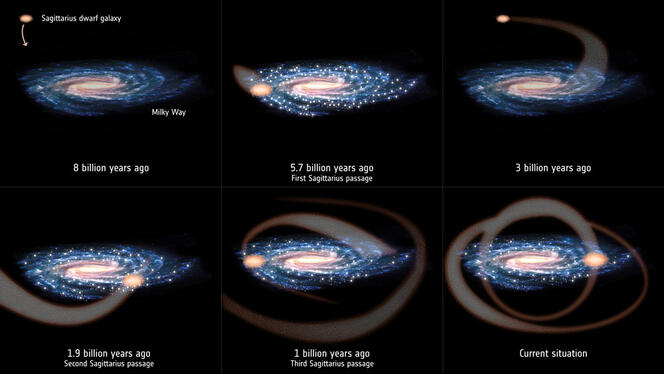

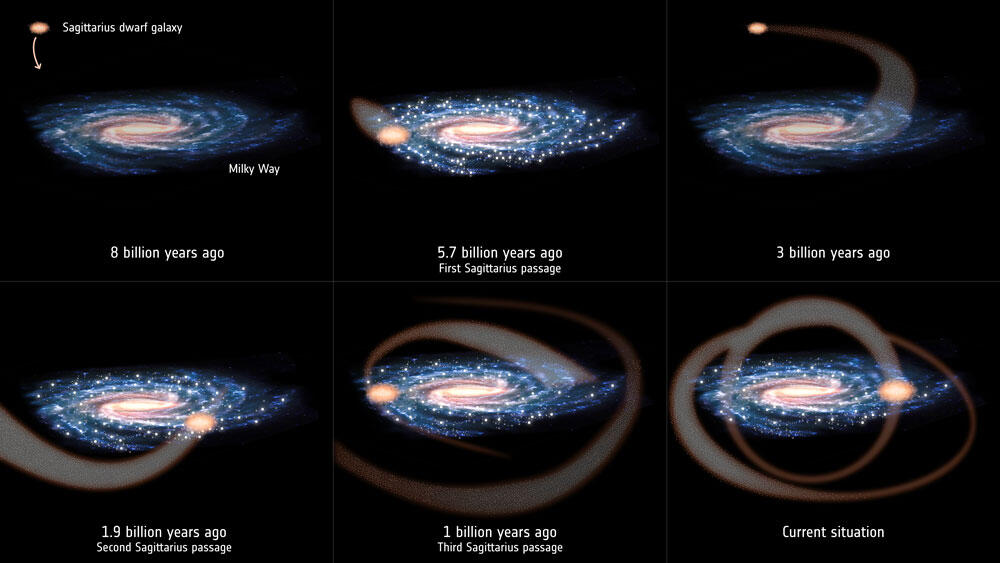
The Sagittarius Dwarf Spheroidal Galaxy has been orbiting the Milky Way for billions of years. According to a recent study, the three known collisions between this dwarf galaxy and the Milky Way have triggered major episodes of star formation, one of which may have given rise to our Solar System.
CNRS News
The Sagittarius Dwarf Spheroidal Galaxy has been orbiting the Milky Way for billions of years. According to a recent study, the three known collisions between this dwarf galaxy and the Milky Way have triggered major episodes of star formation, one of which may have given rise to our Solar System.
ESA
ESA
Share
Share
[7] [10] [9]

In fact, Gaia has called into question a number of things we thought we understood. “The telescope is so precise that we can measure the motion of stars,” explains Nicolas Martin, at the Strasbourg Astronomical Observatory2. “This enables us to identify groups of stars, known as stellar currents, that are moving in the same direction. After that, it takes a considerable amount of work sifting through data and modelling to find out where these currents come from and thus reconstruct the formation of the Milky Way.”

Unravelling the tangle of stellar currents

The results of this work have shown that, rather than a chaotic period immediately after the Big Bang followed by several billion years of calm, there has in fact been a constant evolution process that has continued until the present day. In other words, the Milky Way is still undergoing subtle transformations as a result of stellar currents. To  reconstruct this galactic history, a huge number of stars have to be studied. “You couldn't piece together the history of France by focusing on just a handful of people!” Recio-Blanco says in jest. Gaia has already observed 2% of the stars in our Galaxy, and is revealing events and structures from the past that had until now eluded astronomers, such as the Gaia-Enceladus galaxy, discovered in 2018.
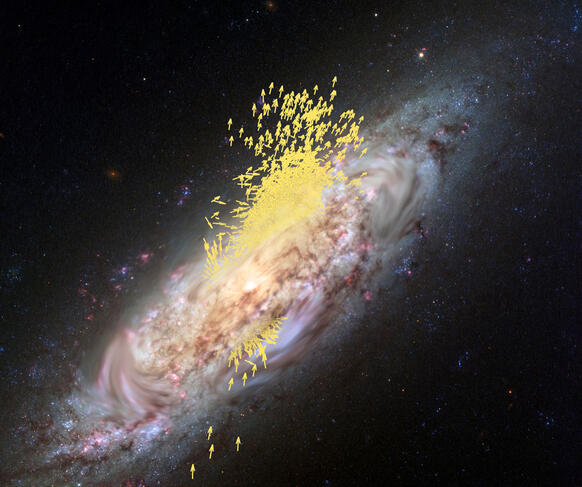
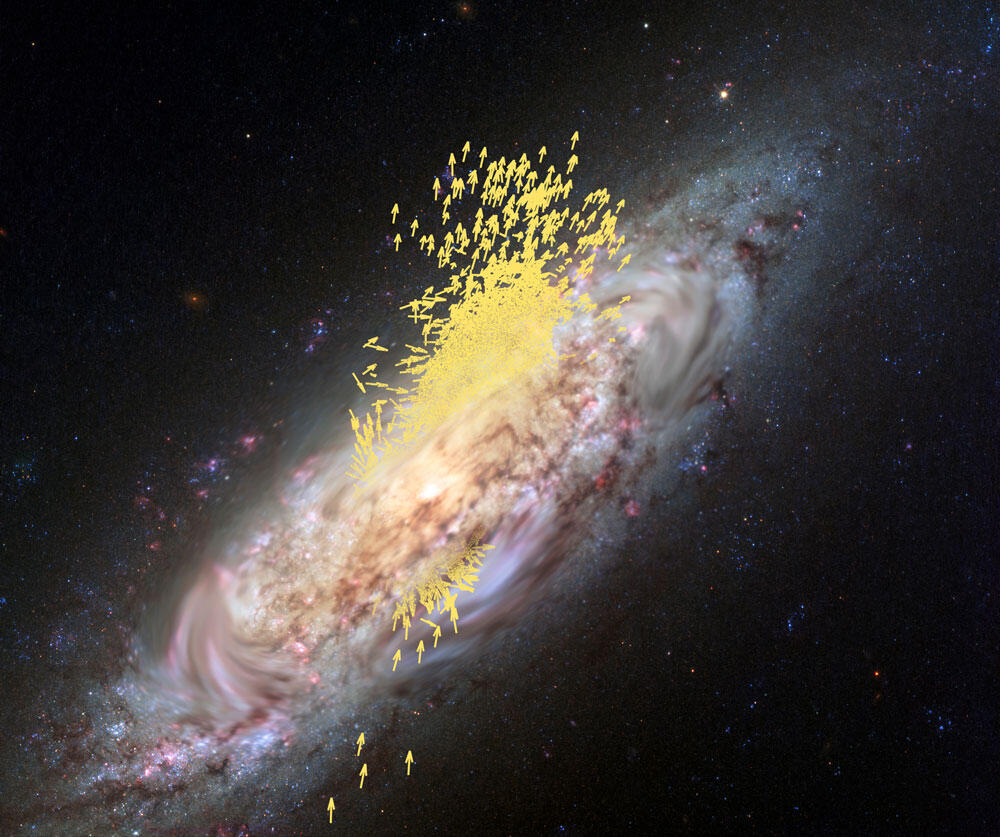
Illustration of the merger between the Gaia-Enceladus galaxy and the Milky Way, thought to have occurred during the early stages of the formation of our Galaxy 10 billion years ago (the yellow arrows represent the stars formed by the merger).
CNRS News
Illustration of the merger between the Gaia-Enceladus galaxy and the Milky Way, thought to have occurred during the early stages of the formation of our Galaxy 10 billion years ago (the yellow arrows represent the stars formed by the merger).
ESA (artist’s impression and composition); Koppelman, Villalobos and Helmi (simulation); Nasa/ESA/Hubble (galaxy image)
Share
Share
[7] [11] [9]

With a mass similar to that of the Small Magellanic Cloud, it merged with the Milky Way about ten billion years ago, transforming the structure and evolution of our Galaxy.  “This was a major event in the history of the Milky Way,” Recio-Blanco believes. “Without knowing about it we can’t understand our own Galaxy.” It is now more than ten years since Gaia was placed in orbit, and although our new view of the history of the Galaxy is still sketchy, we can increasingly clearly make out the different stellar currents that coalesced to form the Milky Way as we know it.

Hunting down relic stars

As well as studying stellar motion, galactic archaeologists such as Martin are also hunting down the oldest relic stars, as part of the Pristine project. “We're looking for the oldest stars in our Galaxy. Because they're so rare they are hard to find, but they do have a number of interesting characteristics,” he says.
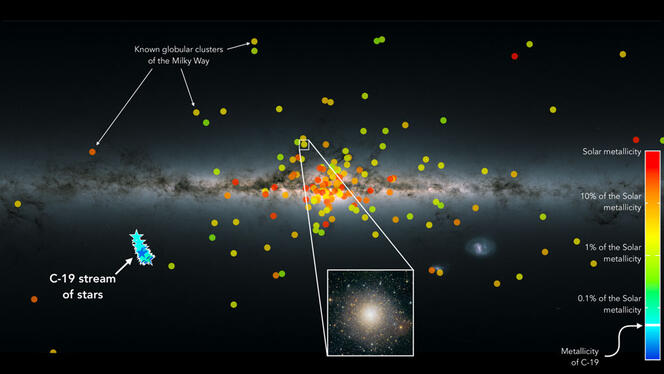
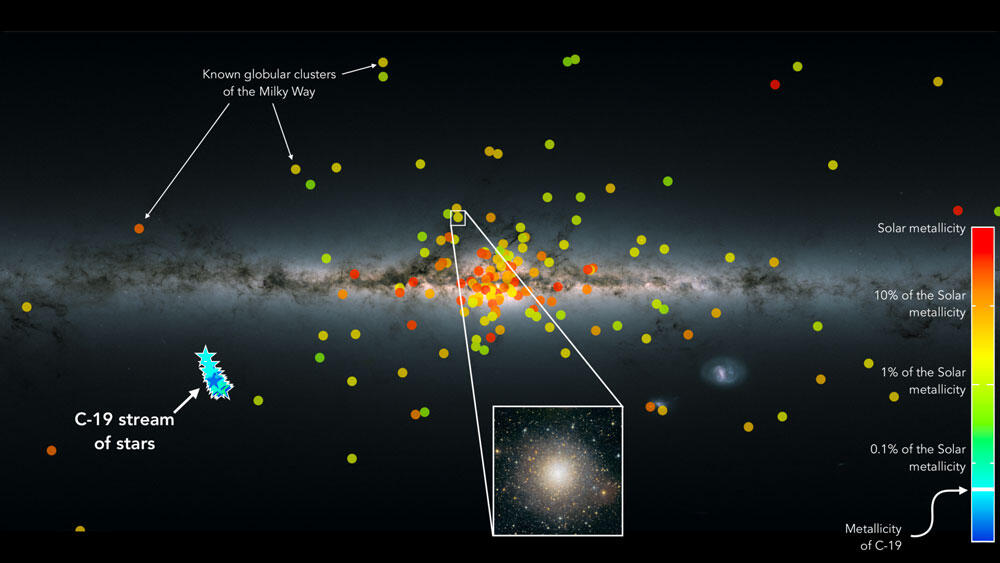
Distribution of very dense groups of stars called globular clusters in the Milky Way, superimposed on a map of our Galaxy compiled from data from the Gaia space probe. Each dot represents a cluster of a few thousand to several million stars (insert image shows the Messier 10 cluster). The colour of the dots indicates their metallicity (abundance of heavy elements) compared with that of the Sun.
CNRS News
Distribution of very dense groups of stars called globular clusters in the Milky Way, superimposed on a map of our Galaxy compiled from data from the Gaia space probe. Each dot represents a cluster of a few thousand to several million stars (insert image shows the Messier 10 cluster). The colour of the dots indicates their metallicity (abundance of heavy elements) compared with that of the Sun.
Nicolas Martin & Observatoire astronomique de Strasbourg; Canada-France-Hawaii Telescope / Coelum; ESA/Gaia/DPAC
Share
Share
[7] [12] [9]

For the past ten years, Pristine has been using the Canada-France-Hawaii Telescope on Mauna Kea (Hawaii, US) to track down these objects. The telescope is equipped with a special filter that enables it to measure the metallicity (the abundance of elements heavier than hydrogen and helium) of the stars observed, a key factor in determining their age. “Shortly after the Big Bang, there were no atoms heavier than helium in the Universe. All the other elements came later, produced in the cores of the first stars and then scattered into space when these celestial bodies exploded,” Martin explains. “This means that the composition of a star that emerged more recently will be slightly richer in metals than an older one, which enables us to roughly define their age.”

In the ten years the Pristine programme has been running, millions of stars have been observed, several hundred of which have such low metallicity that they apparently formed during the first two billion years of the Universe, making them exceptional relics.

The goal is to compare these findings with Gaia data in order to reconstruct their paths and discover how these early clusters ended up capturing other stellar currents. “These  fossil stars are a window into the distant past,” Martin adds. “We are beginning to sketch out the early history of the Milky Way, even if we still have a long way to go.”

Ongoing collision

Reconstructing the entire past of our Galaxy, from the earliest stars to its present-day structure, is still a far cry despite the impressive progress made since the launch of Gaia. “What we now know is that the Milky Way is not cut off from its surroundings,” Recio-Blanco says. “We are constantly affected by our environment, even on a galactic scale.”
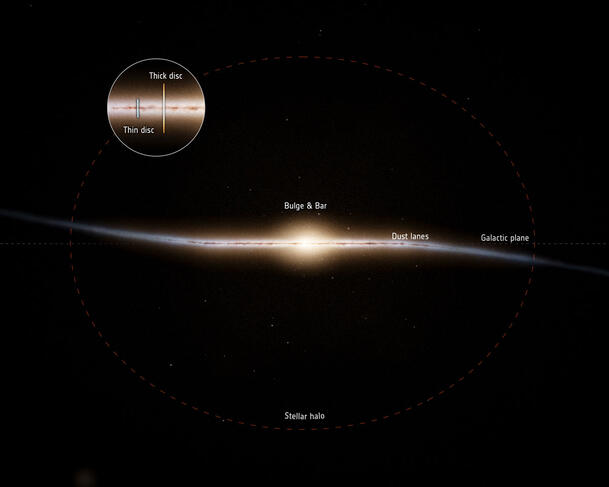
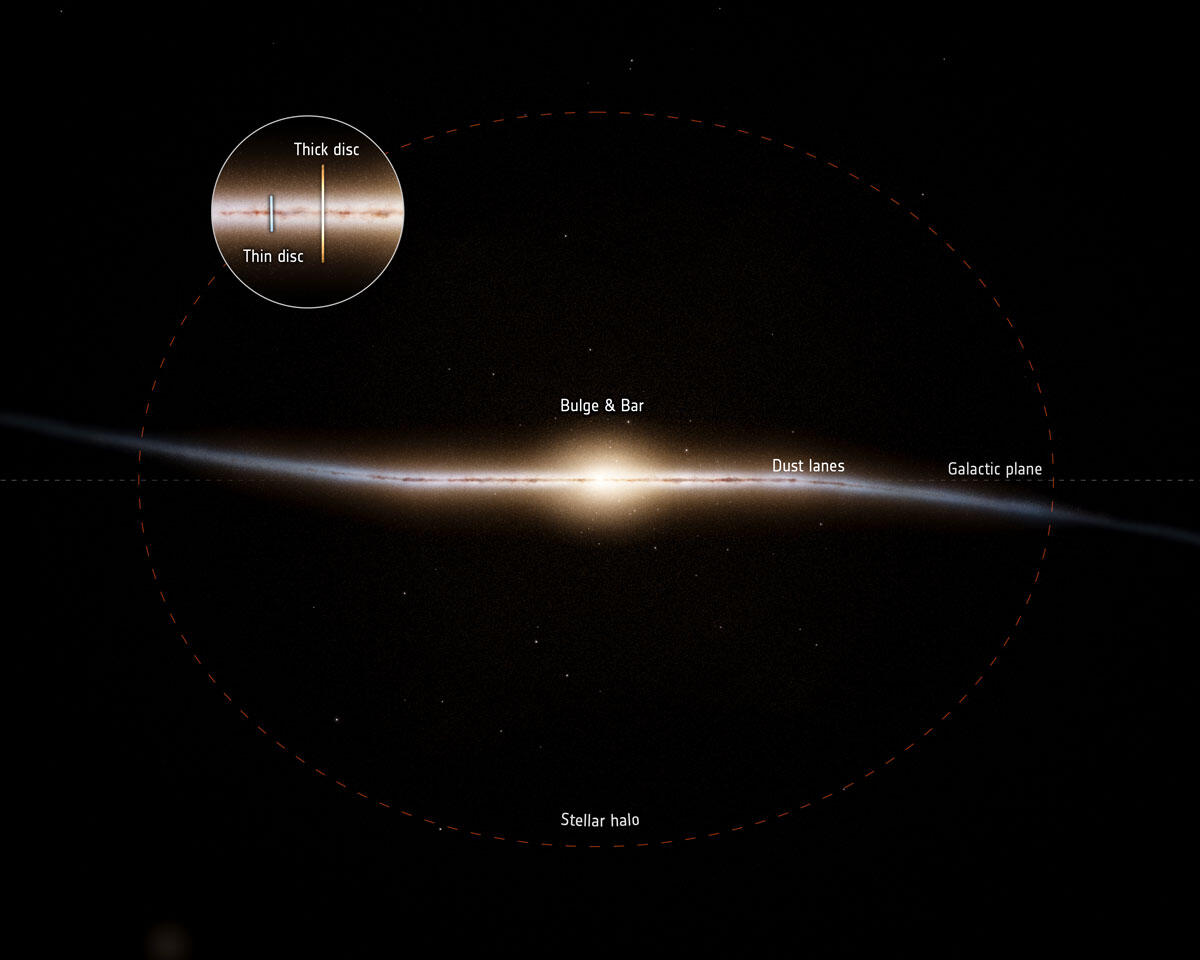
Hubble and Gaia data show that the disc of the Milky Way has a radius of 129,000 light-years (as measured from the centre of the Galaxy).
CNRS News
Hubble and Gaia data show that the disc of the Milky Way has a radius of 129,000 light-years (as measured from the centre of the Galaxy).
Image Stefan Payne-Wardenaar / MPIA
Share
Share
[7] [13] [9]

The most recent illustration of this was the discovery that the galactic disc ripples up and down slightly, rather like a pond into which a pebble has been thrown. This oscillation, revealed by Gaia material, is thought to be due to the passage of the Sagittarius Dwarf Spheroidal Galaxy through the Milky Way, into which it is gradually falling. This satellite galaxy, 10,000 light-years wide and discovered barely thirty years ago, disturbs the galactic disc each time it passes through it, triggering waves of star formation. In any case, Gaia's work is by no means over, and the latest data catalogue published in October 2023 covers only the first 34 months of the mission. Galactic archaeologists still have years of star observations to analyse, and of one thing they can be sure: the Milky Way is far from having given up all the secrets of its tumultuous history. ♦

Further reading on our website
   Gaia: le catalogue galactique est arrivé (Gaia: the new galactic catalogue now available) [14]. In French.   
 
  Les plus vieilles galaxies jamais confirmées (The oldest galaxies ever discovered) [15]. In French.


Footnotes
  • 1. Laboratoire Joseph-Louis Lagrange (CNRS / Observatoire de la Côte d’Azur / Université Côte d’Azur).
  • 2. CNRS / Université de Strasbourg.

Explore more

Space
This illustration shows the merger of two black holes and the gravitational waves that ripple outward as the black holes spiral toward each other.
[16]
Article
11/03/2025
Gravitational wave detections spark great expectations [16]
Image Nasa / GSFC / Solar Dynamics Observatory
[17]
Article
10/09/2025
Hottest news from the Sun's corona [17]
Vera C. Rubin observatory © RubinObs / NSF / DOE / NOIRLab / SLAC / AURA / H. Stockebrand
[18]
Article
09/12/2025
The Big Bang within the reach of telescopes [18]
[19]
Article
07/09/2025
1905: Einstein initiates the quantum age [19]
Mont-Saint-Michel © GLAZ / Mathieu Rivrin / Hemis.fr
[20]
Article
03/18/2025
Solar storms ahead [20]
Astronomy
Image Nasa / Jet Propulsion Laboratory-Caltech
[21]
Article
08/30/2024
Planet 9, do you copy? [21]
© Peter Jurik / stock.adobe.com
[22]
Article
04/24/2024
Gaia BH3, the black hole that shouldn't exist [22]
 Nasa / Goddard / University of Arizona
[23]
Article
02/12/2024
An asteroid reveals its secrets [23]
© Sonia Collavizza, CNRS 2022
[24]
Video
06/08/2023
The birth of exoplanets [24]
[25]
Video
10/02/2022
Hunting Martian auroras [25]
Gaia
© Peter Jurik / stock.adobe.com
[22]
Article
04/24/2024
Gaia BH3, the black hole that shouldn't exist [22]
GAÏA
[26]
Article
09/13/2016
Gaia: the Great Galactic Map [26]

Keywords

Gaia [27] Milky Way [28] Star [29] Galaxy [30] Big Bang [31] Stellar currents [32] Gaia-Enceladus galaxy [33] Small Magellanic Cloud [34] relic stars [35] Hydrogen [36] helium [37] metallicity [38] galactic disk [39] Sagittarius Dwarf Spheroidal Galaxy [40]

Share this article

[41]
[42]
[7]
[9]

Source URL:https://news.cnrs.fr/articles/archaeology-goes-galactic

Links
[1] https://news.cnrs.fr/ [2] https://lejournal.cnrs.fr/articles/larcheologie-devient-galactique [3] https://news.cnrs.fr/space [4] https://news.cnrs.fr/astronomy [5] https://news.cnrs.fr/javascript%3A%3B [6] https://news.cnrs.fr/authors/hugo-ruher [7] https://twitter.com/intent/tweet?url=https%3A//news.cnrs.fr/print/2065%2F&text=Archaeology goes galactic [8] http://www.facebook.com/sharer/sharer.php?s=100&p%5Burl%5D=https%3A//news.cnrs.fr/print/2065&p%5Btitle%5D=Archaeology%20goes%20galactic&p%5Bimages%5D%5B0%5D=https%3A//news.cnrs.fr/sites/default/files/styles/lightbox-hd/public/assets/images/2_milky_way_annotated_72dpi.jpg%3Fitok%3DVk6couBm&p%5Bsummary%5D= [9] https://bsky.app/intent/compose?text=Archaeology goes galactic%0Ahttps%3A//news.cnrs.fr/print/2065 [10] http://www.facebook.com/sharer/sharer.php?s=100&p%5Burl%5D=https%3A//news.cnrs.fr/print/2065&p%5Btitle%5D=Archaeology%20goes%20galactic&p%5Bimages%5D%5B0%5D=https%3A//news.cnrs.fr/sites/default/files/styles/lightbox-hd/public/assets/images/3_sagittarius_collisions_trigger_star_formation_milky_way_72dpi.jpg%3Fitok%3DXx4tHBQN&p%5Bsummary%5D= [11] http://www.facebook.com/sharer/sharer.php?s=100&p%5Burl%5D=https%3A//news.cnrs.fr/print/2065&p%5Btitle%5D=Archaeology%20goes%20galactic&p%5Bimages%5D%5B0%5D=https%3A//news.cnrs.fr/sites/default/files/styles/lightbox-hd/public/assets/images/4_major_event_formation_milky_way_72dpi.jpg%3Fitok%3DfGnvF--h&p%5Bsummary%5D= [12] http://www.facebook.com/sharer/sharer.php?s=100&p%5Burl%5D=https%3A//news.cnrs.fr/print/2065&p%5Btitle%5D=Archaeology%20goes%20galactic&p%5Bimages%5D%5B0%5D=https%3A//news.cnrs.fr/sites/default/files/styles/lightbox-hd/public/assets/images/5_pr_figure1_en_72dpi.jpg%3Fitok%3DXuVV4Mqh&p%5Bsummary%5D= [13] http://www.facebook.com/sharer/sharer.php?s=100&p%5Burl%5D=https%3A//news.cnrs.fr/print/2065&p%5Btitle%5D=Archaeology%20goes%20galactic&p%5Bimages%5D%5B0%5D=https%3A//news.cnrs.fr/sites/default/files/styles/lightbox-hd/public/assets/images/6_milky_way_edge-on_view_72dpi.jpg%3Fitok%3DB2lQuiCx&p%5Bsummary%5D= [14] https://lejournal.cnrs.fr/articles/gaia-le-catalogue-galactique-nouveau-est-arrive [15] https://lejournal.cnrs.fr/articles/les-plus-vieilles-galaxies-jamais-confirmees [16] https://news.cnrs.fr/articles/gravitational-wave-detections-spark-great-expectations [17] https://news.cnrs.fr/articles/hottest-news-from-the-suns-corona [18] https://news.cnrs.fr/articles/the-big-bang-within-the-reach-of-telescopes [19] https://news.cnrs.fr/articles/1905-einstein-initiates-the-quantum-age [20] https://news.cnrs.fr/articles/solar-storms-ahead [21] https://news.cnrs.fr/articles/planet-9-do-you-copy [22] https://news.cnrs.fr/articles/gaia-bh3-the-black-hole-that-shouldnt-exist [23] https://news.cnrs.fr/articles/an-asteroid-reveals-its-secrets [24] https://news.cnrs.fr/videos/the-birth-of-exoplanets [25] https://news.cnrs.fr/videos/hunting-martian-auroras [26] https://news.cnrs.fr/articles/gaia-the-great-galactic-map [27] https://news.cnrs.fr/gaia [28] https://news.cnrs.fr/milky-way [29] https://news.cnrs.fr/star [30] https://news.cnrs.fr/galaxy [31] https://news.cnrs.fr/big-bang [32] https://news.cnrs.fr/stellar-currents [33] https://news.cnrs.fr/gaia-enceladus-galaxy [34] https://news.cnrs.fr/small-magellanic-cloud [35] https://news.cnrs.fr/relic-stars [36] https://news.cnrs.fr/hydrogen [37] https://news.cnrs.fr/helium [38] https://news.cnrs.fr/metallicity [39] https://news.cnrs.fr/galactic-disk [40] https://news.cnrs.fr/sagittarius-dwarf-spheroidal-galaxy [41] http://www.facebook.com/sharer/sharer.php?s=100&p%5Burl%5D=https%3A//news.cnrs.fr/print/2065&p%5Btitle%5D=Archaeology%20goes%20galactic&p%5Bimages%5D%5B0%5D=&p%5Bsummary%5D= [42] https://news.cnrs.fr/printmail/2065