CNRS News
Published on CNRS News (https://news.cnrs.fr)

Home > Detecting muons in Iceland

Detecting muons in Iceland

You are here

Home [1]
Lire en français [2]
slideshow
-A [3] +A [3]
Matter [4]
Earth [5]
Particle physics [6]

Detecting muons in Iceland

01.26.2023, by
The Editorial Team [7]
CNRS News takes you on a trip to the foot of Snaefellsjökull, a volcano in Iceland close to the heart not only of French writer Jules Verne but also of the researchers at the Institute of Physics of the 2 Infinities (IP2I) in Lyon (central eastern France). Their goal is to obtain images of the volcano's interior, so as to monitor its dynamics as well as changes in the thickness of its glacier in real time. Our guide is Jacques Marteau, laureate of the CNRS 2022 Innovation Medal, who uses muography, an innovative technique to image the interior of structures.

Jacques Marteau is a physicist at the IP2I (CNRS / Université Claude Bernard Lyon 1). In 2021 he launched the start-up Muodim. His team has carried out several missions to the Soufrière lava dome, in Guadeloupe, and also installed detectors in several tunnel-boring machines to help with the tunnelling phase of the Grand Paris Express scheme to extend the Paris underground network.

1
Iceland, Snaefellsjökull volcano, south face. This is where Jules Verne located the entrance for his famous “Journey to the Centre of the Earth”, a work of fiction published in 1864. But for researchers today, it is above all a key site for research in volcanology and glaciology.
Carol Müller / CNRS Photothèque
Slideshow mode
Share
Share
[8]
[9]
[10]
2
Before heading there, IP2I researchers in Lyon are putting the finishing touches to their muon detector. Muons are particles that are produced naturally in the atmosphere. The light they emit as they travel through thick layers of matter makes it possible to obtain images of the interior of structures, in much the same way as X-rays do in medical imaging. Here, the detector is being thoroughly tested to avoid any loss of data during the mission.
Carol Müller / CNRS Photothèque
Slideshow mode
Share
Share
[8]
[11]
[10]
3
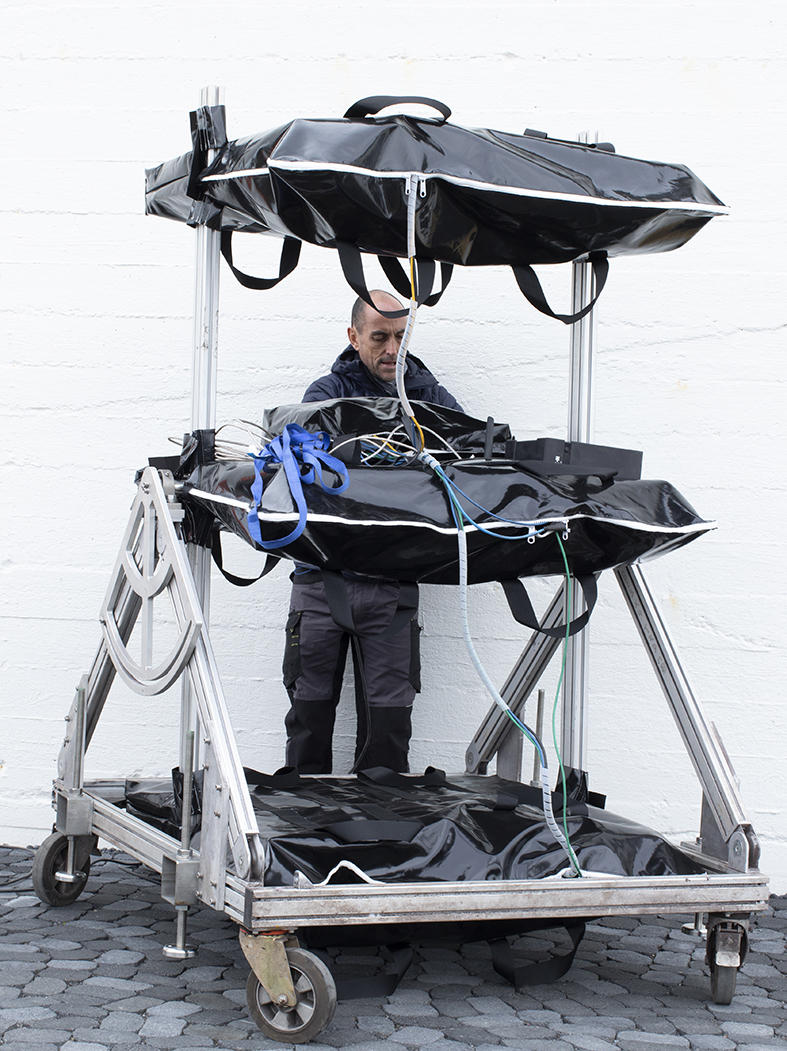
When ready, the detector was shipped to Iceland with the invaluable assistance of Icelandic scientists. Before its installation, IP2I's Jacques Marteau and Jean-Christophe Ianigro are seen here assembling the detection plans for the “muon trajectograph” on a metal structure.
Carol Müller / CNRS Photothèque
Slideshow mode
Share
Share
[8]
[12]
[10]
4
Once mounted, the detector still needed to be calibrated. Here, this operation is carried out at the Malarrif base, in the heart of the Snaefellsjökull National Park. The detector is pointed vertically upwards in order to measure the unimpeded flow of particles. This reference value, which is specific to the location, latitude, altitude, atmospheric conditions, etc., is meant to avoid future errors in data interpretation.
Carol Müller / CNRS Photothèque
Slideshow mode
Share
Share
[8]
[13]
[10]
5
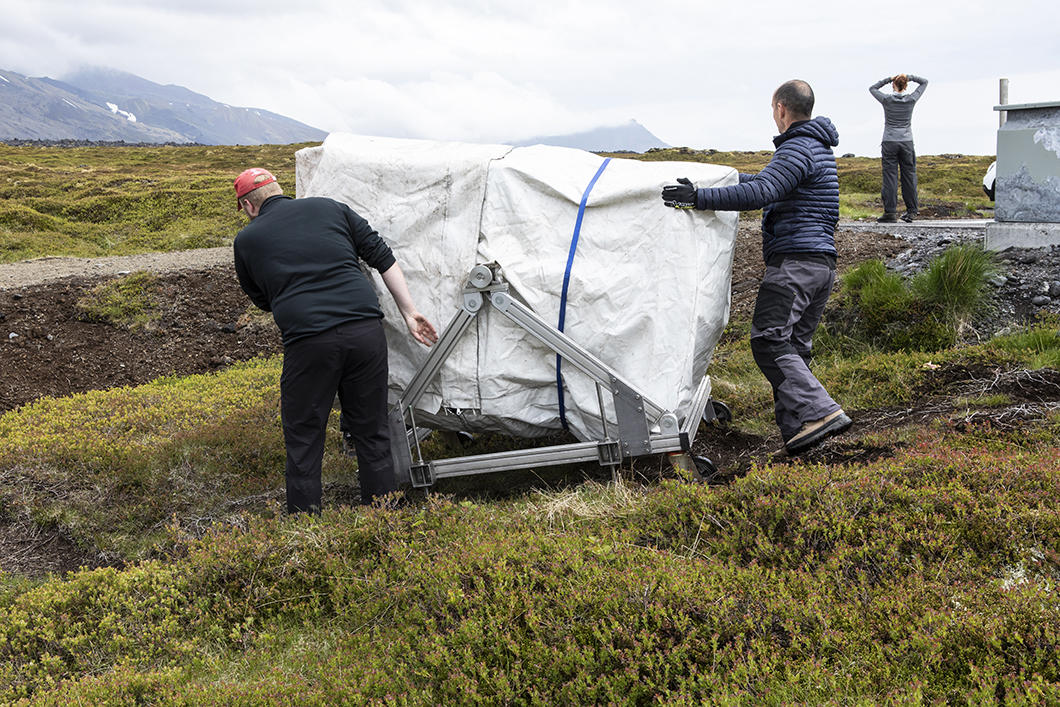
Once assembled and calibrated, the muon detector is covered with a tarpaulin to protect it from the region's heavy rainfall and high winds. It can at last be transported to the vicinity of Snaefellsjökull to begin real-time monitoring of the volcano's dynamics as well as changes in the thickness of its glacier.
Carol Müller / CNRS Photothèque
Slideshow mode
Share
Share
[8]
[14]
[10]
6
Protected by its white tarpaulin, the detector is placed well away from the volcano to capture an initial test image. It will then be moved closer to the target to obtain higher-quality resolution.
Carol Müller / CNRS Photothèque
Slideshow mode
Share
Share
[8]
[15]
[10]
7
The detector is securely fastened, and pointed at the summit of the Snaefellsjökull volcano. The distance to the top is around 6 kilometres, which makes it possible to simultaneously view the internal plumbing of the volcano, its summit and the sky, and carry out dynamic correction of the images.
Carol Müller / CNRS Photothèque
Slideshow mode
Share
Share
[8]
[16]
[10]
8
In this first “image” obtained using the detector, the bottom part represents the volcano's shadow while, behind it, the yellow shape seems to reflect the setting sun. The image shows the detector's acceptance, in other words, all the muon trajectories that are in its field of view. It is the first in a series of many images to be reconstructed.
Jacques Marteau, IP2I
Slideshow mode
Share
Share
[8]
[17]
[10]
9
The highest point on the volcano's summit glacier, whose maximum thickness no longer ever exceeds 200 metres, will be the subject of a second phase of measurements. The glacier is now melting increasingly fast due to climate change, which makes it difficult – and even dangerous – to access. However, muography can remotely locate the ice-rock boundary, determine the residual ice thickness and how it varies over time.
Carol Müller / CNRS Photothèque
Slideshow mode
Share
Share
[8]
[18]
[10]
10
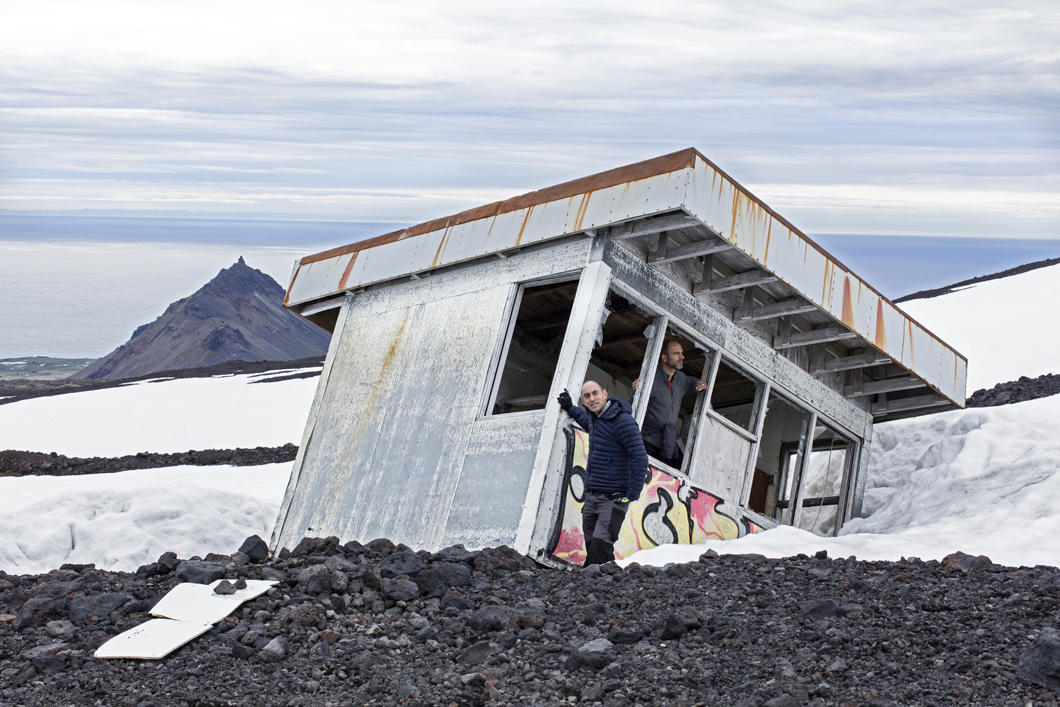
To perform these measurements on the summit glacier, the equipment will need to be carried to high altitude over a terrain that can sometimes hold surprises, such as this disused ski lift hut that will be used to secure the detector. However, there's little chance of the team coming across the entrance to the centre of the Earth described by Jules Verne in his celebrated nineteenth-century masterpiece!
Carol Müller / CNRS Photothèque
Slideshow mode
Share
Share
[8]
[19]
[10]

Explore more

Matter
Workers are sorting discarded plastic bottles collected from the garbage heap and preparing them for recycling. © Suvra Kanti Das / ZUMA Press / RÉA
[20]
Article
10/27/2025
Plastic recycling is counter-productive [20]
[21]
Slideshow
07/17/2025
Seeing life in purple [21]
Sand ripples, Maspalomas, Grande Canarie, Spain. © Sopotnicki/Shutterstock
[22]
Article
07/07/2025
The secret of sand patches [22]
[23]
Article
03/26/2025
Space experiments aboard the ISS [23]
© Erwan Amice / LEMAR / CNRS Images
[24]
Slideshow
03/19/2025
Breaking the ice [24]
Particle physics
[25]
Article
02/28/2024
The origins of the Standard Model [25]
[26]
Article
04/19/2020
First Ten Years of the LHC: the Adventure Continues [26]

Keywords

Iceland [27] Volcanoes [28] Muons [29] Muography [30] Snaefellsjökull [31] Glaciers [32]

Share this article

[33]
[34]
[8]
[10]

Source URL:https://news.cnrs.fr/slideshows/detecting-muons-in-iceland

Links
[1] https://news.cnrs.fr/ [2] https://lejournal.cnrs.fr/diaporamas/des-muons-en-islande [3] https://news.cnrs.fr/javascript%3A%3B [4] https://news.cnrs.fr/matter [5] https://news.cnrs.fr/earth [6] https://news.cnrs.fr/particle-physics [7] https://news.cnrs.fr/authors/la-redaction [8] https://twitter.com/intent/tweet?url=https%3A//news.cnrs.fr/print/1929%2F&text=Detecting muons in Iceland [9] http://www.facebook.com/sharer/sharer.php?s=100&p%5Burl%5D=https%3A//news.cnrs.fr/print/1929&p%5Btitle%5D=Detecting%20muons%20in%20Iceland%20&p%5Bimages%5D%5B0%5D=https%3A//news.cnrs.fr/sites/default/files/styles/lightbox-hd/public/assets/images/1_u4a6070.jpg%3Fitok%3D_unJfd3r&p%5Bsummary%5D= [10] https://bsky.app/intent/compose?text=Detecting muons in Iceland %0Ahttps%3A//news.cnrs.fr/print/1929 [11] http://www.facebook.com/sharer/sharer.php?s=100&p%5Burl%5D=https%3A//news.cnrs.fr/print/1929&p%5Btitle%5D=Detecting%20muons%20in%20Iceland%20&p%5Bimages%5D%5B0%5D=https%3A//news.cnrs.fr/sites/default/files/styles/lightbox-hd/public/assets/images/2_u4a5113.jpg%3Fitok%3DSkr5oopn&p%5Bsummary%5D= [12] http://www.facebook.com/sharer/sharer.php?s=100&p%5Burl%5D=https%3A//news.cnrs.fr/print/1929&p%5Btitle%5D=Detecting%20muons%20in%20Iceland%20&p%5Bimages%5D%5B0%5D=https%3A//news.cnrs.fr/sites/default/files/styles/lightbox-hd/public/assets/images/3_u4a5737.jpg%3Fitok%3DB61AQPxc&p%5Bsummary%5D= [13] http://www.facebook.com/sharer/sharer.php?s=100&p%5Burl%5D=https%3A//news.cnrs.fr/print/1929&p%5Btitle%5D=Detecting%20muons%20in%20Iceland%20&p%5Bimages%5D%5B0%5D=https%3A//news.cnrs.fr/sites/default/files/styles/lightbox-hd/public/assets/images/4_u4a6643.jpg%3Fitok%3D90Kdww-J&p%5Bsummary%5D= [14] http://www.facebook.com/sharer/sharer.php?s=100&p%5Burl%5D=https%3A//news.cnrs.fr/print/1929&p%5Btitle%5D=Detecting%20muons%20in%20Iceland%20&p%5Bimages%5D%5B0%5D=https%3A//news.cnrs.fr/sites/default/files/styles/lightbox-hd/public/assets/images/5_u4a6701_72dpi.jpg%3Fitok%3DippQ2m2E&p%5Bsummary%5D= [15] http://www.facebook.com/sharer/sharer.php?s=100&p%5Burl%5D=https%3A//news.cnrs.fr/print/1929&p%5Btitle%5D=Detecting%20muons%20in%20Iceland%20&p%5Bimages%5D%5B0%5D=https%3A//news.cnrs.fr/sites/default/files/styles/lightbox-hd/public/assets/images/cnrs_20220119_0019_72dpi.jpg%3Fitok%3Df4HpP2TZ&p%5Bsummary%5D= [16] http://www.facebook.com/sharer/sharer.php?s=100&p%5Burl%5D=https%3A//news.cnrs.fr/print/1929&p%5Btitle%5D=Detecting%20muons%20in%20Iceland%20&p%5Bimages%5D%5B0%5D=https%3A//news.cnrs.fr/sites/default/files/styles/lightbox-hd/public/assets/images/7_u4a6976.jpg%3Fitok%3DCco8AKe6&p%5Bsummary%5D= [17] http://www.facebook.com/sharer/sharer.php?s=100&p%5Burl%5D=https%3A//news.cnrs.fr/print/1929&p%5Btitle%5D=Detecting%20muons%20in%20Iceland%20&p%5Bimages%5D%5B0%5D=https%3A//news.cnrs.fr/sites/default/files/styles/lightbox-hd/public/assets/images/8_nd-acpt.jpg%3Fitok%3DsMxMGE-q&p%5Bsummary%5D= [18] http://www.facebook.com/sharer/sharer.php?s=100&p%5Burl%5D=https%3A//news.cnrs.fr/print/1929&p%5Btitle%5D=Detecting%20muons%20in%20Iceland%20&p%5Bimages%5D%5B0%5D=https%3A//news.cnrs.fr/sites/default/files/styles/lightbox-hd/public/assets/images/9_u4a6518.jpg%3Fitok%3DD7WY4tvG&p%5Bsummary%5D= [19] http://www.facebook.com/sharer/sharer.php?s=100&p%5Burl%5D=https%3A//news.cnrs.fr/print/1929&p%5Btitle%5D=Detecting%20muons%20in%20Iceland%20&p%5Bimages%5D%5B0%5D=https%3A//news.cnrs.fr/sites/default/files/styles/lightbox-hd/public/assets/images/10_u4a6576.jpg%3Fitok%3D3PLBshn4&p%5Bsummary%5D= [20] https://news.cnrs.fr/articles/plastic-recycling-is-counter-productive [21] https://news.cnrs.fr/slideshows/seeing-life-in-purple [22] https://news.cnrs.fr/articles/the-secret-of-sand-patches [23] https://news.cnrs.fr/articles/space-experiments-aboard-the-iss [24] https://news.cnrs.fr/slideshows/breaking-the-ice [25] https://news.cnrs.fr/articles/the-origins-of-the-standard-model [26] https://news.cnrs.fr/articles/first-ten-years-of-the-lhc-the-adventure-continues [27] https://news.cnrs.fr/iceland [28] https://news.cnrs.fr/volcanoes [29] https://news.cnrs.fr/muons [30] https://news.cnrs.fr/muography [31] https://news.cnrs.fr/snaefellsjokull [32] https://news.cnrs.fr/glaciers [33] http://www.facebook.com/sharer/sharer.php?s=100&p%5Burl%5D=https%3A//news.cnrs.fr/print/1929&p%5Btitle%5D=Detecting%20muons%20in%20Iceland%20&p%5Bimages%5D%5B0%5D=&p%5Bsummary%5D= [34] https://news.cnrs.fr/printmail/1929