
Jewish presence predates Islam in Arabia
You are here
 Lire en français [2]
Jewish presence predates Islam in Arabia
What is the historical context surrounding the recent unearthings in the ancient settlement of Dadan1, in Saudi Arabia?
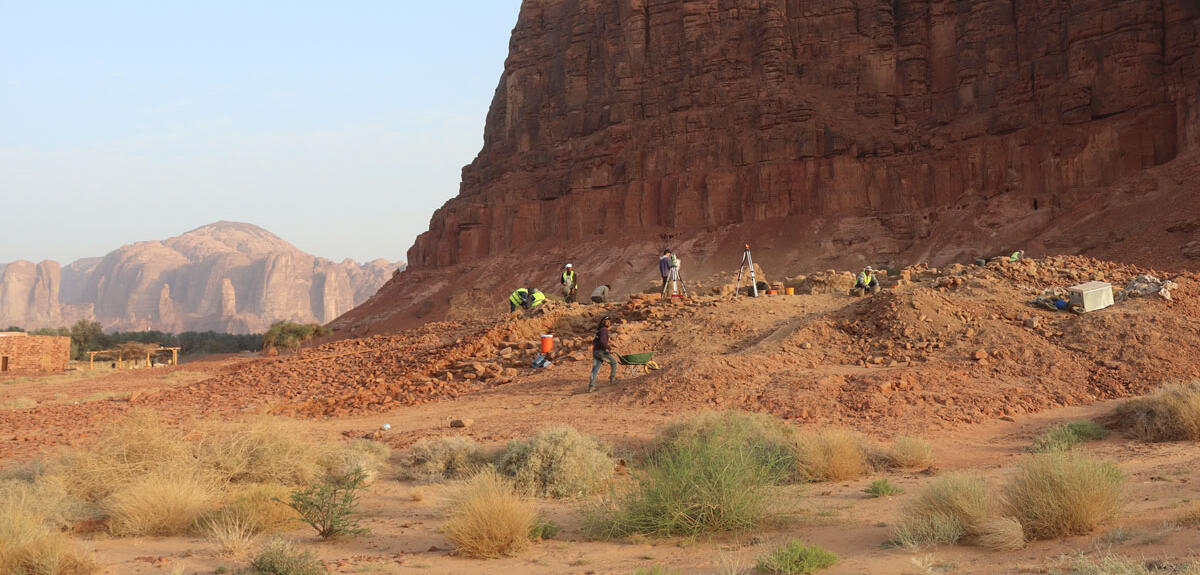
Jérôme Rohmer2 Discovered in the late nineteenth century by the first Europeans to explore the area, starting with the Englishman Charles Doughty, Dadan is one of the most important oasis sites in northwest Arabia [7]. During an archaeological mission there in around 1910, the travellers Antonin Jaussen and Raphaël Savignac, Dominican friars from the French Biblical School of Jerusalem (ÉBAF), also remarked on the extent of these remains and the large number of rock inscriptions in their vicinity.
After studying these inscriptions (the vast majority of which are written in an alphabet and language specific to the oasis known as Dadanitic), they showed that the site corresponds to a lush oasis mentioned in the Old Testament by the name of Dadan and described as one of Arabia's main caravan settlements.
It also features in the writings and chronicles of Nabonidus, the last king of Babylon (556-539 BC). In his account of his conquest of northwest Arabia, he mentions his encounter with a ‘king of Dadan’, confirming the existence of an oasis kingdom located at the site at that time. Later, in the second half of the first millennium BC, Dadan saw the emergence of a larger tribal kingdom, Lihyan, which extended its rule over other oases and was mentioned by Greek and Latin geographers.
Excavations at the site, which had been known for over a century, didn't begin until the early 2000s, following a resurgence of archaeological activity in Saudi Arabia, particularly in the Al-Ula [8] region. In 2004, whilst a French-Saudi mission jointly led by the CNRS was beginning to explore the Nabataean site of Hegra, whose beautiful tomb façades are reminiscent of Petra, in Jordan, a Saudi mission from King Saud University (KSU) in Riyadh embarked on the first excavations at Dadan.
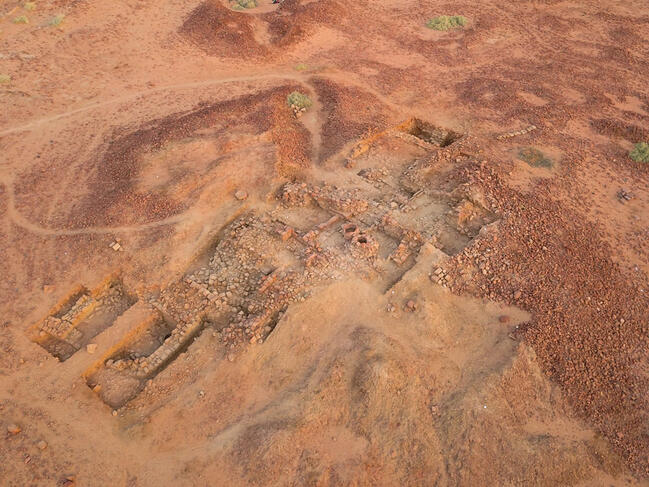

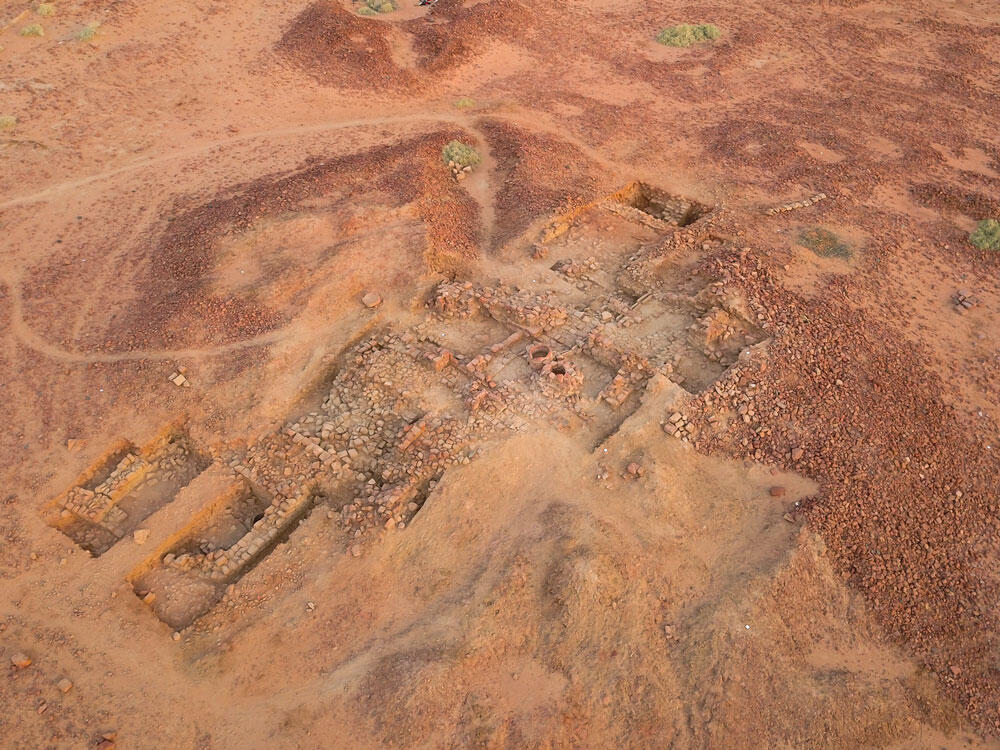
Since 2020, together with my Saudi colleague Abdulrahman Alsuhaibani, we have resumed these excavations as part of a collaboration between the CNRS, the French Agency for Al-Ula Development (AFALULA) and the Royal Commission for Al-Ula (RCU). At present, unfortunately, the international situation has forced us to suspend our work, which we hope to resume in the autumn of 2026.
What has this new archaeological campaign uncovered?
J. R. The main thing we found out is that Dadan, until then believed to have played an important role only during the 1st millennium BC, was in fact inhabited for a much longer period than previously thought. Its history actually spans more than 3000 years, from the end of the 3rd millennium BC until the 11th century AD! During our investigations into previously unknown periods of settlement, we came across, in particular, a village dating from Late Antiquity (3rd to 7th centuries AD), located on the outskirts of the town.
How did you discover the village?
J. R. In 2019, during a preliminary survey, we were investigating an as yet unexplored area 1 km south of the main site, when we noticed several stone mounds suggesting the remains of ruined buildings. Among the material collected from the surface, we were lucky enough to find a bright orange shard of African red slip ware (terra sigillata, a fine ceramic [12] produced in North Africa and widely exported throughout the Roman-Byzantine world), suggesting that the area was settled in the 5th and 6th centuries AD.
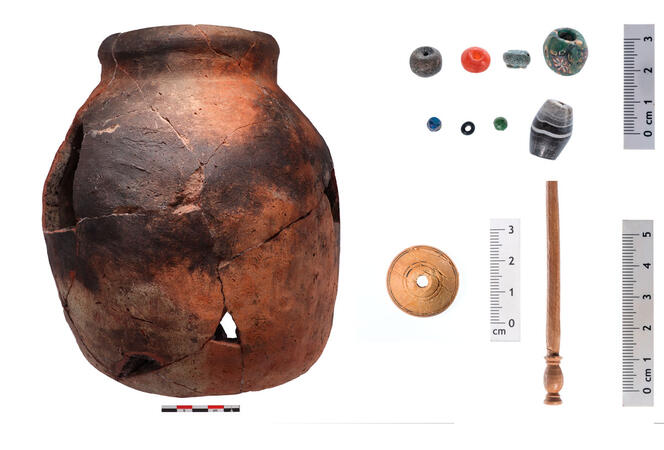
After excavations were temporarily suspended in 2021 due to Covid-19, we explored the largest building. It was fortified and had a well, a relatively unusual example of an independent water supply. Artefacts from the Roman-Byzantine world (cosmetic items such as hairpins and make-up spoons, as well as beads) suggest that it was the residence of local dignitaries, a ‘manor house’ owned by the ruling family.
During subsequent excavations, we also observed an architectural continuity, unsuspected when viewed from the surface, between the various mounds. It was therefore a genuine village, stretching over an area of at least a hectare.

Why is the discovery of this village significant?
J. R. The question of the settlement of the Hejaz (the northwest of present-day Saudi Arabia) during Late Antiquity has long been debated. A number of Arab sources refer to prosperous oases inhabited, shortly before the advent of Islam, by sedentary communities, especially Jewish ones. However, these texts, written after the event, could have rewritten history, and therefore had to be treated with caution. Archaeologically speaking, there was virtually nothing to support this assumption. Indeed, the hypothesis of a massive return to a nomadic way of life had long prevailed, for lack of any archaeological evidence pointing to sedentary settlements throughout this period.
In fact, our findings – corroborated by ongoing work at other sites in the region, such as Khaybar – show that the sedentary communities hadn't disappeared, but had instead frequently migrated to new locations. At Dadan, the Late-Antique village was founded shortly after the old city was abandoned, in around 250 AD.
We still don't know why this relocation took place. It cannot be attributed to an environmental factor, since the new village is situated only a very short distance away. The dilapidated state of the old settlement, which was in decline, may simply have prompted the inhabitants to settle further afield in order to rebuild their houses using recycled stones.
How did these communities survive?
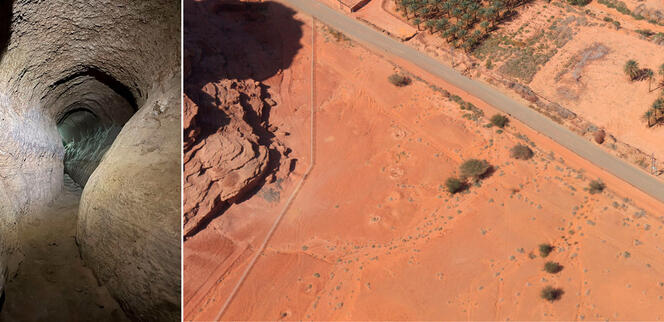
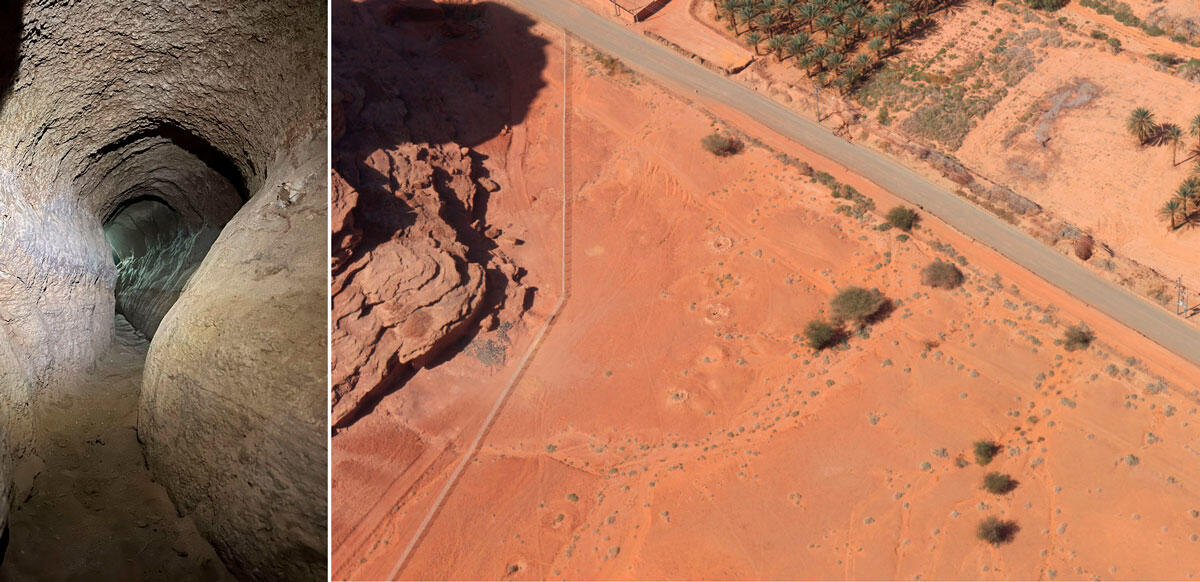
J. R. Around the village, we found evidence of agriculture, including what appears to be an irrigation system, the nature of which is still a matter of debate. We know that there is an entire underground network of water channels in the Al-Ula valley, called ‘qanats’ [14]. We haven't yet managed to find out when they first appeared, and we have no idea whether they were already in use at that time. Oasis agriculture from earlier antiquity appears to have persisted there, with its three-tiered structure: at the top, date palms provided shade for fruit trees in the middle, beneath which cereals were grown on the ground.
Cotton, which had been introduced into the region a few centuries earlier, also appeared at the site around that period. The introduction of this species, used for making textiles, indicates a certain agricultural vitality. But, above all, while we were excavating the building's large 'rubbish pits', it rapidly became apparent that we were dealing with a distinctive population, since we found large quantities of goat and sheep bones, but, surprisingly, none from dromedaries.
What does this lack of dromedary bones suggest?
J. R. This anomaly is all the more intriguing given that, at Dadan, dromedaries had always accounted for 5-20% of animal remains ever since they were first domesticated, around 1000 BC. The idea that they simply disappeared appears highly unlikely. On the nearby site of Hegra, their presence is attested until the early 5th century AD and, in general, they continued to be the most common pack animals throughout the Middle East during Late Antiquity.
But we know that they were subject to a taboo. In Judaism, dromedaries are named in Leviticus and Deuteronomy (the third and fifth books of the Torah – Editor’s note) as the foremost of the unclean animals, because they don’t have cloven hooves. This dietary taboo was adopted by some Christians during the Byzantine period.
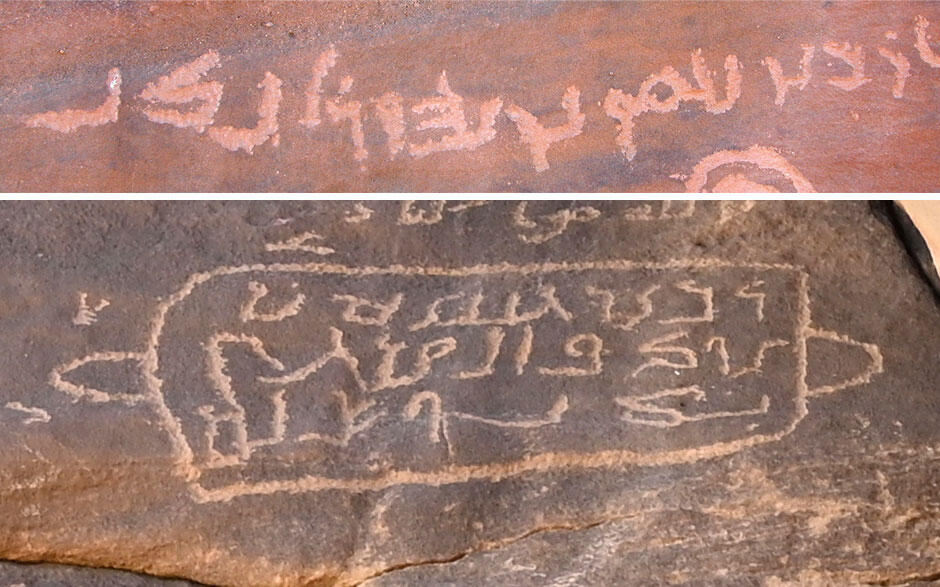
However, in the Al-Ula Valley, Christian inscriptions in Greek are found only along the caravan routes, probably left by foreign travellers. There is therefore no epigraphic evidence of local Christians. On the other hand, later inscriptions, in a script that is transitional between Nabataean [16] and Arabic, do mention local Jews. In addition, accounts of the Prophet's conquest of the Arabian Peninsula mention sedentary Jewish farmers living in this region. They seem to have found, as was often the case, a modus vivendi with the nomadic tribes, to whom they handed over a certain percentage of their harvests.
Where did these Jewish populations come from?
J. R. Their origin is subject to debate. Did they belong to a Jewish diaspora that came from Palestine, for example following the destruction of the Temple of Jerusalem by the Romans, or were they local populations converted to Judaism? I would tend to favour the second hypothesis, especially since conversion, whether partial or total, was a widespread phenomenon in the ancient world. Many Romans became converts, with some observing the precepts of Judaism without, however, going so far as to undergo the dreaded circumcision.
Research in the last few decades also highlights the importance of the development of monotheistic religions in Arabia shortly before the advent of Islam, although the Quran and many Islamic Arab sources portray the region as a land of pagans and idolaters at the time of the Prophet's arrival.
Today, scholars of Islam agree that the Quran is deeply imbued with references to Christianity and Judaism, and that it could only have emerged in an environment largely influenced by monotheism. We also know that at the other end of the Arabian Peninsula, in Yemen, the Jewish kingdom of Himyar reached its peak around the 5th century AD. From its position in the South, it may have played a role in the expansion of Judaism throughout the region.

Could several religions have coexisted in the village you are exploring?
J. R. As we have only excavated one building, it is still too early to tell whether this village was religiously homogeneous, but we shouldn't forget that it was a small settlement. At Hegra, for instance, where inscriptions mention the presence of Jewish communities in the 4th century, remains of dromedaries have been found. This may indicate the coexistence of several religious communities at the site, or perhaps variations in the observance of dietary restrictions. However, there is no evidence of any other religion being practised at that time in the Dadan oasis.
And what became of this Jewish community?
J. R. The Late-Antique village of Dadan was in turn abandoned in the early 7th century, at the dawn of Islam, leading to the building of a new settlement to the north of the site – one that was to be occupied for the next three to four centuries. Although the religious identity of its inhabitants is still unknown, a number of mediaeval Hebrew inscriptions have been found nearby, suggesting the continuing presence of a Jewish community there until the 10th century. Arab geographers of the Abbasid period (8th to 10th centuries AD – Editor's note) also tell us that the region of Al-Ula – then called Wadi al-Qura – was still predominantly populated by Jews at that time.
What are your research plans at Dadan?
J. R. The discovery of a Late-Antique settlement at Dadan fills a gap between a flourishing ancient period, evidence for which extends up until the 3rd century AD, and a renaissance during the Islamic era, thereby providing a more nuanced picture than that of a massive return to nomadism in the meantime. But that's just one aspect of our research on Dadan.
We are now delving further back in history to extend the chronological scope of our research to the formative periods of the oasis settlement– the 2nd and 3rd millennia BC. Dadan, an oasis that was already prosperous in the Bronze Age, derives its uniqueness from its almost uninterrupted sequence of sedentary occupation from the end of the 3rd millennium BC until around 1100 AD, a period spanning over 3000 years!
- 1. Rohmer, J., A. Alsuhaibani, C. Bouchaud, et al., “Bridging the Late Antique Gap in Northwest Arabia: New Archaeological Evidence on the Occupation of Wādī al-Qurā (al-ʿUlā , Saudi Arabia) Between the Third and Seventh Centuries CE ", Arabian Archaeology and Epigraphy, 2025: https://doi.org/10.1111/aae.70009 [18]
- 2. Archaeologist and co-director of Dadan's archaeological mission, Jérôme Rohmer is a researcher at the Orient & Méditerranée laboratory (CNRS / Collège de France / EPHE-PSL / Sorbonne Université / Université Panthéon-Sorbonne).
Explore more