
CNRS News
Published on CNRS News (https://news.cnrs.fr)

Home > The brain knows the score

The brain knows the score

You are here

Home [1]
Lire en français [2]
Life [3]
Society [4]
Musicology [5]
-A [6] +A [6]
article

The brain knows the score

07.24.2026, by
Servane Pierre [7]
Reading time: 5 minutes
Electric Daisy Carnival 2021, Orlando
The Electric Daisy Carnival electronic music festival in Orlando (Florida, USA), December 2021.
Denny Pictures / Shutterstock.com
Behind the pleasure of listening to a song lies an astonishing brain activity: an anticipatory mechanism that translates simple vibrations into emotions. A phenomenon that is especially used in electronic music.

Whether it is in public transport, while working, or while cooking, music accompanies our everyday lives. Pop, rap, classical, jazz, rock, electro, metal, techno… The styles are different, but all involve two elements: rhythm and melody.

However, hidden behind the pleasure of listening to a song lies an astonishing brain activity, namely that of predicting what it will hear next. Thanks to rhythms and repetition, our auditory system permanently anticipates what is coming next in music, a mechanism that plays a central role in musical pleasure. 

Sound travels

Originally, sound is a variation in air pressure. When we push the “Play” button, it travels through the air to our ears, then through a series of structures, before ultimately being interpreted by the brain. It travels through the ear canal to the eardrum, and then to the ossicles, which amplify vibrations. It completes its path in the cochlea, an organ resembling a snail shell, from where it is transmitted to the basilar membrane. The mechanical movement of this membrane’s cilia is transformed into an electrical signal that travels along the auditory nerve all the way to the brain.
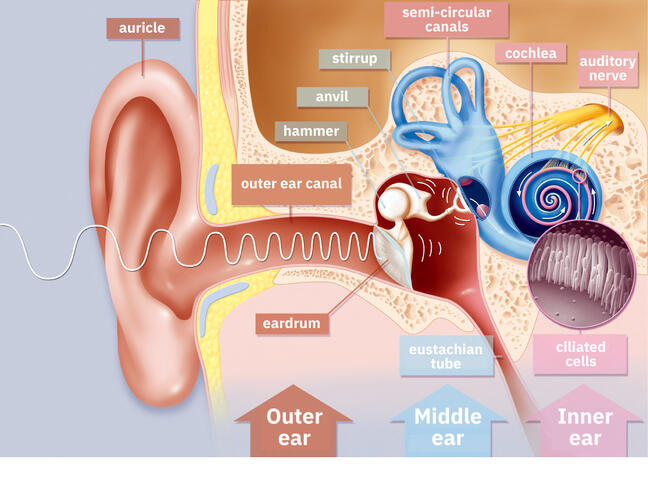

Anatomy of Outer, Middle and Inner ears
Illustration of the pathway travelled by sound in the inner ear.
CNRS News
Anatomy of Outer, Middle and Inner ears
Illustration of the pathway travelled by sound in the inner ear.
Sophie Jacopin / BSIP via AFP
Share
Share
[8] [9] [10]

“This system is remarkable for its speed. Variations in air pressure are conveyed in the auditory nerve in less than 2 milliseconds,” emphasises Boris Gourévitch, a research professor at the Hearing Institute (IdA) in Paris1 and member of the Plasticity of Central Auditory Circuits team.

Music (de)coded by the brain

The perception of melodies and rhythms is very well organised in the brain. Sound is first decomposed when it travels through the cochlea. Depending on their frequency, deep or low sounds activate a certain area of the cochlea, while higher ones stimulate a different part. This organisation, known as “tonotopic”, stretches all the way to the auditory cortex.

The rhythm of music is also coded directly in the auditory nerve. “All frequency and temporal variations are reproduced in the auditory nerve, a little like a spectrogram,” Gourévitch explains.

Musical information is coded individually by a neuron, or within a group of neurons. They can, for instance, code the harmonics that make up sound in order to bring forth its specific tone. “When a violin and a piano play the same note, they can be distinguished by their tone. With the piano, some harmonics will be stronger than those of the violin, and others less so,” Gourévitch points out.

schematic example of where an electrode array’s contacts can stimulate the cochlea.
Tonotopic organisation of the cochlea: specific parts of the cochlea are activated for each frequency range.
CNRS News
schematic example of where an electrode array’s contacts can stimulate the cochlea.
Tonotopic organisation of the cochlea: specific parts of the cochlea are activated for each frequency range.
2026 MED-EL Medical Electronics. All rights reserved
Share
Share
[8] [11] [10]

The brain is on the beat…

For the brain, repetitive musical rhythms and structures play a special role. “When something is repeated, reorganisation and neuroplasticity mechanisms are set in motion, and become extremely powerful for the auditory brain,” stresses Daniel Pressnitzer, a CNRS research professor at the LSP perceptual systems laboratory2.

This neuroplasticity is partly based on the auditory cortex. In the presence of a rhythm, the brain will use those that have already been memorised in order to anticipate the content of the next measure, thereby stabilising and lending meaning to its sound environment. Such anticipatory mechanisms are crucial for hearing in general. The musical sensation emerges from this faculty.

…but there is room for surprise

When a prediction proves correct, the auditory cortex enters a kind of resonance that activates the areas of the brain associated with pleasure and reward. The enjoyment of listening to music is based on a subtle balance between predictability and surprise.

“Musical elation seems to occur when the brain can anticipate changes to a piece of music, all while remaining slightly surprised. It is these small surprises that generate the sense of pleasure,” Pressnitzer explains. 

A SEM image of Guinea Pig's cochlea
The spiral structure of a guinea pig’s cochlea, seen under a false colour electron microscope. It is covered with sensory cells that react to different sound frequencies.
CNRS News
A SEM image of Guinea Pig's cochlea
The spiral structure of a guinea pig’s cochlea, seen under a false colour electron microscope. It is covered with sensory cells that react to different sound frequencies.
Dr David Furness / Wellcome Collection CC BY-NC 4.0
Share
Share
[8] [12] [10]

The brain paced by electronic music

Some musical styles make extensive use of these prediction and surprise mechanisms. This is especially true of electronic music, whose repetitive structures offer a preferred playground for the brain. Composers engage listeners by repeating words or abstract sounds, all while modulating their rhythms.

“In the song ‘Dominas’3 by Carl Craig, a pioneer of techno music, the word ‘Dominas’ is repeated. With each measure, the repetition transforms this simple word into music.” This brings to mind an auditory illusion currently being studied by his team, known as “speech to song”4.

Electronic music also exploits the brain’s prediction mechanisms thanks to a “drop” phenomenon: the music gradually rises, creating an expectation, then briefly interrupts this movement before building up again.

Shared emotion

Anticipation is also a social aspect of listening to music. Whether it is at a concert or festival, a crowd hearing the same music shares the same rhythmical points of reference, and generally the same musical expectations. This common experience encourages synchronised movements and emotions, creating a strong sense of cohesion within the group. The word “trance” is often used…but that is another story.

From the first vibration captured by the ear to the emotions shared during a concert, behind each rhythm hides an ever-active brain busy predicting the next note.

See also

How the piano set the world in tune [13]

Footnotes
  • 1. CNRS / INSERM / Institut Pasteur.
  • 2. CNRS / ENS-PSL.
  • 3. https://www.youtube.com/watch?v=aHg0s6DtH74 [14]
  • 4. https://deutsch.ucsd.edu/psychology/pages.php?i=212 [15]

Explore more

Life
Marthe Gautier en 2014 © Rodolphe Escher
[16]
Article
07/09/2026
A supernumerary discoverer [16]
A tick
[17]
Article
06/17/2026
Ticks under watch [17]
Sleeping iguana © Sagi Iltus / iStockphoto.com
[18]
Article
06/04/2026
Sleeping in cold blood [18]
une fourmi zombifiée par un champignon
[19]
Article
05/22/2026
Slaves to parasites [19]
[20]
Article
04/30/2026
Shedding coherent light on the brain [20]
Musicology
[21]
Article
09/06/2017
Using Semantics to Interpret Music [21]
Brain
Sleeping iguana © Sagi Iltus / iStockphoto.com
[18]
Article
06/04/2026
Sleeping in cold blood [18]
une fourmi zombifiée par un champignon
[19]
Article
05/22/2026
Slaves to parasites [19]
[20]
Article
04/30/2026
Shedding coherent light on the brain [20]
Gamevasion © Julian Stratenschulte/DPA via Zuma Press/Réa
[22]
Article
04/15/2026
Are video games to blame for today's violence? [22]
Young woman with vitiligo, autoimmune depigmenting skin disorder
[23]
Article
03/27/2026
Women at greater risk of severe diseases [23]

Keywords

Brain [24] Music [25] auditory system [26] Sound [27] cochlea [28] Neuron [29] harmonics [30]

Share this article

[31]
[32]
[8]
[10]

Source URL:https://news.cnrs.fr/articles/the-brain-knows-the-score

Links
[1] https://news.cnrs.fr/ [2] https://lejournal.cnrs.fr/articles/musique-le-cerveau-aime-anticiper [3] https://news.cnrs.fr/life [4] https://news.cnrs.fr/society [5] https://news.cnrs.fr/musicology-0 [6] https://news.cnrs.fr/javascript%3A%3B [7] https://news.cnrs.fr/authors/servane-pierre [8] https://twitter.com/intent/tweet?url=https%3A//news.cnrs.fr/print/2267%2F&text=The brain knows the score [9] http://www.facebook.com/sharer/sharer.php?s=100&p%5Burl%5D=https%3A//news.cnrs.fr/print/2267&p%5Btitle%5D=The%20brain%20knows%20the%20score&p%5Bimages%5D%5B0%5D=https%3A//news.cnrs.fr/sites/default/files/styles/lightbox-hd/public/assets/images/069_bsip_012908_032_72dpi_va_0.jpg%3Fitok%3D4hjFf0N_&p%5Bsummary%5D= [10] https://bsky.app/intent/compose?text=The brain knows the score%0Ahttps%3A//news.cnrs.fr/print/2267 [11] http://www.facebook.com/sharer/sharer.php?s=100&p%5Burl%5D=https%3A//news.cnrs.fr/print/2267&p%5Btitle%5D=The%20brain%20knows%20the%20score&p%5Bimages%5D%5B0%5D=https%3A//news.cnrs.fr/sites/default/files/styles/lightbox-hd/public/assets/images/ccc-schematisch_2013_72dpi_0.jpg%3Fitok%3Dkzo5CQ8N&p%5Bsummary%5D= [12] http://www.facebook.com/sharer/sharer.php?s=100&p%5Burl%5D=https%3A//news.cnrs.fr/print/2267&p%5Btitle%5D=The%20brain%20knows%20the%20score&p%5Bimages%5D%5B0%5D=https%3A//news.cnrs.fr/sites/default/files/styles/lightbox-hd/public/assets/images/wellcome_h2yymu26_72dpi.jpg%3Fitok%3Dclb7zZiD&p%5Bsummary%5D= [13] https://news.cnrs.fr/articles/how-the-piano-set-the-world-in-tune [14] https://www.youtube.com/watch?v=aHg0s6DtH74 [15] https://deutsch.ucsd.edu/psychology/pages.php?i=212 [16] https://news.cnrs.fr/articles/a-supernumerary-discoverer [17] https://news.cnrs.fr/articles/ticks-under-watch [18] https://news.cnrs.fr/articles/sleeping-in-cold-blood [19] https://news.cnrs.fr/articles/slaves-to-parasites [20] https://news.cnrs.fr/articles/shedding-coherent-light-on-the-brain [21] https://news.cnrs.fr/articles/using-semantics-to-interpret-music [22] https://news.cnrs.fr/articles/are-video-games-to-blame-for-todays-violence [23] https://news.cnrs.fr/articles/women-at-greater-risk-of-severe-diseases [24] https://news.cnrs.fr/brain [25] https://news.cnrs.fr/music-0 [26] https://news.cnrs.fr/auditory-system [27] https://news.cnrs.fr/sound [28] https://news.cnrs.fr/cochlea [29] https://news.cnrs.fr/neuron [30] https://news.cnrs.fr/harmonics [31] http://www.facebook.com/sharer/sharer.php?s=100&p%5Burl%5D=https%3A//news.cnrs.fr/print/2267&p%5Btitle%5D=The%20brain%20knows%20the%20score&p%5Bimages%5D%5B0%5D=&p%5Bsummary%5D= [32] https://news.cnrs.fr/printmail/2267