CNRS News
Published on CNRS News (https://news.cnrs.fr)

Home > "The James Webb Space Telescope images are extraordinary"

"The James Webb Space Telescope images are extraordinary"

You are here

Home [1]
Lire en français [2]
Space [3]
astrophysics [4]
-A [5] +A [5]
article

"The James Webb Space Telescope images are extraordinary"

07.06.2022, by
Sophie Felix [6]
Reading time: 7 minutes
With this picture of the Carina Nebula, a stellar nursery four times larger and brighter than the Orion Nebula, the JWST promises Olivier Berné's team a flurry of new discoveries.
NASA, ESA, CSA, and STScI
Today the American (NASA), European (ESA), and Canadian (CSA) space agencies released the first colour images and spectroscopic data from the James Webb Space Telescope (JWST). Coordinator of one of the first observation programmes involving the telescope, the astrophysicist Olivier Berné shares his insights on the images.

You were finally able to see the first images from the James Webb Space Telescope (JWST) launched last December. What do you think?
Olivier Berné:1
It's very moving! These images are extraordinary, with a depth and sharpness of detail never before achieved with previous land or space observatories, such as the Hubble. The initial results show remarkable sensitivity, on the order of 6-10 times greater than before. This allows us to finally observe very distant objects, such as primordial galaxies, or to have a better view of closer objects that are not very luminous, such as stars or planets in formation. There is also much more information in these images with a higher resolution, thanks to the James Webb’s mirror measuring 6.5 metres. In concrete terms, in terms of details, it's a little like going from an impressionist painting to a realist style
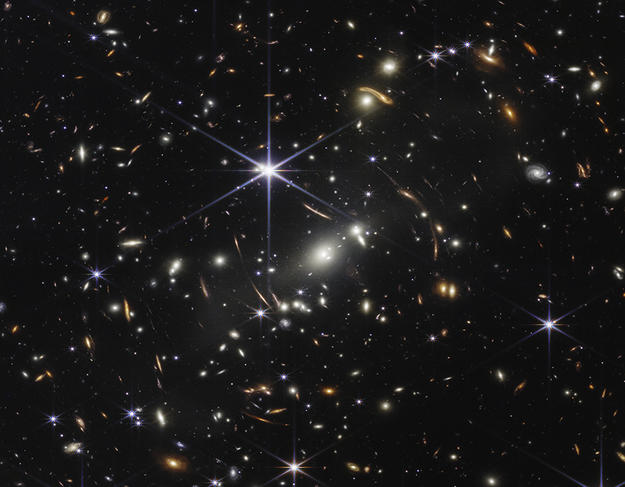

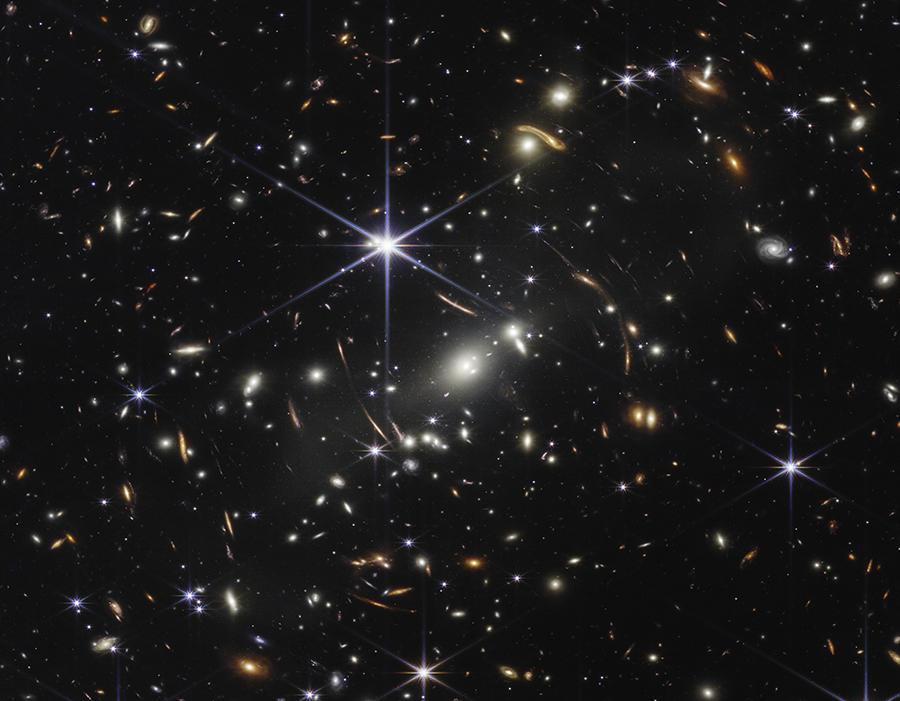
The SMACS 0723 galaxy cluster is so massive that it magnifies and distorts the light of objects behind it. In addition to JWST’s abilities, this makes it possible to obtain a deep field view into both the extremely distant and intrinsically faint galaxy populations, producing the "deepest image of our Universe that has ever been taken," according to Olivier Berné.
CNRS News
The SMACS 0723 galaxy cluster is so massive that it magnifies and distorts the light of objects behind it. In addition to JWST’s abilities, this makes it possible to obtain a deep field view into both the extremely distant and intrinsically faint galaxy populations, producing the "deepest image of our Universe that has ever been taken," according to Olivier Berné.
NASA, ESA, CSA, and STScI
Share
Share
[7] [8] [9]

The James Webb Space Telescope can also observes visible light, but does so primarily in infrared. Why is that?
O. B.:
Infrared wavelengths are larger than those in the visible spectrum. Observing in infrared enables us to go further back into the Universe's past, and to observe galaxies that formed in the early Universe. Given that the Universe is expanding, the light signal from these first galaxies was considerably shifted toward the infrared, falling outside the visible spectrum. So we must find their light in infrared to understand the nature of the Universe's first stars, and how they formed just after the Big Bang about 13.5 billion years ago. The deep field of distant galaxies that we see in this image is a perfect illustration of the JWST's capacity in this regard. These wavelengths also make it possible to observe, among other things, nascent stars or planets through the cocoons of dust and gas surrounding them.
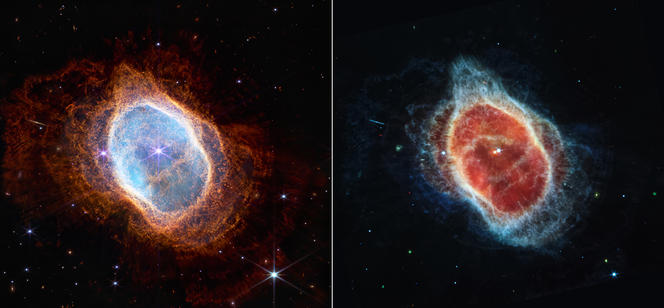
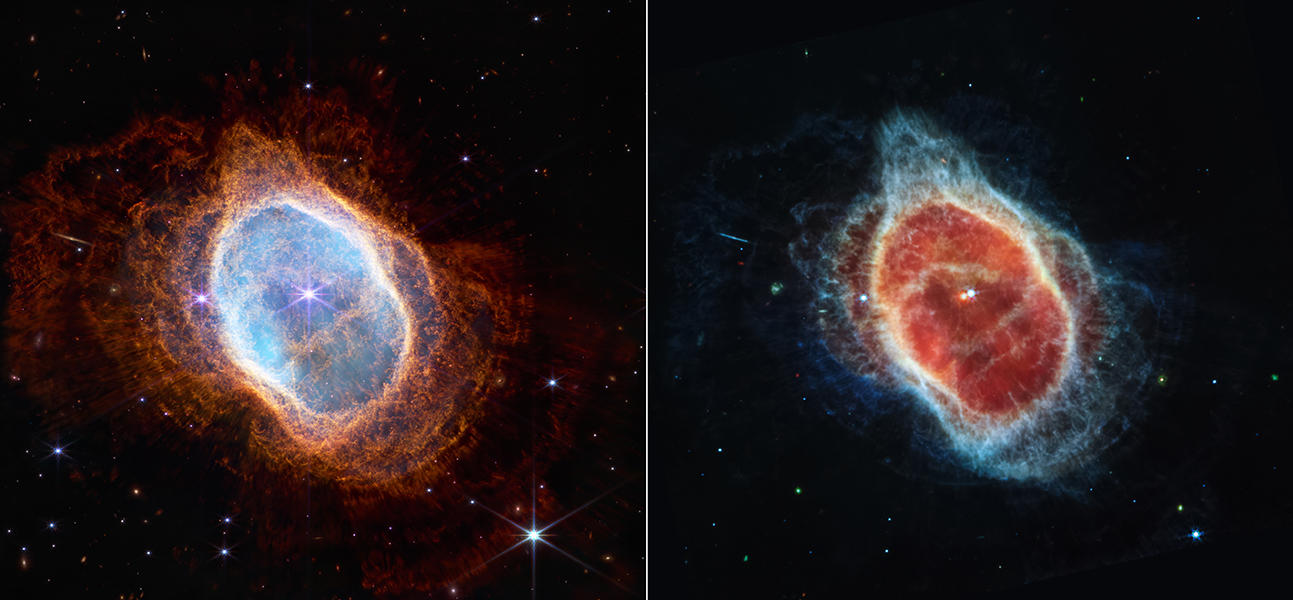
Located in the constellation approximately 2,000 light years away from Earth, the Southern Ring nebula is a planetary nebula – an expanding cloud of gas, surrounding a dying star visible in the center. "The level of details is astonishing: you can see an entire granular texture that was previously invisible," enthuses Olivier Berné.
CNRS News
Located in the constellation approximately 2,000 light years away from Earth, the Southern Ring nebula is a planetary nebula – an expanding cloud of gas, surrounding a dying star visible in the center. "The level of details is astonishing: you can see an entire granular texture that was previously invisible," enthuses Olivier Berné.
NASA, ESA, CSA, and STScI
Share
Share
[7] [10] [9]

Do scientists use these images for their research?
O. B.: These images use false colours for aesthetic purposes, all while presenting information that is not normally visible to the naked eye. Scientists do not use these colour images directly for their work. They are especially interested in the data gathered by each of the telescope's filters, at specific wavelengths for images or via spectrographs. This provides information on the temperature, density, and chemical composition, and sometimes the movements, of the observed objects. This allows us to grasp the physical phenomena at work.

However, the James Webb's role is not solely scientific. With its fantastic images that touch the general public, the Hubble telescope has had a major impact on how humanity sees the cosmos, and on the collective imagination regarding the Universe in which we live. It is a fundamental role that the JWST will certainly fulfil, one that is at least as important as the scientific discoveries. I had wagered that there would be an allusion to the Hubble's work in the images released today, and the one depicting the Carina Nebula proves me right!

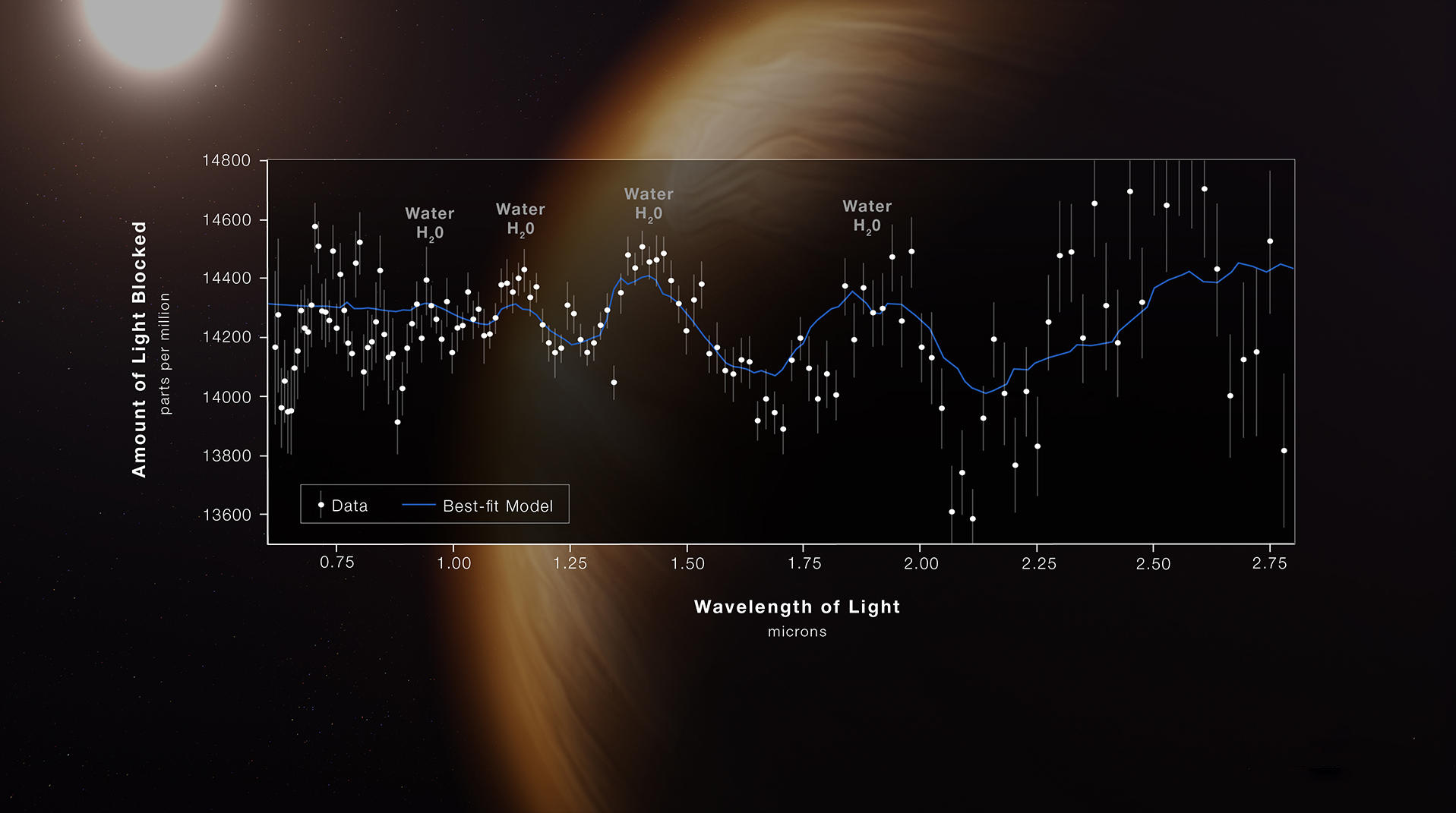
The JWST reveals the spectrum of the gas giant exoplanet WASP-96b’s atmosphere. The planet, located nearly 1,150 light-years from Earth (in the Phoenix constellation), orbits its star every 3.4 days and has about half the mass of Jupiter.
CNRS News
The JWST reveals the spectrum of the gas giant exoplanet WASP-96b’s atmosphere. The planet, located nearly 1,150 light-years from Earth (in the Phoenix constellation), orbits its star every 3.4 days and has about half the mass of Jupiter.
NASA, ESA, CSA, and STScI
Share
Share
[7] [11] [9]

But the data the space agencies released today is invaluable for you. Can you explain in what regard? 
O. B.: Today the agencies released these admirable images, as well as the observations that were made and the data that was produced during the test phase. This data is of considerable scientific interest, as it allows us to assess the quality of various instruments, and to test the data processing algorithms we have prepared. Astronomers and astrophysicist like myself have been waiting impatiently for decades to conduct science with this telescope!

Your own observations will take place between 10 September and 3 October. What are you trying to analyse, and what advantages does the JWST offer your project?
O. B.:Our team is coordinated by three managers: Els Peeters at the University of Western Ontario in Canada, Emilie Habart at the Institut d’astrophysique spatiale (France) and myself. This trio coordinates an international team that includes about 150 people from 18 countries, with a core team of 30 researchers. We have secured 40 hours of observation to study the Orion Nebula, a cloud of gas and dust at the heart of the constellation of the same name. Slots are hard to come by, with only 13 projects being selected worldwide for this first phase, or approximately one fortunate winner per 10 candidates. We are the only programme whose main responsibility is french.
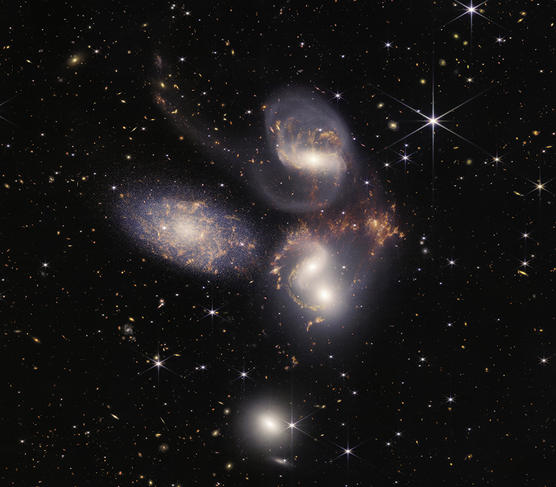
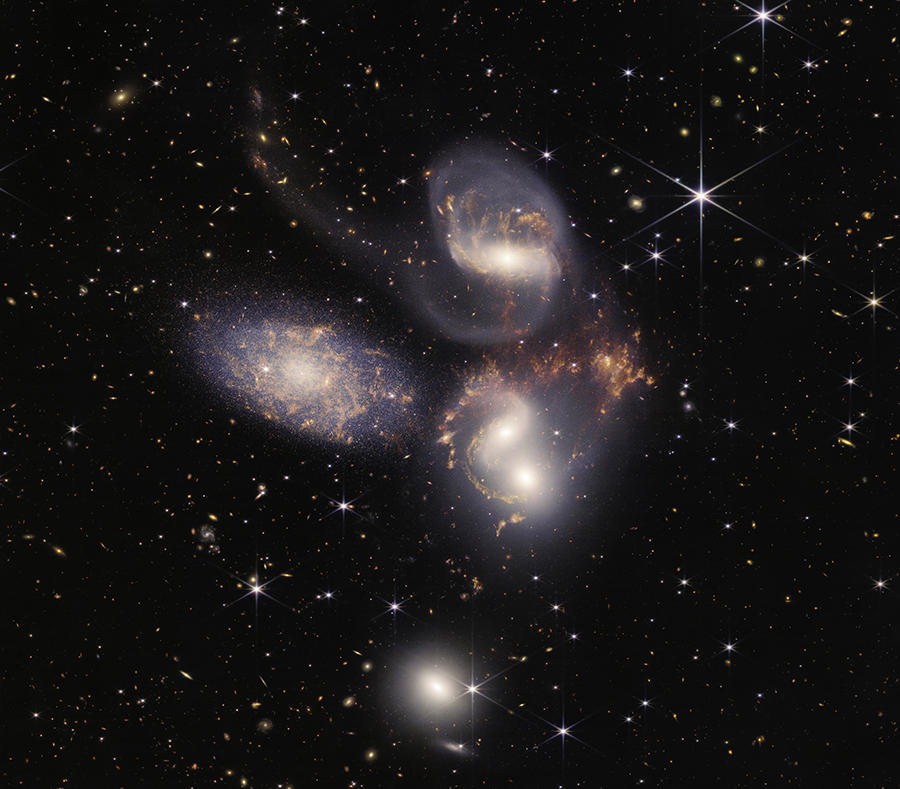
About 290 million light-years away, Stephan’s Quintet is notable for being the first compact galaxy group ever discovered in 1877. Four of the five galaxies within the quintet are locked in a cosmic dance of repeated close encounters. For Olivier Berné, "it's like being able to zoom to infinity and finding more and more details, it's extraordinary."
CNRS News
About 290 million light-years away, Stephan’s Quintet is notable for being the first compact galaxy group ever discovered in 1877. Four of the five galaxies within the quintet are locked in a cosmic dance of repeated close encounters. For Olivier Berné, "it's like being able to zoom to infinity and finding more and more details, it's extraordinary."
NASA, ESA, CSA, and STScI
Share
Share
[7] [12] [9]

The Orion Nebula is interesting in two respects. First, it is a region of star and planet formation that is at least partially representative of the environment in which the Solar System formed. Studying it allows us to go back in time and better understand, via analogy, the formation of the Sun and the planets that surround it, like the Earth.
Second, the distant galaxies observed by the James Webb are at a point in their evolution in which they form many stars. Consequently, their infrared radiation is dominated by a light signal similar to the one we receive from the Orion Nebula. The difference is that Orion is close enough for us to observe the different regions of the nebula that have different parameters (temperature and gas density, star formation rate, intensity of the radiation field, etc.). Our project is to provide models that connect the aspect of the light signal with these parameters, some templates that will allow us to interpret the signals received from distant galaxies. We have been preparing this project for about 10 years, and these observations will be central to our research for a number of years!

Update of September 12, 2022

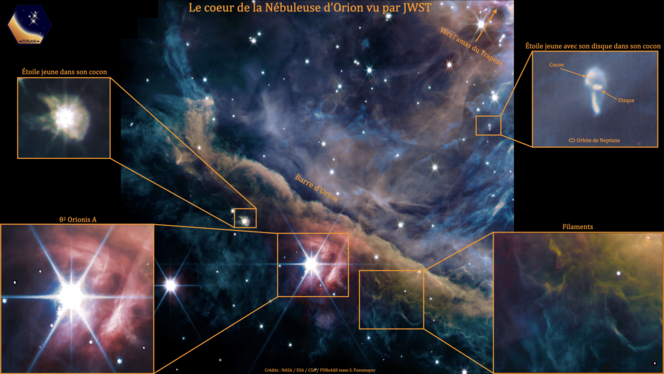
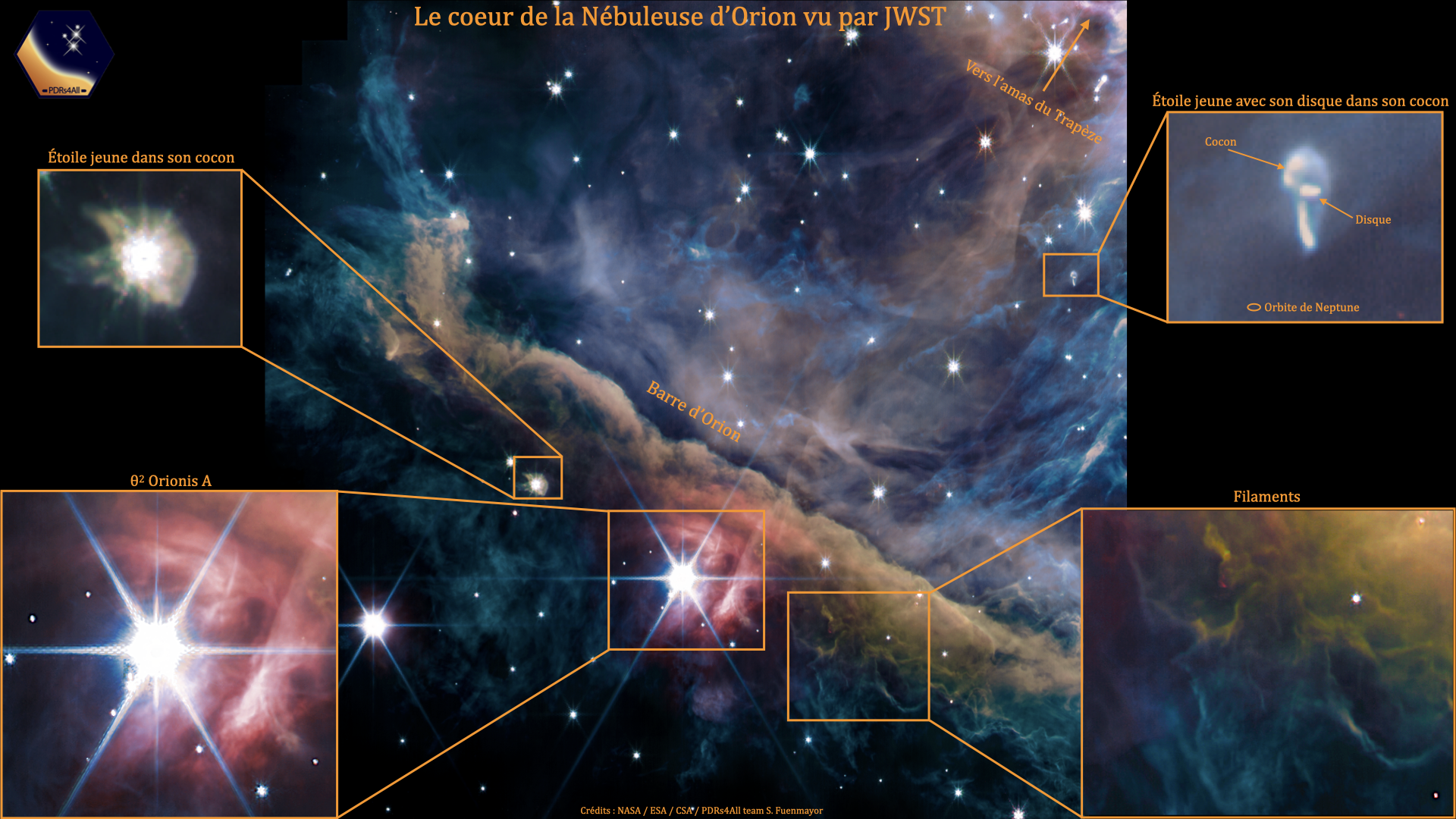
The team co-led by Olivier Berné unveiled the first images of the Orion Nebula, revealing in particular many spectacular structures, up to scales of about 40 astronomical units (one unit is equivalent to the Earth-Sun distance). Among them are a number of dense filaments of matter, which could favor the birth of a new generation of stars, as well as stellar systems in formation.
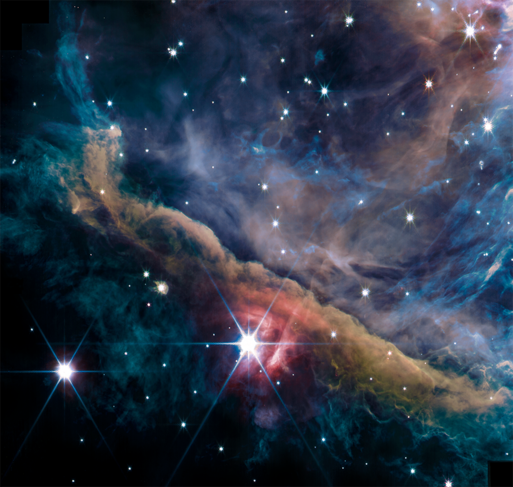
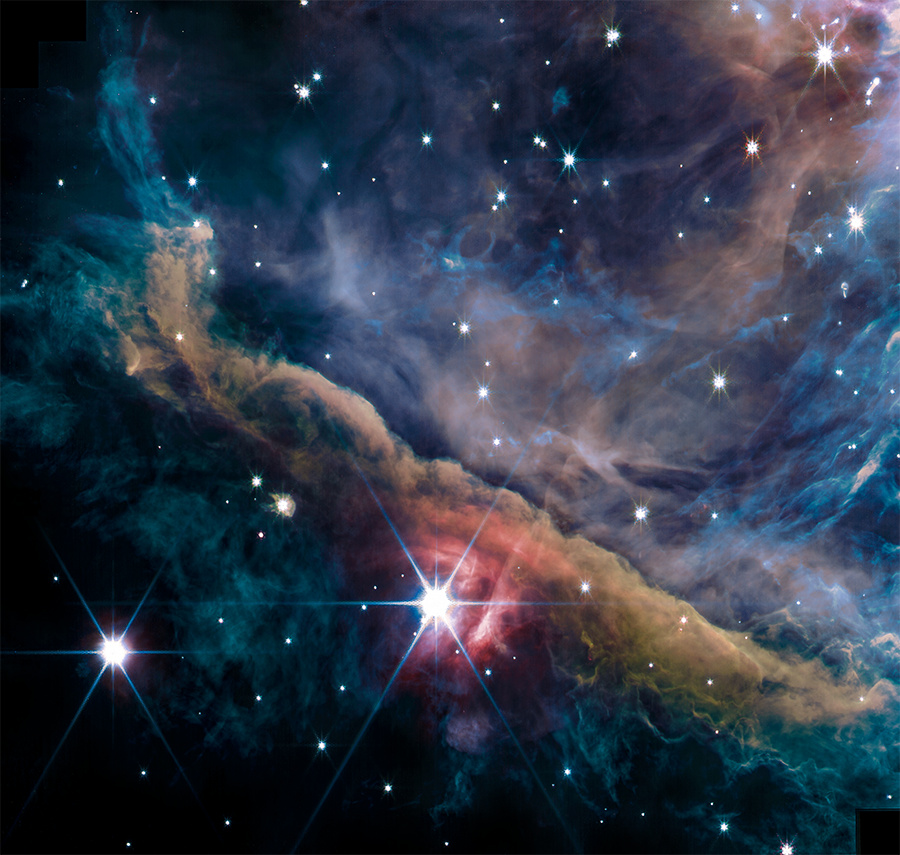
James Webb Space Telescope image of the inner region of the Orion Nebula.
CNRS News
James Webb Space Telescope image of the inner region of the Orion Nebula.
NASA/ESA/CSA/PDRs4All ERS Team/Salomé Fuenmayor
Share
Share
[7] [13] [9]
The heart of the Orion Nebula seen by JWST
CNRS News
The heart of the Orion Nebula seen by JWST
NASA/ESA/CSA/PDRs4All ERS Team/Salomé Fuenmayor
Share
Share
[7] [14] [9]

The inner region of the Orion Nebula as seen by the Hubble Space Telescope (left) and the James Webb Space Telescope (right).
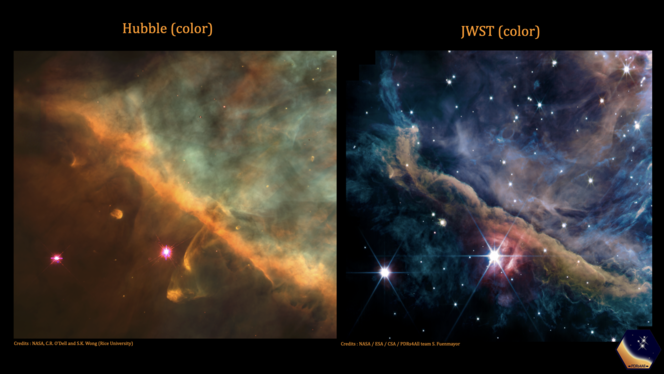
 

Comparison between two images of the internal region of the nebula, seen by Hubble and the JWST.
CNRS News
Comparison between two images of the internal region of the nebula, seen by Hubble and the JWST.
NASA/ESA/CSA/PDRs4All ERS Team/Salomé Fuenmayor/Olivier Berné
Share
Share
[7] [15] [9]

_______________________________________________________________________
The James Webb Space Telescope, a giant at the service of knowledge
The JWST is the largest and most powerful space telescope ever launched. It was created to better understand our Solar System, to observe distant worlds located around other stars, and to probe the origins of the Universe. It grew out of an international partnership between NASA, the ESA, and the Canadian Space Agency (CSA). The ESA provided two of the Webb's four scientific instruments: the NIRSpec spectrograph, and 50% of the MIRI spectrograph and imager. A number of CNRS-associated laboratories took part, such as the Laboratoire d'études spatiales et d'instrumentation en astrophysique, the Laboratoire d'astrophysique de Marseille or the Institut d’astrophysique spatiale. The telescope was on board an Ariane 5 rocket launched from the European Space Centre in French Guiana on 25 December 2021. With its mirror measuring 6.5 metres, it is now orbiting the L2 Lagrange point of the Sun-Earth system, located 1.5 million kilometres from the Earth on the opposite side of the Sun.

Footnotes
  • 1. Institut de recherche en astrophysique et planétologie de Toulouse (CNRS/CNES/Université Toulouse III-Paul Sabatier).

Explore more

Space
This illustration shows the merger of two black holes and the gravitational waves that ripple outward as the black holes spiral toward each other.
[16]
Article
11/03/2025
Gravitational wave detections spark great expectations [16]
Image Nasa / GSFC / Solar Dynamics Observatory
[17]
Article
10/09/2025
Hottest news from the Sun's corona [17]
Vera C. Rubin observatory © RubinObs / NSF / DOE / NOIRLab / SLAC / AURA / H. Stockebrand
[18]
Article
09/12/2025
The Big Bang within the reach of telescopes [18]
[19]
Article
07/09/2025
1905: Einstein initiates the quantum age [19]
Mont-Saint-Michel © GLAZ / Mathieu Rivrin / Hemis.fr
[20]
Article
03/18/2025
Solar storms ahead [20]
astrophysics
This illustration shows the merger of two black holes and the gravitational waves that ripple outward as the black holes spiral toward each other.
[16]
Article
11/03/2025
Gravitational wave detections spark great expectations [16]
Image Nasa / GSFC / Solar Dynamics Observatory
[17]
Article
10/09/2025
Hottest news from the Sun's corona [17]
Illustration Nasa / ESA L. Hustak (STScI)
[21]
Article
02/06/2025
Those stars that come and go [21]
[22]
Article
01/29/2025
On the trail of cosmic cataclysms [22]
[23]
Article
12/04/2024
James Webb illuminates the grey areas of astrophysics [23]
James Webb
Vera C. Rubin observatory © RubinObs / NSF / DOE / NOIRLab / SLAC / AURA / H. Stockebrand
[18]
Article
09/12/2025
The Big Bang within the reach of telescopes [18]

Keywords

James Webb [24] Telescope [25] universe [26]

Share this article

[27]
[28]
[7]
[9]

Source URL:https://news.cnrs.fr/articles/the-james-webb-space-telescope-images-are-extraordinary

Links
[1] https://news.cnrs.fr/ [2] https://lejournal.cnrs.fr/articles/le-james-webb-space-telescope-revele-ses-premieres-images [3] https://news.cnrs.fr/space [4] https://news.cnrs.fr/astrophysics [5] https://news.cnrs.fr/javascript%3A%3B [6] https://news.cnrs.fr/authors/sophie-felix [7] https://twitter.com/intent/tweet?url=https%3A//news.cnrs.fr/print/1870%2F&text="The James Webb Space Telescope images are extraordinary" [8] http://www.facebook.com/sharer/sharer.php?s=100&p%5Burl%5D=https%3A//news.cnrs.fr/print/1870&p%5Btitle%5D=%26quot%3BThe%20James%20Webb%20Space%20Telescope%20images%20are%20extraordinary%26quot%3B&p%5Bimages%5D%5B0%5D=https%3A//news.cnrs.fr/sites/default/files/styles/lightbox-hd/public/assets/images/webb_s_first_deep_field_72dpi.jpg%3Fitok%3DPhxbRNwO&p%5Bsummary%5D= [9] https://bsky.app/intent/compose?text="The James Webb Space Telescope images are extraordinary"%0Ahttps%3A//news.cnrs.fr/print/1870 [10] http://www.facebook.com/sharer/sharer.php?s=100&p%5Burl%5D=https%3A//news.cnrs.fr/print/1870&p%5Btitle%5D=%26quot%3BThe%20James%20Webb%20Space%20Telescope%20images%20are%20extraordinary%26quot%3B&p%5Bimages%5D%5B0%5D=https%3A//news.cnrs.fr/sites/default/files/styles/lightbox-hd/public/assets/images/main_image_stellar_death_s_ring_miri_nircam_sidebyside-5mb_72dpi.jpg%3Fitok%3Dd6RSsCry&p%5Bsummary%5D= [11] http://www.facebook.com/sharer/sharer.php?s=100&p%5Burl%5D=https%3A//news.cnrs.fr/print/1870&p%5Btitle%5D=%26quot%3BThe%20James%20Webb%20Space%20Telescope%20images%20are%20extraordinary%26quot%3B&p%5Bimages%5D%5B0%5D=https%3A//news.cnrs.fr/sites/default/files/styles/lightbox-hd/public/assets/images/main_image_exoplanet_wasp_72dpi.jpg%3Fitok%3Dze3yuRK1&p%5Bsummary%5D= [12] http://www.facebook.com/sharer/sharer.php?s=100&p%5Burl%5D=https%3A//news.cnrs.fr/print/1870&p%5Btitle%5D=%26quot%3BThe%20James%20Webb%20Space%20Telescope%20images%20are%20extraordinary%26quot%3B&p%5Bimages%5D%5B0%5D=https%3A//news.cnrs.fr/sites/default/files/styles/lightbox-hd/public/assets/images/main_image_galaxies_stephans_quintet_sq_nircam_miri_final-5mb_72dpi.jpg%3Fitok%3D4VzIugiA&p%5Bsummary%5D= [13] http://www.facebook.com/sharer/sharer.php?s=100&p%5Burl%5D=https%3A//news.cnrs.fr/print/1870&p%5Btitle%5D=%26quot%3BThe%20James%20Webb%20Space%20Telescope%20images%20are%20extraordinary%26quot%3B&p%5Bimages%5D%5B0%5D=https%3A//news.cnrs.fr/sites/default/files/styles/lightbox-hd/public/assets/images/orion_d_72dpi.png%3Fitok%3DzOSzBVJf&p%5Bsummary%5D= [14] http://www.facebook.com/sharer/sharer.php?s=100&p%5Burl%5D=https%3A//news.cnrs.fr/print/1870&p%5Btitle%5D=%26quot%3BThe%20James%20Webb%20Space%20Telescope%20images%20are%20extraordinary%26quot%3B&p%5Bimages%5D%5B0%5D=https%3A//news.cnrs.fr/sites/default/files/styles/lightbox-hd/public/assets/images/images_release.007.png%3Fitok%3DTVrpwoQ4&p%5Bsummary%5D= [15] http://www.facebook.com/sharer/sharer.php?s=100&p%5Burl%5D=https%3A//news.cnrs.fr/print/1870&p%5Btitle%5D=%26quot%3BThe%20James%20Webb%20Space%20Telescope%20images%20are%20extraordinary%26quot%3B&p%5Bimages%5D%5B0%5D=https%3A//news.cnrs.fr/sites/default/files/styles/lightbox-hd/public/assets/images/images_release.005.png%3Fitok%3DA1ycStNt&p%5Bsummary%5D= [16] https://news.cnrs.fr/articles/gravitational-wave-detections-spark-great-expectations [17] https://news.cnrs.fr/articles/hottest-news-from-the-suns-corona [18] https://news.cnrs.fr/articles/the-big-bang-within-the-reach-of-telescopes [19] https://news.cnrs.fr/articles/1905-einstein-initiates-the-quantum-age [20] https://news.cnrs.fr/articles/solar-storms-ahead [21] https://news.cnrs.fr/articles/those-stars-that-come-and-go [22] https://news.cnrs.fr/articles/on-the-trail-of-cosmic-cataclysms [23] https://news.cnrs.fr/articles/james-webb-illuminates-the-grey-areas-of-astrophysics [24] https://news.cnrs.fr/james-webb [25] https://news.cnrs.fr/telescope-0 [26] https://news.cnrs.fr/universe [27] http://www.facebook.com/sharer/sharer.php?s=100&p%5Burl%5D=https%3A//news.cnrs.fr/print/1870&p%5Btitle%5D=%26quot%3BThe%20James%20Webb%20Space%20Telescope%20images%20are%20extraordinary%26quot%3B&p%5Bimages%5D%5B0%5D=&p%5Bsummary%5D= [28] https://news.cnrs.fr/printmail/1870