CNRS News
Published on CNRS News (https://news.cnrs.fr)

Home > Mercury in the Air

Mercury in the Air

You are here

Home [1]
Lire en français [2]
slideshow
-A [3] +A [3]
Matter [4]
Earth [5]
environmental sciences [6]

Mercury in the Air

12.13.2019, by
Nicolas Baker [7]
Invisible, and yet everywhere. Mercury is present in the atmosphere, oceans, and even in our plates! Since the adoption of the Minamata Convention on Mercury in 2013, 128 countries have been striving to limit the spread of this pollutant. However, the complex dynamics of mercury—which passes from the environment to living beings before potentially being released again into the environment—remain poorly understood.

The study of this process in a tropical environment was recently conducted by the Institut des Géosciences de l’Environnement at the Maido Observatory on Reunion Island.
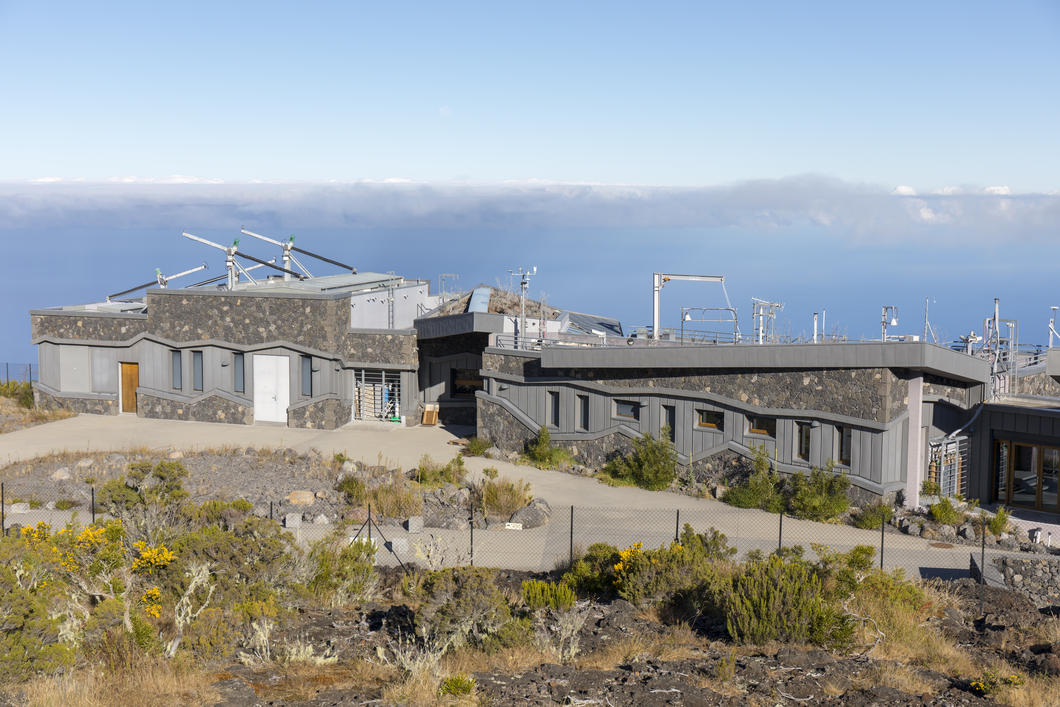
Environment observatory on the island of La Réunion in the Indian Ocean
1
Located at an altitude of 2,200 m on Reunion Island, the Maido Observatory is the ideal site for measuring the concentration of various species of atmospheric mercury. These compounds are emitted in the environment by both natural phenomena and human activity.
Thibaut VERGOZ / IGE / CNRS Photothèque
Slideshow mode
Share
Share
[8]
[9]
[10]
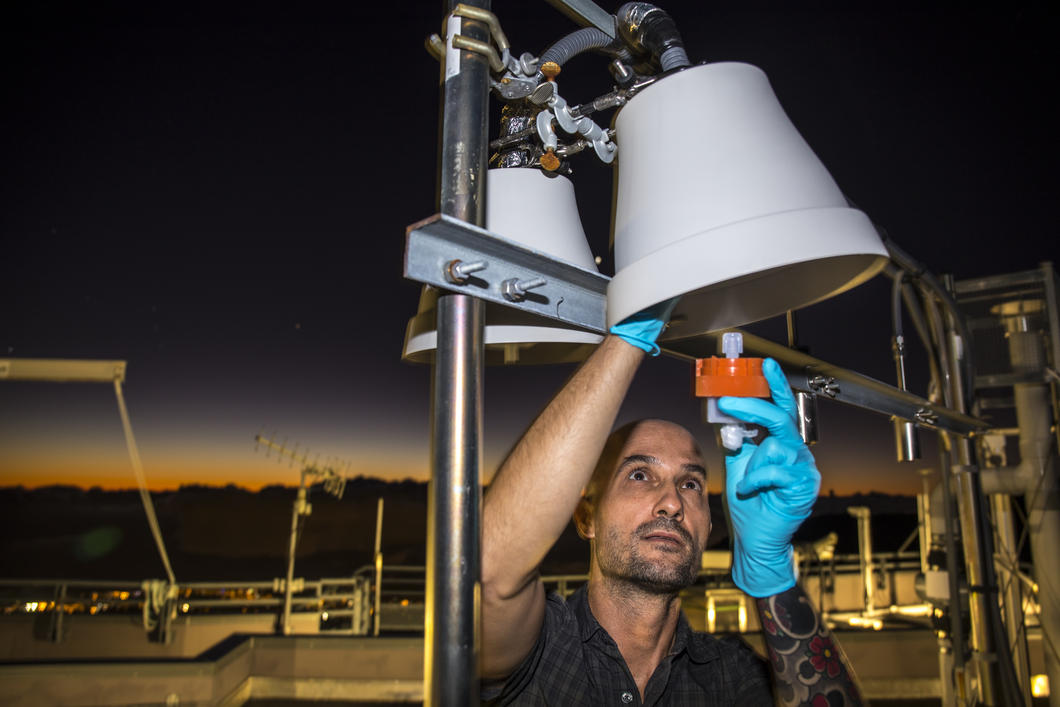
Engineer installing an atmospheric mercury detector
2
On the roof of the observatory, engineer Olivier Magand installs a device that collects the oxidized form of mercury present in the atmosphere. The sample will be analysed to determine the isotopic composition of oxidized species of mercury (measure of the proportion of different mercury isotopes). The isotopes have the same number of protons as their nucleus, but a different number of neutrons. Isotopic composition allows for a detailed interpretation of the processes at work in the atmosphere.
Thibaut VERGOZ / IGE / CNRS Photothèque
Slideshow mode
Share
Share
[8]
[11]
[10]
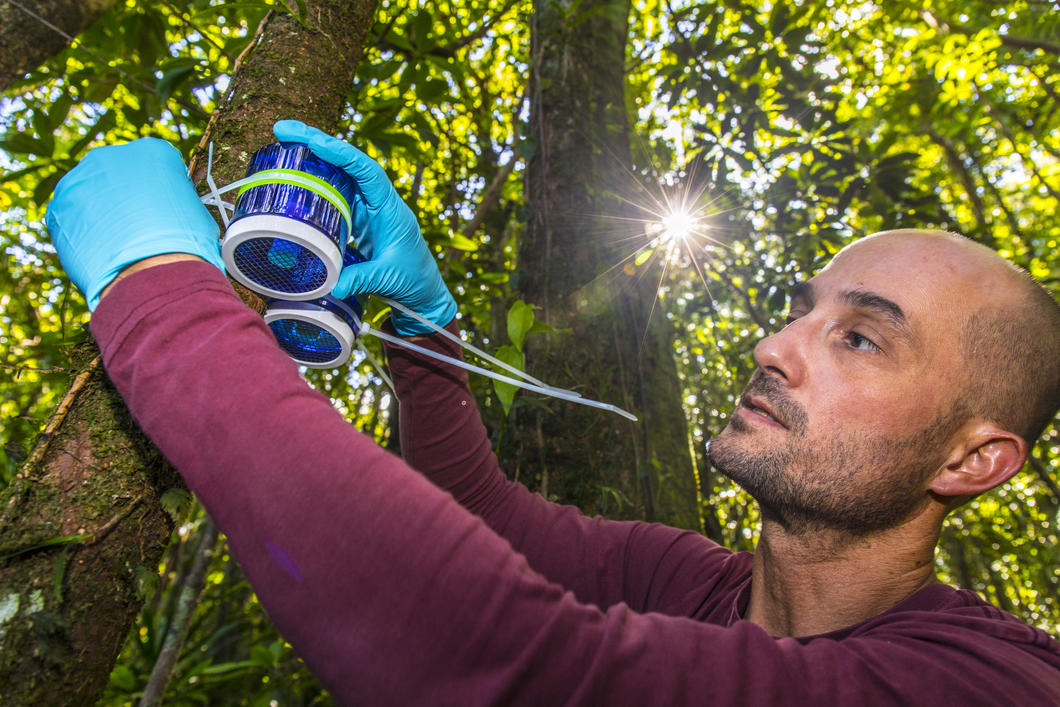
Engineer installing a mercury detector on a tree
3
Olivier Magand sets passive traps to collect gaseous atmospheric mercury in Mare-Longue forest, in the south of the island. These devices will test the hypothesis that vegetation is a “sink” for the pollutant.
Thibaut VERGOZ / IGE / CNRS Photothèque
Slideshow mode
Share
Share
[8]
[12]
[10]
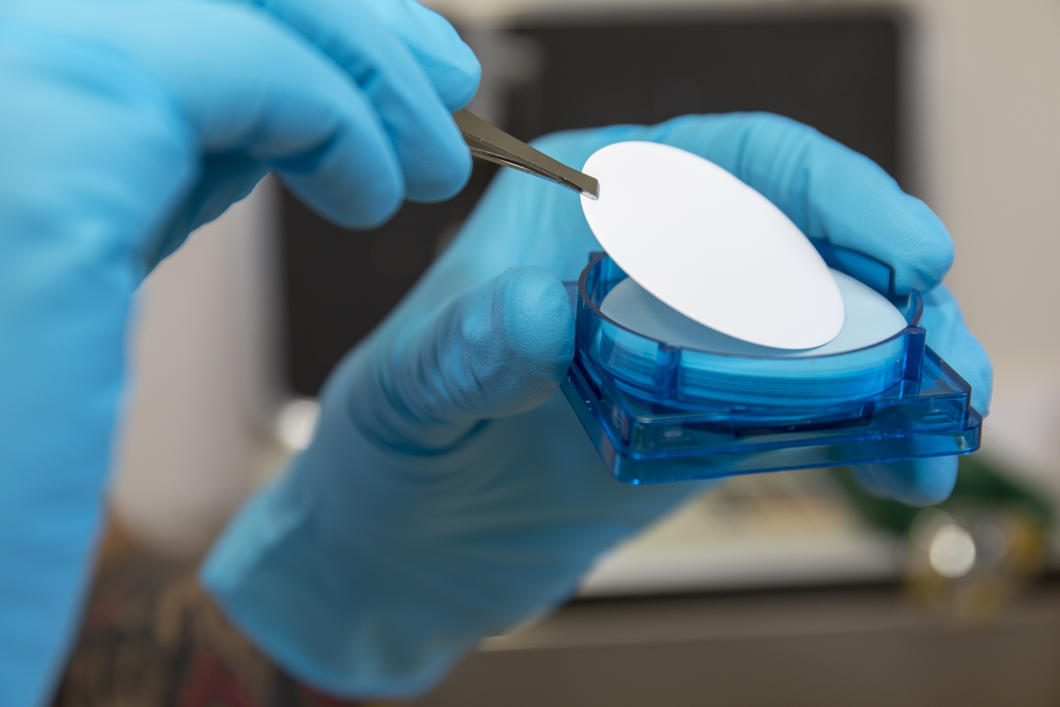
Close up shot of hands removing a filter from a mercury detector
4
The collection instruments installed at the Maido Observatory include a unique Teflon filter-holder and a polyethersulfone filter, which can measure the oxidized mercury present in the atmosphere in extremely low concentrations (on the order of pg m-3).
Thibaut VERGOZ / IGE / CNRS Photothèque
Slideshow mode
Share
Share
[8]
[13]
[10]
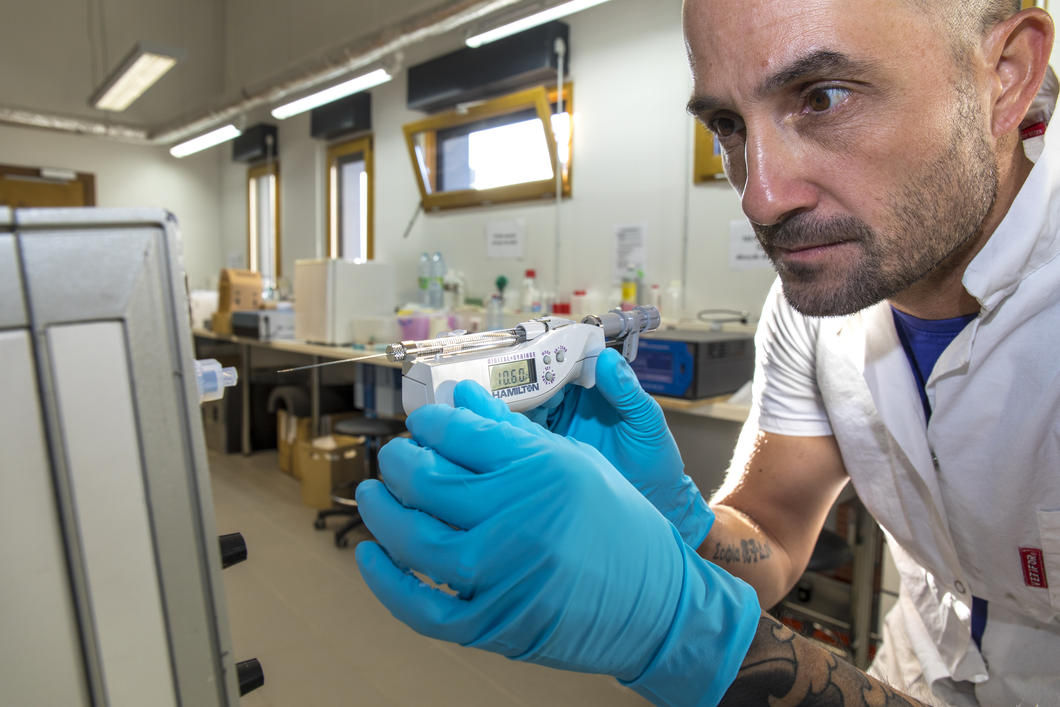
Engineer injecting mercury vapors into a detector for calibration.
5
An electronic syringe containing mercury vapour is used to calibrate the instrument, which performs continuous analysis of elementary mercury concentrations in the atmosphere. This device takes measurements every 5 to 15 minutes, thereby tracking the evolution of concentrations for the entire duration of the field campaign.
Thibaut VERGOZ / IGE / CNRS Photothèque
Slideshow mode
Share
Share
[8]
[14]
[10]
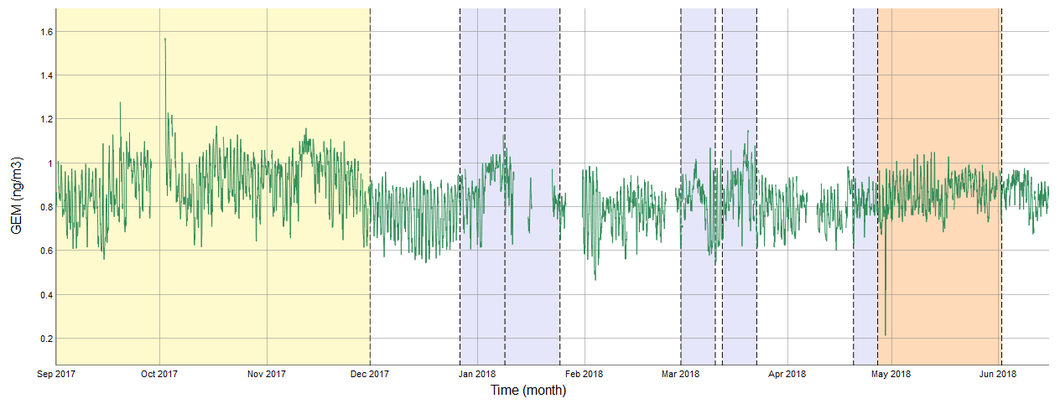
Graphic showing the evolution of mercury in the atmosphere during a year
6
The initial results for the evolution of elementary mercury concentrations in the island’s atmosphere reveal the possible influence of three natural processes: biomass fires (yellow), cyclones (blue), and the volcanic eruption of Piton de la Fournaise (orange). Multiple years of analysis are still needed to better understand the mercury cycle in tropical regions. The results will help to better assess the impact of the environmental policies currently implemented to reduce mercury pollution on a planetary scale.
IGE / CNRS Photothèque
Slideshow mode
Share
Share
[8]
[15]
[10]

Explore more

Matter
Workers are sorting discarded plastic bottles collected from the garbage heap and preparing them for recycling. © Suvra Kanti Das / ZUMA Press / RÉA
[16]
Article
10/27/2025
Plastic recycling is counter-productive [16]
[17]
Slideshow
07/17/2025
Seeing life in purple [17]
Sand ripples, Maspalomas, Grande Canarie, Spain. © Sopotnicki/Shutterstock
[18]
Article
07/07/2025
The secret of sand patches [18]
[19]
Article
03/26/2025
Space experiments aboard the ISS [19]
© Erwan Amice / LEMAR / CNRS Images
[20]
Slideshow
03/19/2025
Breaking the ice [20]
environmental sciences
[21]
Video
02/17/2022
The Antarctic: an icy laboratory [21]
[22]
Article
08/08/2019
Shells, the Sentinels of the Ocean [22]
Huge Indian banyan tree
[23]
Video
08/09/2018
India: Nature Under Pressure [23]
Mercury
[24]
Article
10/17/2018
BepiColombo: Two Orbiters Head to Mercury [24]

Keywords

Mercury [25] Pollution [26] atmosphere [27] cycle [28]

Share this article

[29]
[30]
[8]
[10]

Source URL:https://news.cnrs.fr/slideshows/mercury-in-the-air

Links
[1] https://news.cnrs.fr/ [2] https://lejournal.cnrs.fr/diaporamas/du-mercure-dans-lair [3] https://news.cnrs.fr/javascript%3A%3B [4] https://news.cnrs.fr/matter [5] https://news.cnrs.fr/earth [6] https://news.cnrs.fr/environmental-sciences [7] https://news.cnrs.fr/authors/nicolas-baker [8] https://twitter.com/intent/tweet?url=https%3A//news.cnrs.fr/print/1541%2F&text=Mercury in the Air [9] http://www.facebook.com/sharer/sharer.php?s=100&p%5Burl%5D=https%3A//news.cnrs.fr/print/1541&p%5Btitle%5D=Mercury%20in%20the%20Air&p%5Bimages%5D%5B0%5D=https%3A//news.cnrs.fr/sites/default/files/styles/lightbox-hd/public/assets/images/diapo_mercure_01.jpg%3Fitok%3DFCYZiEcg&p%5Bsummary%5D= [10] https://bsky.app/intent/compose?text=Mercury in the Air%0Ahttps%3A//news.cnrs.fr/print/1541 [11] http://www.facebook.com/sharer/sharer.php?s=100&p%5Burl%5D=https%3A//news.cnrs.fr/print/1541&p%5Btitle%5D=Mercury%20in%20the%20Air&p%5Bimages%5D%5B0%5D=https%3A//news.cnrs.fr/sites/default/files/styles/lightbox-hd/public/assets/images/diapo_mercure_couv.jpg%3Fitok%3DDKl8iN8A&p%5Bsummary%5D= [12] http://www.facebook.com/sharer/sharer.php?s=100&p%5Burl%5D=https%3A//news.cnrs.fr/print/1541&p%5Btitle%5D=Mercury%20in%20the%20Air&p%5Bimages%5D%5B0%5D=https%3A//news.cnrs.fr/sites/default/files/styles/lightbox-hd/public/assets/images/diapo_mercure_03.jpg%3Fitok%3D7hcnqj27&p%5Bsummary%5D= [13] http://www.facebook.com/sharer/sharer.php?s=100&p%5Burl%5D=https%3A//news.cnrs.fr/print/1541&p%5Btitle%5D=Mercury%20in%20the%20Air&p%5Bimages%5D%5B0%5D=https%3A//news.cnrs.fr/sites/default/files/styles/lightbox-hd/public/assets/images/diapo_mercure_04.jpg%3Fitok%3Dn50HRWr4&p%5Bsummary%5D= [14] http://www.facebook.com/sharer/sharer.php?s=100&p%5Burl%5D=https%3A//news.cnrs.fr/print/1541&p%5Btitle%5D=Mercury%20in%20the%20Air&p%5Bimages%5D%5B0%5D=https%3A//news.cnrs.fr/sites/default/files/styles/lightbox-hd/public/assets/images/diapo_mercure_05.jpg%3Fitok%3DP8xg7kJY&p%5Bsummary%5D= [15] http://www.facebook.com/sharer/sharer.php?s=100&p%5Burl%5D=https%3A//news.cnrs.fr/print/1541&p%5Btitle%5D=Mercury%20in%20the%20Air&p%5Bimages%5D%5B0%5D=https%3A//news.cnrs.fr/sites/default/files/styles/lightbox-hd/public/assets/images/diapo_mercure_06.png%3Fitok%3DnFZ_gtVZ&p%5Bsummary%5D= [16] https://news.cnrs.fr/articles/plastic-recycling-is-counter-productive [17] https://news.cnrs.fr/slideshows/seeing-life-in-purple [18] https://news.cnrs.fr/articles/the-secret-of-sand-patches [19] https://news.cnrs.fr/articles/space-experiments-aboard-the-iss [20] https://news.cnrs.fr/slideshows/breaking-the-ice [21] https://news.cnrs.fr/videos/the-antarctic-an-icy-laboratory [22] https://news.cnrs.fr/articles/shells-the-sentinels-of-the-ocean [23] https://news.cnrs.fr/videos/india-nature-under-pressure [24] https://news.cnrs.fr/articles/bepicolombo-two-orbiters-head-to-mercury [25] https://news.cnrs.fr/mercury [26] https://news.cnrs.fr/pollution-0 [27] https://news.cnrs.fr/atmosphere [28] https://news.cnrs.fr/cycle-0 [29] http://www.facebook.com/sharer/sharer.php?s=100&p%5Burl%5D=https%3A//news.cnrs.fr/print/1541&p%5Btitle%5D=Mercury%20in%20the%20Air&p%5Bimages%5D%5B0%5D=&p%5Bsummary%5D= [30] https://news.cnrs.fr/printmail/1541