CNRS News
Published on CNRS News (https://news.cnrs.fr)

Home > Did the Mont-Blanc Glaciers Shrink Before?

Did the Mont-Blanc Glaciers Shrink Before?

You are here
Home [1]
slideshow
-A [2] +A [2]
Earth [3]
Glaciology [4]

Did the Mont-Blanc Glaciers Shrink Before?

06.01.2017, by
Audrey Diguet [5]
Global warming is currently responsible for a spectacular drop in glacier surface area in the Mont-Blanc massif. Yet researchers suspect that since the last ice age, there have been periods during which these areas may have been even smaller. They collected rock samples to assess and date these periods of glacier shrinkage.

The ANR’s VIP Mont-Blanc Program (Rates of the processes controlling the morphologic and environmental changes in the Mont-Blanc massif). ASTER (Accélérateur pour les Sciences de la Terre, Environnement, Risques) is supported by CEREGE (the European Centre for Research and Education in Environmental Geosciences).
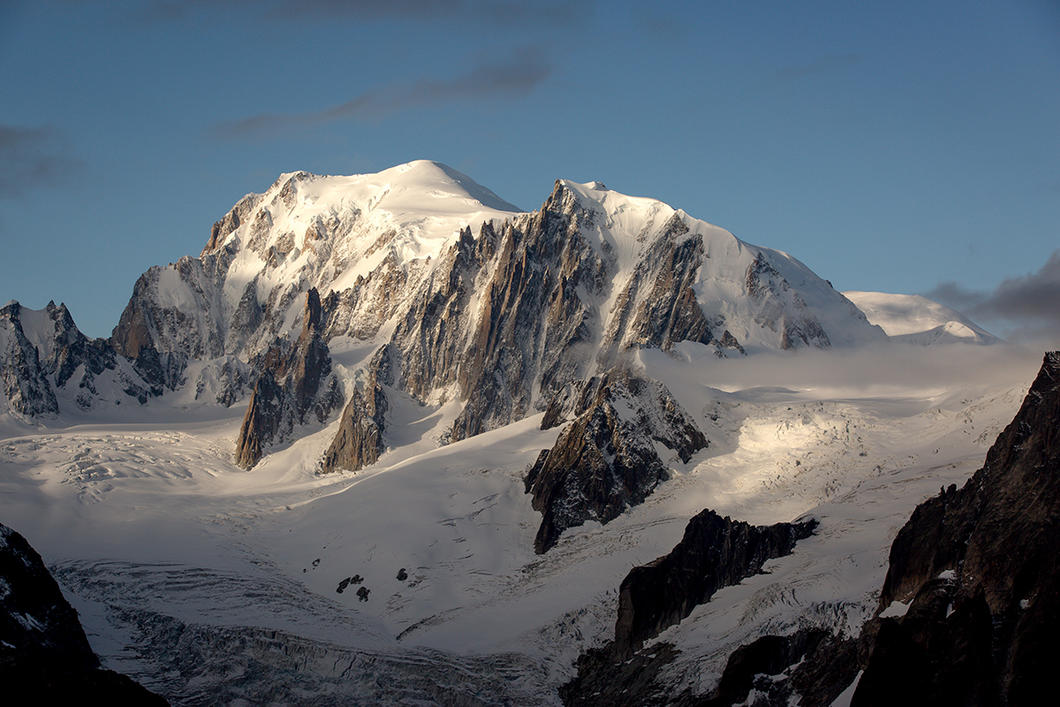
1
Over the last 10,000 years, the Earth has experienced periods of natural warming. During the Holocene Climate Optimum that occurred from 5000 to 9000 BP, warming reached its maximum, resulting probably in considerable recession of all glaciers in the Mont-Blanc massif.
Jean-François BUONCRISTIANI/Biogéosciences/CNRS Photothèque
Slideshow mode
Share
Share
[6]
[7]
[8]
2
Scientists go on location to assess the status and rate of melting. They reach the various areas where they plan to obtain rock samples by helicopter, carrying with them all the necessary equipment.
Jean-François BUONCRISTIANI/Biogéosciences/CNRS Photothèque
Slideshow mode
Share
Share
[6]
[9]
[8]
3
In particular, they selected the Jardin de Talèfre, a small rocky area measuring 3 km² that does not appear to have been covered by glaciers over the last 200 years. But how about during the last 10,000 years?
Jean-François BUONCRISTIANI/Biogéosciences/CNRS Photothèque
Slideshow mode
Share
Share
[6]
[10]
[8]
4
Rocks not covered by ice are bombarded by cosmic rays that interact with mineral atoms to produce rare isotopes such as beryllium-10. These isotopes accumulate in the crystalline structure of the rock.
Jean-François BUONCRISTIANI/Biogéosciences/CNRS Photothèque
Slideshow mode
Share
Share
[6]
[11]
[8]
5
Cosmic rays only affect the first few meters of rock beneath the surface. Consequently, the researchers take samples only from the surface of rocks that were polished by the glaciers when they were covered with ice.
Jean-François BUONCRISTIANI/Biogéosciences/CNRS Photothèque
Slideshow mode
Share
Share
[6]
[12]
[8]
6
The optimal sampling method involves cutting small cubes of rock measuring 10 x 10 cm. These cubes will later be analyzed in the laboratory using cosmogenic nuclide dating method.
Jean-François BUONCRISTIANI/Biogéosciences/CNRS Photothèque
Slideshow mode
Share
Share
[6]
[13]
[8]
7
This technique involves the careful preparation of samples in the laboratory to measure the total amount of beryllium-10 atoms that has built up in the rock using the ASTER (see above) mass spectrometer.
Jean-François BUONCRISTIANI/Biogéosciences/CNRS Photothèque
Slideshow mode
Share
Share
[6]
[14]
[8]
8
These measurements are used to determine how long the rocks were exposed to cosmic rays over the last 10,000 years, i.e. the total duration of glacier recession. In all, 23 samples will be analyzed—some 40 kg of rock.
Jean-François BUONCRISTIANI/Biogéosciences/CNRS Photothèque
Slideshow mode
Share
Share
[6]
[15]
[8]
9
For each rock sampled, the scientists accurately record the GPS coordinates of each sampling site to establish its position in relation to the surrounding geomorphological structures and glacial deposits.
Jean-François BUONCRISTIANI/Biogéosciences/CNRS Photothèque
Slideshow mode
Share
Share
[6]
[16]
[8]
10
They also map out the area’s topography to assess its impact on rock exposure to cosmic rays. This measurement, carried out with a survey level, will be used to correct the analyses based on exposure rates.
Jean-François BUONCRISTIANI/Biogéosciences/CNRS Photothèque
Slideshow mode
Share
Share
[6]
[17]
[8]
11
The initial analyses suggest that over the last 10,000 years, the glaciers of the Mont-Blanc massif have witnessed greater shrinkage than today. These preliminary results show that such glacier retreats may have been caused by periods of climatic warming due to natural causes. Next is to determine the exact extent and chronology of these retreats to better incorporate the natural melting processes in future climate projections.
Jean-François BUONCRISTIANI/Biogéosciences/CNRS Photothèque
Slideshow mode
Share
Share
[6]
[18]
[8]

Explore more

Earth
[19]
Article
01/08/2026
Scooping out oceanic CO₂ to make room for more [19]
adoption of a historic global warming pact at the COP21 Climate Conference in Le Bourget, north of Paris, on December 12, 2015
[20]
Article
11/09/2025
Ten years on, mixed results for the Paris Agreement [20]
aerial handout photo from the Saskatchewan Public Safety Agency, taken in July/August 2025, shows billowing smoke and flames from the Muskeg, Trail, and Knee fires in northern Saskatchewan, Canada.
[21]
Article
10/22/2025
North American fires contaminate Europe [21]
Marie Tharp in July 2001 at Lamont-Doherty Earth Observatory
[22]
Article
07/16/2025
A pioneer wiped off the map [22]
Sand ripples, Maspalomas, Grande Canarie, Spain. © Sopotnicki/Shutterstock
[23]
Article
07/07/2025
The secret of sand patches [23]
Glaciology
[24]
Slideshow
11/14/2019
Monitoring Glaciers at the Top of the world [24]
Glacier
[25]
Video
03/14/2019
In the Heart of a Glacier [25]
[26]
Slideshow
01/14/2019
Memory on Ice [26]
[27]
Article
05/03/2017
A Prestigious Award for Claude Lorius [27]
[28]
Slideshow
01/12/2017
Icebergs: the Hidden Face of Ice Giants [28]

Keywords

Mont-Blanc [29] ANR [30] Shrinkage [31] Cosmic Rays [32] Beryllium-10 [33] Cosmogenic nuclide dating method [34] Climate change [35]

Share this article

[36]
[37]
[6]
[8]

Source URL:https://news.cnrs.fr/slideshows/did-the-mont-blanc-glaciers-shrink-before

Links
[1] https://news.cnrs.fr/ [2] https://news.cnrs.fr/javascript%3A%3B [3] https://news.cnrs.fr/earth [4] https://news.cnrs.fr/glaciology [5] https://news.cnrs.fr/authors/audrey-diguet [6] https://twitter.com/intent/tweet?url=https%3A//news.cnrs.fr/print/1134%2F&text=Did the Mont-Blanc Glaciers Shrink Before? [7] http://www.facebook.com/sharer/sharer.php?s=100&p%5Burl%5D=https%3A//news.cnrs.fr/print/1134&p%5Btitle%5D=Did%20the%20Mont-Blanc%20Glaciers%20Shrink%20Before%3F&p%5Bimages%5D%5B0%5D=https%3A//news.cnrs.fr/sites/default/files/styles/lightbox-hd/public/assets/images/cnrs_20160105_0003_r.jpg%3Fitok%3DTsVBCT0v&p%5Bsummary%5D= [8] https://bsky.app/intent/compose?text=Did the Mont-Blanc Glaciers Shrink Before?%0Ahttps%3A//news.cnrs.fr/print/1134 [9] http://www.facebook.com/sharer/sharer.php?s=100&p%5Burl%5D=https%3A//news.cnrs.fr/print/1134&p%5Btitle%5D=Did%20the%20Mont-Blanc%20Glaciers%20Shrink%20Before%3F&p%5Bimages%5D%5B0%5D=https%3A//news.cnrs.fr/sites/default/files/styles/lightbox-hd/public/assets/images/20160105_0002.jpg%3Fitok%3DZo0mc-jW&p%5Bsummary%5D= [10] http://www.facebook.com/sharer/sharer.php?s=100&p%5Burl%5D=https%3A//news.cnrs.fr/print/1134&p%5Btitle%5D=Did%20the%20Mont-Blanc%20Glaciers%20Shrink%20Before%3F&p%5Bimages%5D%5B0%5D=https%3A//news.cnrs.fr/sites/default/files/styles/lightbox-hd/public/assets/images/20160105_0001.jpg%3Fitok%3DM9a3M2kC&p%5Bsummary%5D= [11] http://www.facebook.com/sharer/sharer.php?s=100&p%5Burl%5D=https%3A//news.cnrs.fr/print/1134&p%5Btitle%5D=Did%20the%20Mont-Blanc%20Glaciers%20Shrink%20Before%3F&p%5Bimages%5D%5B0%5D=https%3A//news.cnrs.fr/sites/default/files/styles/lightbox-hd/public/assets/images/20160105_0004.jpg%3Fitok%3D6N3CQ-df&p%5Bsummary%5D= [12] http://www.facebook.com/sharer/sharer.php?s=100&p%5Burl%5D=https%3A//news.cnrs.fr/print/1134&p%5Btitle%5D=Did%20the%20Mont-Blanc%20Glaciers%20Shrink%20Before%3F&p%5Bimages%5D%5B0%5D=https%3A//news.cnrs.fr/sites/default/files/styles/lightbox-hd/public/assets/images/20160105_0015.jpg%3Fitok%3DBv_wEQS0&p%5Bsummary%5D= [13] http://www.facebook.com/sharer/sharer.php?s=100&p%5Burl%5D=https%3A//news.cnrs.fr/print/1134&p%5Btitle%5D=Did%20the%20Mont-Blanc%20Glaciers%20Shrink%20Before%3F&p%5Bimages%5D%5B0%5D=https%3A//news.cnrs.fr/sites/default/files/styles/lightbox-hd/public/assets/images/20160105_0017.jpg%3Fitok%3DPkqOCzZv&p%5Bsummary%5D= [14] http://www.facebook.com/sharer/sharer.php?s=100&p%5Burl%5D=https%3A//news.cnrs.fr/print/1134&p%5Btitle%5D=Did%20the%20Mont-Blanc%20Glaciers%20Shrink%20Before%3F&p%5Bimages%5D%5B0%5D=https%3A//news.cnrs.fr/sites/default/files/styles/lightbox-hd/public/assets/images/20160105_0018.jpg%3Fitok%3DVCf5yXtw&p%5Bsummary%5D= [15] http://www.facebook.com/sharer/sharer.php?s=100&p%5Burl%5D=https%3A//news.cnrs.fr/print/1134&p%5Btitle%5D=Did%20the%20Mont-Blanc%20Glaciers%20Shrink%20Before%3F&p%5Bimages%5D%5B0%5D=https%3A//news.cnrs.fr/sites/default/files/styles/lightbox-hd/public/assets/images/20160105_0019.jpg%3Fitok%3Dz_P8qDOJ&p%5Bsummary%5D= [16] http://www.facebook.com/sharer/sharer.php?s=100&p%5Burl%5D=https%3A//news.cnrs.fr/print/1134&p%5Btitle%5D=Did%20the%20Mont-Blanc%20Glaciers%20Shrink%20Before%3F&p%5Bimages%5D%5B0%5D=https%3A//news.cnrs.fr/sites/default/files/styles/lightbox-hd/public/assets/images/20160105_0011.jpg%3Fitok%3DPT4KfmOb&p%5Bsummary%5D= [17] http://www.facebook.com/sharer/sharer.php?s=100&p%5Burl%5D=https%3A//news.cnrs.fr/print/1134&p%5Btitle%5D=Did%20the%20Mont-Blanc%20Glaciers%20Shrink%20Before%3F&p%5Bimages%5D%5B0%5D=https%3A//news.cnrs.fr/sites/default/files/styles/lightbox-hd/public/assets/images/20160105_0014.jpg%3Fitok%3D7WTGLCi4&p%5Bsummary%5D= [18] http://www.facebook.com/sharer/sharer.php?s=100&p%5Burl%5D=https%3A//news.cnrs.fr/print/1134&p%5Btitle%5D=Did%20the%20Mont-Blanc%20Glaciers%20Shrink%20Before%3F&p%5Bimages%5D%5B0%5D=https%3A//news.cnrs.fr/sites/default/files/styles/lightbox-hd/public/assets/images/20160105_0007.jpg%3Fitok%3DPT_kV-k8&p%5Bsummary%5D= [19] https://news.cnrs.fr/articles/scooping-out-oceanic-co2-to-make-room-for-more [20] https://news.cnrs.fr/articles/ten-years-on-mixed-results-for-the-paris-agreement [21] https://news.cnrs.fr/articles/north-american-fires-contaminate-europe [22] https://news.cnrs.fr/articles/a-pioneer-wiped-off-the-map [23] https://news.cnrs.fr/articles/the-secret-of-sand-patches [24] https://news.cnrs.fr/slideshows/monitoring-glaciers-at-the-top-of-the-world [25] https://news.cnrs.fr/videos/in-the-heart-of-a-glacier [26] https://news.cnrs.fr/slideshows/memory-on-ice [27] https://news.cnrs.fr/articles/a-prestigious-award-for-claude-lorius [28] https://news.cnrs.fr/slideshows/icebergs-the-hidden-face-of-ice-giants [29] https://news.cnrs.fr/mont-blanc-0 [30] https://news.cnrs.fr/anr [31] https://news.cnrs.fr/shrinkage [32] https://news.cnrs.fr/cosmic-rays [33] https://news.cnrs.fr/beryllium-10 [34] https://news.cnrs.fr/cosmogenic-nuclide-dating-method [35] https://news.cnrs.fr/climate-change [36] http://www.facebook.com/sharer/sharer.php?s=100&p%5Burl%5D=https%3A//news.cnrs.fr/print/1134&p%5Btitle%5D=Did%20the%20Mont-Blanc%20Glaciers%20Shrink%20Before%3F&p%5Bimages%5D%5B0%5D=&p%5Bsummary%5D= [37] https://news.cnrs.fr/printmail/1134