CNRS News
Published on CNRS News (https://news.cnrs.fr)

Home > An Immortal Worm that Kills Bacteria

An Immortal Worm that Kills Bacteria

You are here

Home [1]
Lire en français [2]
Life [3]
immunology [4]
-A [5] +A [5]
video
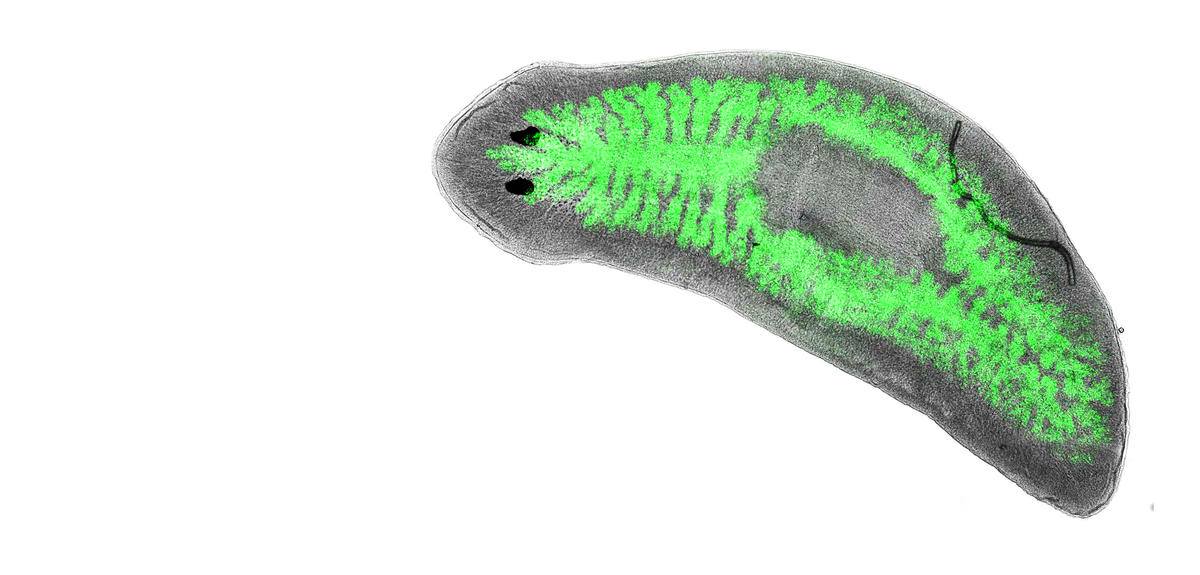
Flatworm with green coloration that shows intestines
© Eric GHIGO/URMITE/CNRS Photothèque

An Immortal Worm that Kills Bacteria

12.18.2015

By studying an aquatic flatworm (planarian), well known for its extraordinary regenerative abilities, researchers in Marseille  identified a gene capable of destroying tuberculosis and Staphylococcus aureus bacteria. Called Morn 2, this very active gene in the planarian is present in humans, but dormant. It could be pharmacologically stimulated to fight diseases that are resistant to antibiotics.

About this video
Original title:
The immortal flatworm
Production year:
2015
Length:
5 min 57
Director:
Christophe Gombert
Producer:
CNRS Images
Speaker(s) :
Eric Ghigo, Research Unit on Emerging Infection and Tropical Diseases (URMITE)
Cédric Torre, PhD student (URMITE)
Landry Laure Tsoumtsa, PhD student (URMITE)

Keywords

flatworm [6]
tuberculosis [7]
staphilococcus aureus [8]
MORN2 gene [9]
Share
[10] [11] [12] [13]

Source URL:https://news.cnrs.fr/videos/an-immortal-worm-that-kills-bacteria

Links
[1] https://news.cnrs.fr/ [2] https://lejournal.cnrs.fr/node/1052 [3] https://news.cnrs.fr/life [4] https://news.cnrs.fr/immunology [5] https://news.cnrs.fr/javascript%3A%3B [6] https://news.cnrs.fr/flatworm [7] https://news.cnrs.fr/tuberculosis [8] https://news.cnrs.fr/staphilococcus-aureus [9] https://news.cnrs.fr/morn2-gene [10] https://twitter.com/intent/tweet?url=https%3A//news.cnrs.fr/print/874%2F&text=An Immortal Worm that Kills Bacteria [11] http://www.facebook.com/sharer/sharer.php?s=100&p%5Burl%5D=https%3A//news.cnrs.fr/print/874&p%5Btitle%5D=An%20Immortal%20Worm%20that%20Kills%20Bacteria&p%5Bimages%5D%5B0%5D=&p%5Bsummary%5D= [12] https://bsky.app/intent/compose?text=An Immortal Worm that Kills Bacteria%0Ahttps%3A//news.cnrs.fr/print/874 [13] https://news.cnrs.fr/printmail/874